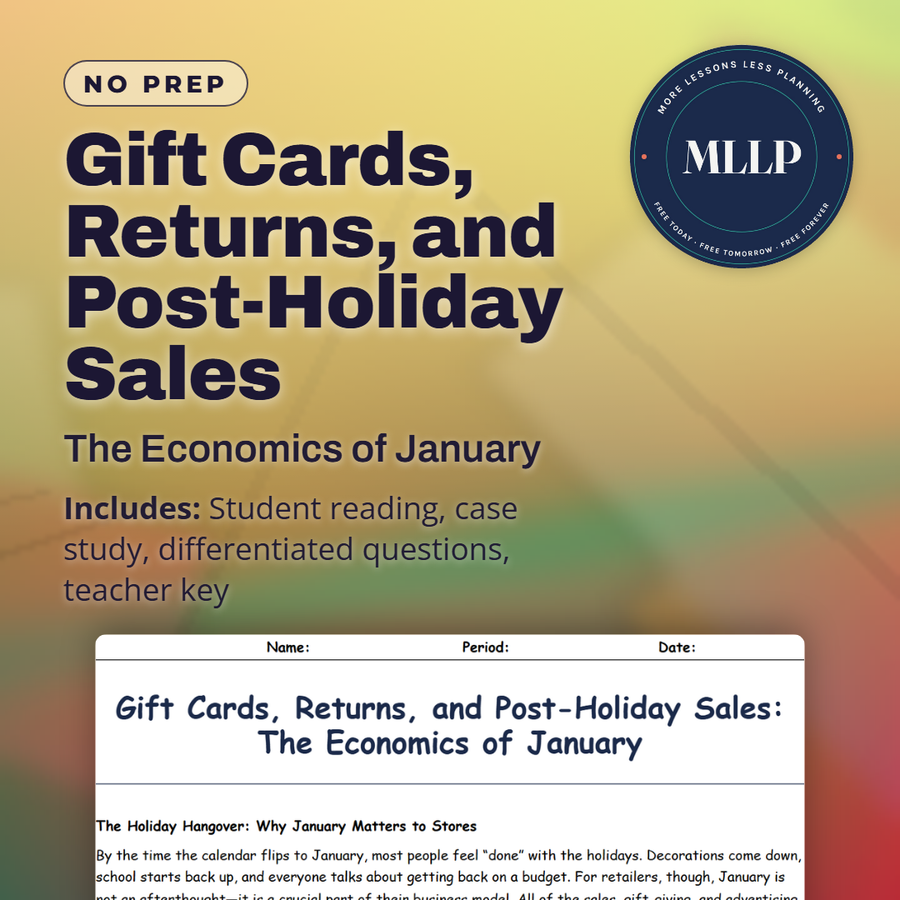
Gift Cards, Returns, and Post-Holiday Sales: The Economics of January
Quality reviewed September 2026
Facts verified September 9, 2026
- Subject
- Social Studies
- Grades
- Grades 9-12
- Length
- 7-page student worksheet
- Time
- About one 50-minute class period
- Great for
- Sub plans and independent work
- Includes
- Reading passage, comprehension questions + full answer key
- Format
- Print-and-go PDF
What students do
- Explain how gift cards function as interest-free loans and describe gift card breakage as profit for retailers
- Analyze how psychological distance between paying for a card and redeeming it affects spending behavior
- Trace the logic behind clearance sales as retailers managing sunk costs and inventory pressure
- Calculate opportunity costs of unused gift card balances using data from the case study
What it covers
- Retail economics and revenue management after peak holiday shopping
- Consumer psychology and how framing affects purchasing decisions
- Sunk costs and price discrimination in retail strategy
Start reading this worksheet
The Holiday Hangover: Why January Matters to Stores
By the time the calendar flips to January, most people feel “done” with the holidays. Decorations come down, school starts back up, and everyone talks about getting back on a budget. For retailers, though, January is not an afterthought—it is a crucial part of their business model. All of the sales, gift-giving, and advertising from November and December spill into a second, quieter season of returns, exchanges, and gift card spending. Stores don’t just think about December; they plan for the entire holiday cycle. In November and December, they push full-priced items, “doorbuster” deals, and big displays to pull customers in. In January, they have a different problem: leftover inventory that didn’t sell and a wave of customers returning items that were the wrong size, color, or style. At the same time, many shoppers walk in carrying gift cards, which act like prepaid store money waiting to be spent. From an economics point of view, January is where we see concepts like sunk costs, opportunity cost, and consumer behavior in action. A sweater that cost the store $20 to buy from a supplier is now a sunk cost—they can’t get that money back. The question becomes: how do they turn that sweater into cash before the season changes and it becomes even harder to sell? That’s where clearance racks, store credit, and careful planning come in.
Gift Cards: Free Loans and “Breakage”
On the surface, gift cards look simple. Someone loads $25 on a card, gives it as a present, and the recipient later uses it in the store. Behind the scenes, gift cards are a powerful financial tool for retailers. When you buy a gift card, the store receives cash up front, often weeks or months before they have to hand over any products. Economists sometimes compare this to an interest-free loan from the customer to the store. The retailer can use that money immediately to pay workers, order inventory, or invest, even though you haven’t picked out your items yet. Another key idea is gift card breakage—the portion of gift card value that is never used. Maybe the card gets lost, a few dollars are left over, or the recipient never finds anything they want. For the consumer, that unused balance is wasted purchasing power. For the store, it is almost pure profit: they received the money, but never had to give up merchandise. Even small leftover amounts matter. If millions of cards each have $1–$3 left on them, that adds up to a large sum. Gift cards also change how people shop. Many customers treat a card as “free money,” even though someone originally paid for it. That makes it easier to justify impulse purchases or upgrading to more expensive items. A $25 card often turns into a $40 sale because the customer cheerfully covers the difference. Economists would say the gift card shifts the reference point in the shopper’s mind; spending feels less painful because the original gift card purchase is psychologically separate, or already “sunk.”
Like what you read? The full reading, the case study, and every question set are in the free download below, along with the answer key.
Why this matters
A gift card sitting unused is money a store already collected without handing over a product, which is why leftover balances count as clean profit. Amari's family had more than sixty dollars stranded across a drawer of half used cards, treated as clutter instead of the interest free loan it actually was.
Watching Amari total that drawer changes how students read a receipt afterward. I assign this in January, right as clearance racks appear, since sunk cost thinking explains both forgotten cards and markdowns on the same aisle. Once students see breakage as designed, not accidental, they stop shopping the same way.
From one teacher to another
The case study is Amari sitting at the kitchen table with a calculator. Her family has a drawer of half-used gift cards totaling more than $60. When the teacher explains gift card breakage, Amari sees that small leftover balances are not accidents. They're part of how stores quietly profit. That moment shifts the whole unit. Students stop thinking about shopping as simple exchange and start seeing the systems underneath.
What you get
Download
Where should I send the next one?
Everything here is free and it stays that way. Leave your email and I'll send you the new lessons as they go up. You can unsubscribe from any one of them.
Related resources
Biology of Evergreen Plants: The Science Behind Christmas Trees
Body Clocks and Midnight Countdowns: Circadian Rhythms at New Year’s
Calendars, Orbits, and the Science of New Year’s Day
Christmas on the Home Front: WWII Rationing and Resilience
Colorful Chemistry: Holiday Lights, Fireworks, and the Science of Glow
Crowded Skies: Holiday Air Travel and the Environment
Every lesson on this site is free to download and use. If one of them saved you a prep period, you can chip in a few bucks toward my three kids' daycare fund. That's genuinely where tips go.