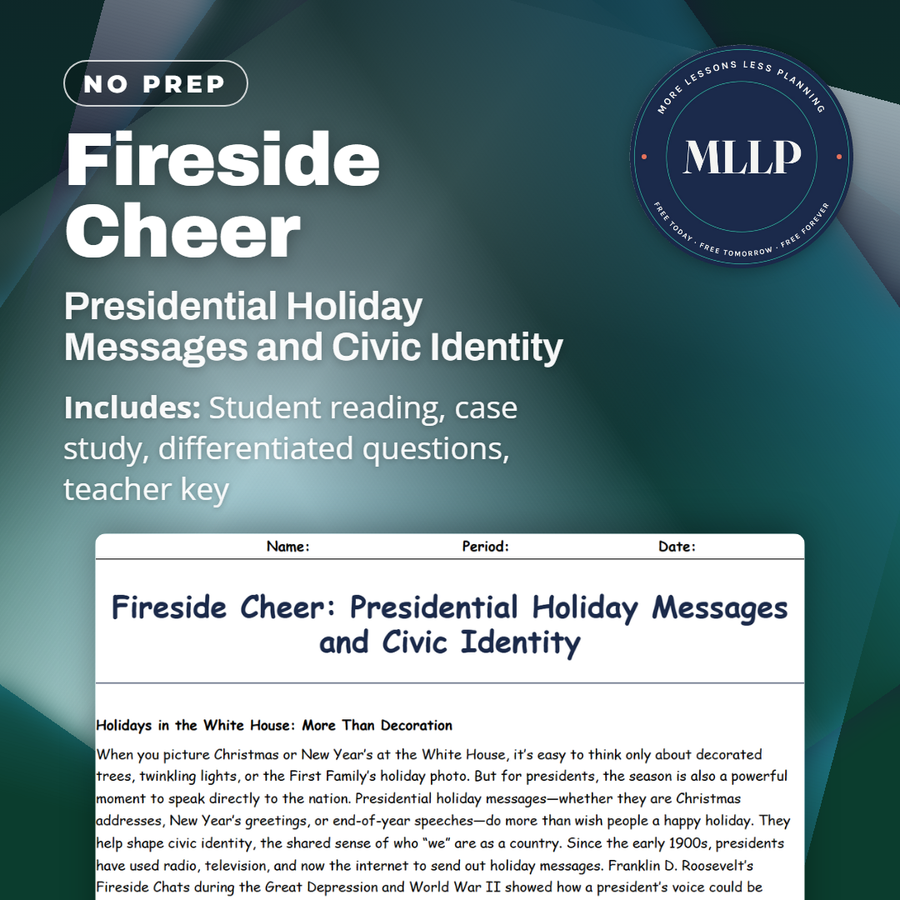
Fireside Cheer: Presidential Holiday Messages and Civic Identity
Quality reviewed September 2026
Facts verified September 9, 2026
- Subject
- Social Studies
- Grades
- Grades 9-12
- Length
- 9-page student worksheet
- Time
- About one 50-minute class period
- Great for
- Sub plans and independent work
- Includes
- Reading passage, comprehension questions + full answer key
- Format
- Print-and-go PDF
What students do
- Identify themes of unity, service, and sacrifice in presidential holiday speeches and analyze their rhetorical purpose
- Explain how inclusive language like "we" and "our" works to build a sense of shared national community
- Evaluate how holidays become moments for political communication about citizenship and shared responsibility
- Assess what stories and examples a president chooses to highlight and what that reveals about national values
What it covers
- Civic rituals and national identity in presidential communication
- Rhetoric of unity and inclusive language in political messaging
- Holiday traditions as opportunities for defining national values and citizenship
Start reading this worksheet
Holidays in the White House: More Than Decoration
When you picture Christmas or New Year’s at the White House, it’s easy to think only about decorated trees, twinkling lights, or the First Family’s holiday photo. But for presidents, the season is also a powerful moment to speak directly to the nation. Presidential holiday messages, whether they are Christmas addresses, New Year’s greetings, or end-of-year speeches, do more than wish people a happy holiday. They help shape civic identity, the shared sense of who “we” are as a country. Since the early 1900s, presidents have used radio, television, and now the internet to send out holiday messages. Franklin D. Roosevelt’s Fireside Chats during the Great Depression and World War II showed how a president’s voice could be invited into living rooms, making national news feel personal. Later presidents continued this pattern with televised Christmas messages and New Year’s speeches that appeared between familiar holiday programs and sports broadcasts. These speeches usually blend personal warmth with political responsibility. A president might mention decorating a tree with their children or attending a religious service. In the next sentence, the same speech might honor troops stationed overseas, encourage generosity to people in need, or call for national unity during a crisis. Students sometimes expect holiday messages to be “just fluff,” but they’re actually carefully written pieces of political communication. The wording, stories, and tone are chosen to make citizens feel connected to one another and to the government, even when people disagree on policies. When you listen closely, you can hear presidents using holiday messages as a kind of national mirror. They describe who Americans are, what they value, and what challenges they face together. In that sense, holiday cheer becomes a tool for teaching democracy, not just for spreading warm feelings.
Rituals, Values, and the “Story of Us”
Holiday messages are part of a wider set of national rituals. Just as families repeat traditions each year, the nation repeats certain civic traditions: the National Christmas Tree lighting, the annual New Year’s address, and official statements honoring diverse winter holidays like Hanukkah, Kwanzaa, and other cultural celebrations. Through these rituals, presidents try to tell a “story of us”: a narrative about what it means to be American. Common themes show up again and again. Presidents talk about freedom, service, faith, family, diversity, and hope for the coming year. They praise volunteers at food banks, first responders working through the holidays, and members of the military who cannot be home. When they highlight these examples, they’re teaching a civic lesson: good citizens are not just voters; they are neighbors who help one another. The rhetoric of these speeches often includes inclusive language such as “we,” “together,” and “as a nation.” This wording is not accidental. It is meant to make listeners see themselves as part of a shared community rather than isolated individuals. Presidents also balance religious references carefully. Some mention Christian traditions because many Americans celebrate Christmas, but they often add lines acknowledging Americans of “all faiths and of no faith,” reinforcing the idea of religious freedom. Students can analyze these speeches like any other text. What values are repeated? Which groups are mentioned by name, and which are left out? How does the president describe the country’s past year: only in positive terms, or with honest references to difficulties? Holiday messages may be wrapped in sentimental language, but underneath they are serious attempts to define what kind of country the United States claims to be. This table shows that a good holiday message is not random. It’s a carefully structured speech that mixes personal warmth with civic themes and a subtle push toward good citizenship.
Crisis, Comfort, and Leadership at Year’s End
Presidential holiday messages become especially important during times of crisis. When the country faces war, economic recession, or a national tragedy, the end-of-year speech is not just a polite greeting. It is a test of leadership. During the Great Depression, Roosevelt used the radio to reassure anxious families that the government was taking action. Later presidents used Christmas or New Year’s remarks to speak about ongoing wars, terrorist attacks, or natural disasters, always trying to blend honesty about danger with encouragement and hope. In these moments, holiday speeches serve three roles at once. First, they provide emotional comfort, recognizing grief, fear, or exhaustion. Second, they explain or defend government actions, giving citizens a sense of direction. Third, they ask people to stay engaged: to keep supporting one another, to continue voting and participating, and to remember shared values. This combination is tricky. If a president sounds too cheerful, the message feels fake. If the tone is too dark, it can discourage people. Good speeches acknowledge pain such as families separated by deployment, businesses struggling, and communities mourning, while still pointing toward resilience. For students studying American government, these speeches offer real-life examples of how a Commander in Chief uses words as a form of leadership. Presidents cannot fix every problem with a holiday message, but they can influence how the nation understands the crisis and its own capacity to respond.
Like what you read? The full reading, the case study, and every question set are in the free download below, along with the answer key.
Why this matters
A president sits by a fireplace on a holiday evening and says "we" and "our" a dozen times in five minutes, and almost no student notices until asked to count. That inclusive language is doing real work, building shared community out of a broadcast rather than simply wishing people well. Students mark up a sample address for that language and list who gets named a good citizen.
Before this exercise, most students dismiss these speeches as holiday fluff, background noise between commercials. One told me afterward that it finally clicked: this is how a democracy teaches itself what it values, using warmth as the delivery method for a civics lesson.
From one teacher to another
This worksheet makes students active analysts instead of passive listeners. They read a sample presidential holiday address, mark up the inclusive language, list who gets named as examples of good citizenship. Then we reverse-engineer the message: what is the president trying to teach? What values are buried inside the warmth? I've watched students shift from "it's just holiday fluff" to "oh, this is actually how democracies teach themselves."
What you get
Download
Where should I send the next one?
Everything here is free and it stays that way. Leave your email and I'll send you the new lessons as they go up. You can unsubscribe from any one of them.
Related resources
Biology of Evergreen Plants: The Science Behind Christmas Trees
Body Clocks and Midnight Countdowns: Circadian Rhythms at New Year’s
Calendars, Orbits, and the Science of New Year’s Day
Christmas on the Home Front: WWII Rationing and Resilience
Colorful Chemistry: Holiday Lights, Fireworks, and the Science of Glow
Crowded Skies: Holiday Air Travel and the Environment
Every lesson on this site is free to download and use. If one of them saved you a prep period, you can chip in a few bucks toward my three kids' daycare fund. That's genuinely where tips go.