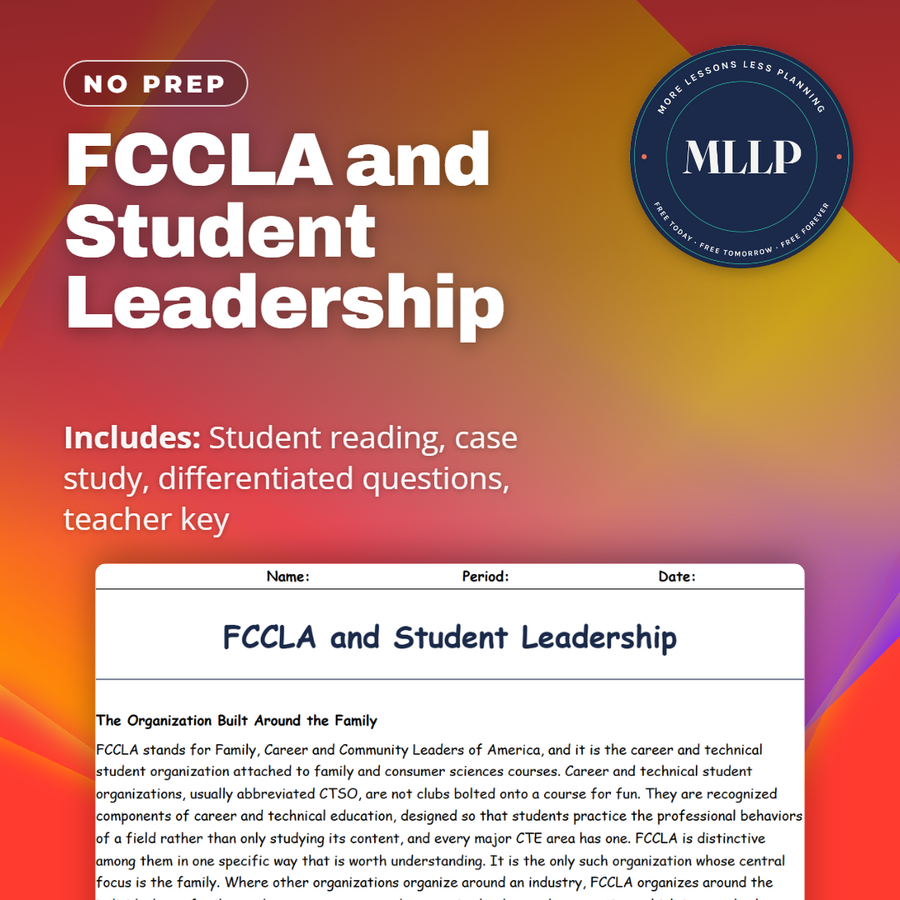
FCCLA and Student Leadership
Quality reviewed September 2026
Facts verified September 23, 2026
- Subject
- Career & Life Skills
- Grades
- Grades 9-12
- Length
- 9-page student worksheet
- Time
- About one 50-minute class period
- Great for
- Sub plans and independent work
- Includes
- Reading passage, comprehension questions + full answer key
- Format
- Print-and-go PDF
What students do
- Bryce's two STAR Event placements, near last and then second at state, frame both case study questions
- Servant leadership gets matched to the real definition of removing obstacles so others can work well
- Identify which multiple choice answer the reading supports on FCCLA's distinct focus, rubrics, and resumes
- Fill in three blanks naming the career letter in FCCLA, STAR Events, and servant leadership
What it covers
- What FCCLA is and how it differs from every other career and technical student organization
- STAR Events, national programs, and how a rubric shapes a competitive project
- Leadership styles and the habits, like following through, that hold up across all of them
Start reading this worksheet
The Organization Built Around the Family
FCCLA stands for Family, Career and Community Leaders of America, and it is the career and technical student organization attached to family and consumer sciences courses. Career and technical student organizations, usually abbreviated CTSO, are not clubs bolted onto a course for fun. They are recognized components of career and technical education, designed so that students practice the professional behaviors of a field rather than only studying its content, and every major CTE area has one. FCCLA is distinctive among them in one specific way that is worth understanding. It is the only such organization whose central focus is the family. Where other organizations organize around an industry, FCCLA organizes around the individual as a family member, wage earner, and community leader at the same time, which is exactly the framing family and consumer sciences uses. Membership is open to students enrolled in or who have taken an FCS course, and chapters operate at the school level with officers elected by members, then connect upward to state associations and a national organization. The practical value for a student is that it converts classroom content into something with an audience and a deadline. A lesson about nutrition is information. A project teaching nutrition to elementary students, presented to judges and evaluated against a rubric, is experience, and experience is what a resume, a scholarship committee, or a hiring manager can actually evaluate.
What Members Actually Do All Year
The visible work of FCCLA runs through two main structures. STAR Events, which stands for Students Taking Action with Recognition, are competitive events in which students prepare a project or demonstration in a chosen category and present it to judges who score against a published rubric. Categories span the breadth of the field, including culinary work, early childhood education, interior design, fashion, entrepreneurship, food innovation, hospitality, teaching, public speaking, and advocacy. Students may compete individually or in teams, and events advance through regional, state, and national levels. Because the rubric is published in advance, preparing for one teaches a professional habit most students never encounter in a graded class, which is designing work backward from the criteria it will be judged against. The second structure is the national programs, which are project frameworks in areas such as nutrition and wellness, financial literacy, career exploration, community service, and safety. Chapters use them to plan year long initiatives with real community impact. Beyond those, chapters run service projects, fundraise, host events, attend state and national conferences, and elect and operate under student officers. The planning process FCCLA teaches asks members to identify a concern, set a goal, form a plan, act on it, and then follow up and evaluate, which is the same decision structure consumer science teaches for purchases and human services uses for cases. Chapters vary widely in how active they are, which is worth saying honestly. A chapter that meets twice a year offers little, while one that competes, serves, and sends students to conferences offers a great deal, and a member who finds the first kind can usually change it by volunteering to run something rather than waiting for the adviser to.
The Skills Employers Cannot Teach Quickly
Employers and colleges consistently report that they can train technical skills and struggle to train the others, and the others are precisely what a functioning student organization builds. Public speaking is the most obvious. Presenting a STAR Event project to a panel of adult judges, answering unscripted questions, and defending choices is a genuinely uncomfortable experience the first time and a durable capability by the third. Project management follows, since a competitive entry requires scoping work, meeting deadlines, gathering materials, and revising after feedback across several months. Working on a team where members have unequal commitment teaches conflict resolution and accountability more effectively than any lesson about them. Officer roles add budgeting, running meetings, delegating, and being answerable to members who elected you. Writing improves because entries require documentation. Networking is real and undersold, since state and national conferences put students in rooms with FCS professionals, college programs, and industry representatives who are there specifically to meet them. There is also a documented pattern worth telling students plainly: research on career and technical student organizations generally finds participants report stronger engagement, leadership development, and career readiness than similar students who do not participate. The honest caveat is that motivated students select into these organizations, so participation is not the only explanation. The experiences themselves, however, are unusually hard to get anywhere else in a high school schedule.
Like what you read? The full reading, the case study, and every question set are in the free download below, along with the answer key.
Why this matters
A student organization can sound like an optional extra next to a graded class, and this reading argues the opposite, that FCCLA is where classroom content gets tested against a real audience and a published rubric. Bryce's story matters because it shows the skill was learnable and specific, reading a rubric and building backward from every category rather than only the one he already liked. For a student applying to college or a job in a few years, the reading also supplies a concrete method, quantified results and progressive responsibility, for turning a membership into something a scholarship committee can actually evaluate.
From one teacher to another
Bryce placed near the bottom of his region in a culinary STAR Event even though he knew his food was good, because cooking was only one of six scored categories on the rubric. This worksheet uses his second attempt to teach what FCCLA actually is, the only career and technical student organization built around the family, and how STAR Events, national programs, and chapter leadership turn a course into documented experience. Students read about the skills employers say they cannot train quickly, then use the case study to explain what changed between Bryce's two competitions. A short answer question asks why the reading includes a caveat about research on student organization participation.
What you get
Download
Where should I send the next one?
Everything here is free and it stays that way. Leave your email and I'll send you the new lessons as they go up. You can unsubscribe from any one of them.
Related resources
Balancing Work, Family, and Personal Life
Careers in Culinary Arts and Hospitality
Careers in Early Childhood Education
Careers in Family and Consumer Sciences
Careers in Fashion and Interior Design
Careers in Human Services
Every lesson on this site is free to download and use. If one of them saved you a prep period, you can chip in a few bucks toward my three kids' daycare fund. That's genuinely where tips go.