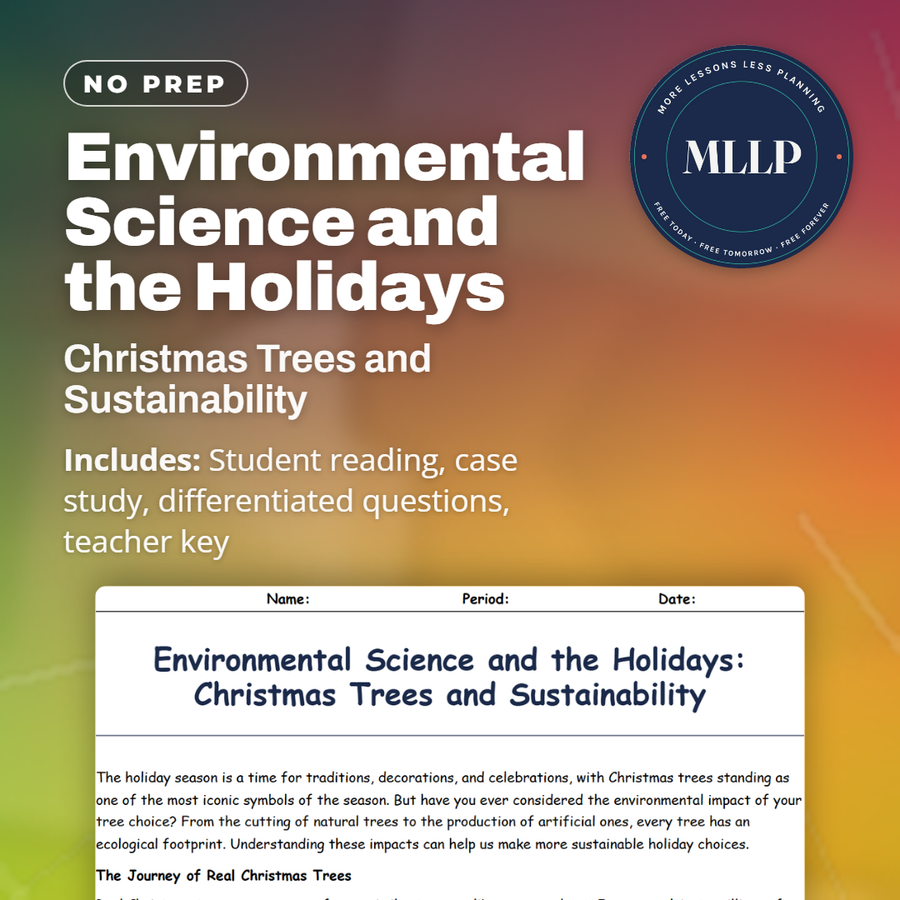
Environmental Science and the Holidays: Christmas Trees and Sustainability
Quality reviewed September 2026
Facts verified September 9, 2026
- Subject
- Science
- Grades
- Grades 9-12
- Length
- 6-page student worksheet
- Time
- About one 50-minute class period
- Great for
- Sub plans and independent work
- Includes
- Reading passage, comprehension questions + full answer key
- Format
- Print-and-go PDF
What students do
- Compare the carbon footprint and lifecycle impacts of real versus artificial Christmas trees
- Analyze why artificial trees require 7-10 years of use to offset their manufacturing and shipping emissions
- Evaluate how consumer choices affected a local tree farm's viability in the case study
- Assess trade-offs between personal convenience and community economic and environmental outcomes
What it covers
- Life cycle assessment and carbon footprints of consumer products
- Fossil fuel dependence in manufacturing and transportation
- Sustainable alternatives and circular economy thinking
Start reading this worksheet
The holiday season is a time for traditions, decorations, and celebrations, with Christmas trees standing as one of the most iconic symbols of the season. But have you ever considered the environmental impact of your tree choice? From the cutting of natural trees to the production of artificial ones, every tree has an ecological footprint. Understanding these impacts can help us make more sustainable holiday choices.
The Journey of Real Christmas Trees
Real Christmas trees are grown on farms, similar to crops like corn or wheat. Farmers cultivate millions of these trees every year, often planting a new tree for every one harvested. These farms support local economies, provide jobs, and help preserve open spaces. While growing, trees absorb carbon dioxide (CO₂) from the atmosphere, improving air quality and contributing to carbon sequestration. However, real Christmas trees are not without environmental costs. Harvesting trees requires heavy machinery, fuel, and transportation, which contribute to greenhouse gas emissions. Additionally, discarded trees often end up in landfills, where they produce methane, a potent greenhouse gas. Composting or recycling programs can reduce this impact, but access to such programs varies by location.
Artificial Trees: A Convenient Alternative?
Artificial trees offer a reusable option, often appealing to those who prefer convenience or have allergies to natural trees. These trees are typically made from polyvinyl chloride (PVC), a type of plastic derived from petroleum. They are produced in factories, often overseas, and shipped worldwide, contributing to carbon emissions from manufacturing and transportation. The lifespan of an artificial tree is a critical factor in determining its sustainability. Studies suggest that an artificial tree must be used for at least 7-10 years to offset its environmental impact compared to using a real tree each year. However, most artificial trees are discarded after only a few years, often ending up in landfills where they take centuries to decompose.
Like what you read? The full reading, the case study, and every question set are in the free download below, along with the answer key.
Why this matters
An Oregon tree farm ran for decades on one fact: real trees need replanting every year, keeping a local supply chain in jobs. Big box retailers began discounting artificial trees, and buyers switched overnight even though a fake tree needs seven to ten years of reuse before its manufacturing and shipping emissions are offset. The farm lost enough business that the land was sold.
This case study raises a question shoppers rarely ask: what happens on the other end of a convenience purchase. A plastic tree feels responsible simply because it gets reused, until the true emissions are counted. One household's choice, repeated by enough people, closed a farm that had survived for decades.
From one teacher to another
The case study is uncomfortable in the best way. A small Oregon tree farm operated for decades, providing jobs and keeping the supply chain local. When big-box retailers undercut the price with discounted artificial trees, consumer preference shifted almost overnight. The farm lost viability, and the land was sold for commercial development. It shows students that their individual choices, multiplied by many people, shape real economies.
What you get
Download
Where should I send the next one?
Everything here is free and it stays that way. Leave your email and I'll send you the new lessons as they go up. You can unsubscribe from any one of them.
Related resources
Biology of Evergreen Plants: The Science Behind Christmas Trees
Body Clocks and Midnight Countdowns: Circadian Rhythms at New Year’s
Calendars, Orbits, and the Science of New Year’s Day
Christmas on the Home Front: WWII Rationing and Resilience
Colorful Chemistry: Holiday Lights, Fireworks, and the Science of Glow
Crowded Skies: Holiday Air Travel and the Environment
Every lesson on this site is free to download and use. If one of them saved you a prep period, you can chip in a few bucks toward my three kids' daycare fund. That's genuinely where tips go.