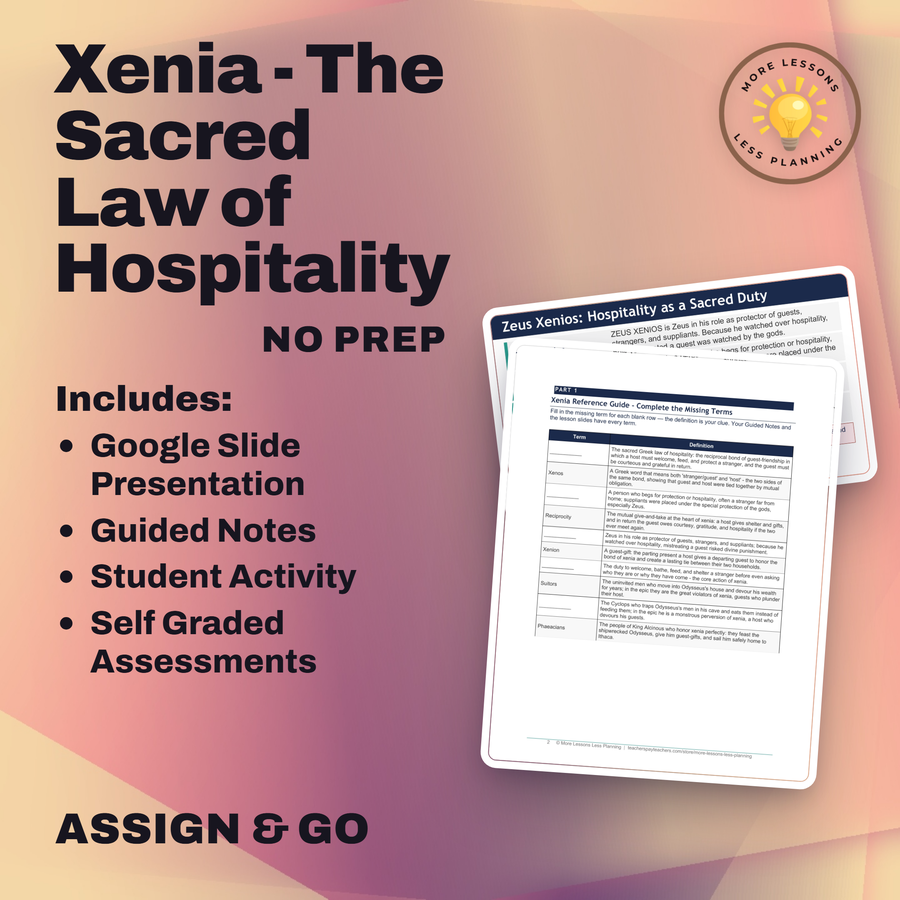
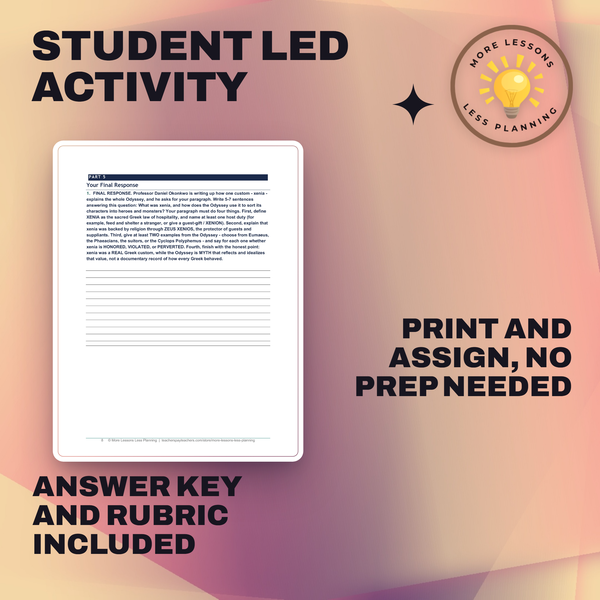
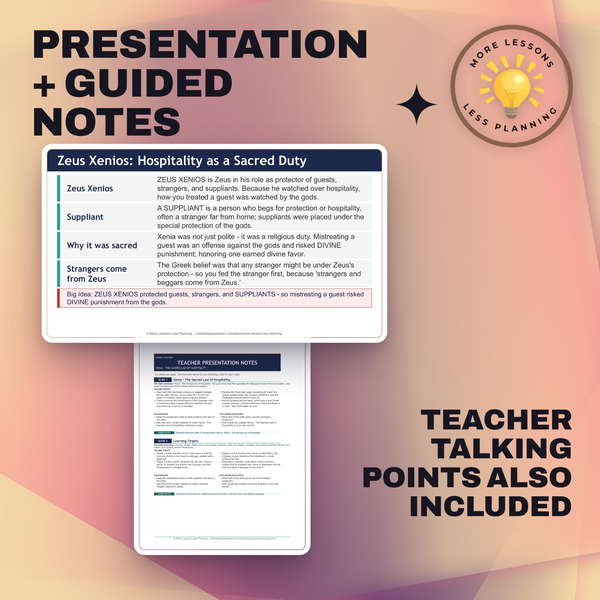

Xenia - The Sacred Law of Hospitality
Quality reviewed September 2026
- Subject
- World History
- Grades
- Grades 9-12
- Time
- About two 50-minute class periods
- Includes
- 11 ready-to-teach files
- Format
- Word (.docx) · PowerPoint (.pptx)
- Slide deck
- Guided notes
- Guided notes teacher key
- Activity + answer key
- Quiz + answer key
- Exit ticket + answer key
- Teacher guide
- Teacher presentation notes
What students do
- Define xenia and explain why a host had to feed and shelter a stranger before even asking his name
- Sort the suitors, the Cyclops, and the Phaeacians into who violates, perverts, or honors the guest-host bond
- Explain why Zeus Xenios gave hospitality religious weight, since "strangers and beggars come from Zeus"
- Read Homer's account of the swineherd Eumaeus and separate the real Greek custom from the myth that dramatizes it
What it covers
- The duties of a host: welcome, feed, and shelter a stranger before asking his name
- Zeus Xenios and the belief that "strangers and beggars come from Zeus"
- Reciprocity and the guest-gift (xenion) that could bond two households for generations
- The honest line between xenia as a documented Greek custom and the Odyssey as myth that idealizes it
Learning targets
- Define xenia, the sacred Greek law of hospitality, and explain its core duties: a host must welcome, feed, and shelter a stranger before asking who they are, and both sides owe reciprocity and guest-gifts (xenion), all under the protection of Zeus Xenios
- Use xenia to explain three key episodes of the Odyssey - the suitors who VIOLATE it, the Cyclops Polyphemus who PERVERTS it, and the Phaeacians and the swineherd Eumaeus who HONOR it - and what each reveals about ancient Greek values
- Distinguish the real history from the myth: xenia was a genuine, well-attested Greek social and religious custom, while the Odyssey is epic literature that reflects and idealizes that value rather than documenting exactly how every Greek behaved
Peek inside
A Sacred Bond Between Host and Stranger
is the sacred Greek law of hospitality - the reciprocal bond in which a host must welcome, feed, and protect a stranger, and the guest must be courteous and grateful in return.
is a Greek word that means BOTH 'stranger/guest' AND 'host', showing that guest and host were tied together by mutual obligation.
far from home had no hotels and no police to protect them, so xenia was ancient Greece’s safety net for the vulnerable traveler at your door.
1. Who originally composed the words you are reading, in what translation, and what kind of source is this excerpt? Use the citation and the context above.
Why this matters
A guest-gift exchanged under xenia was not a party favor. It could bond two households for generations, which turns a night of food and shelter for a total stranger into something closer to a treaty than a kindness.
Xenia did real diplomatic work beyond one meal, since a guest-gift created an obligation that could outlast the people who exchanged it. I point students to Zeus Xenios as the reason a failure to honor that bond counted as more than rudeness, since turning away a stranger was treated as an offense against a watching god.
From one teacher to another
A ragged stranger shows up at your door with nothing - do you feed him or turn him away? Ancient Greece had a sacred answer, and I use it as the single lens that sorts the entire cast of the Odyssey into heroes and monsters: the suitors who plunder Odysseus's house are guests who betray their host, the Cyclops who eats his visitors instead of feeding them is a host who betrays his guests, and the Phaeacians who feast a shipwrecked stranger before they even know his name get it exactly right. Students read Homer's own account of the swineherd Eumaeus welcoming a disguised beggar, and I'm careful to keep the honesty split clean the whole lesson: xenia was a real, documented Greek custom, while the epic itself is myth that idealizes it rather than proving how every Greek actually behaved.
Every file in this toolkit
Download
Where should I send the next one?
Everything here is free and it stays that way. Leave your email and I'll send you the new lessons as they go up. You can unsubscribe from any one of them.
Related resources
Homer and the Oral Tradition
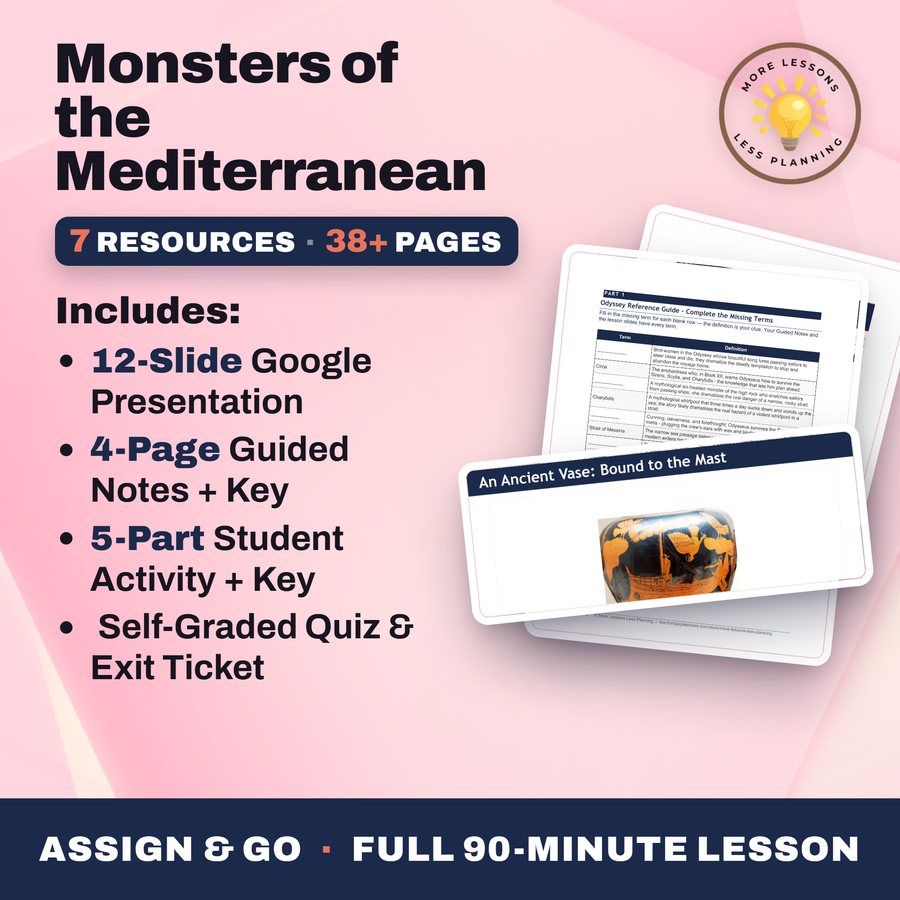
Monsters of the Mediterranean
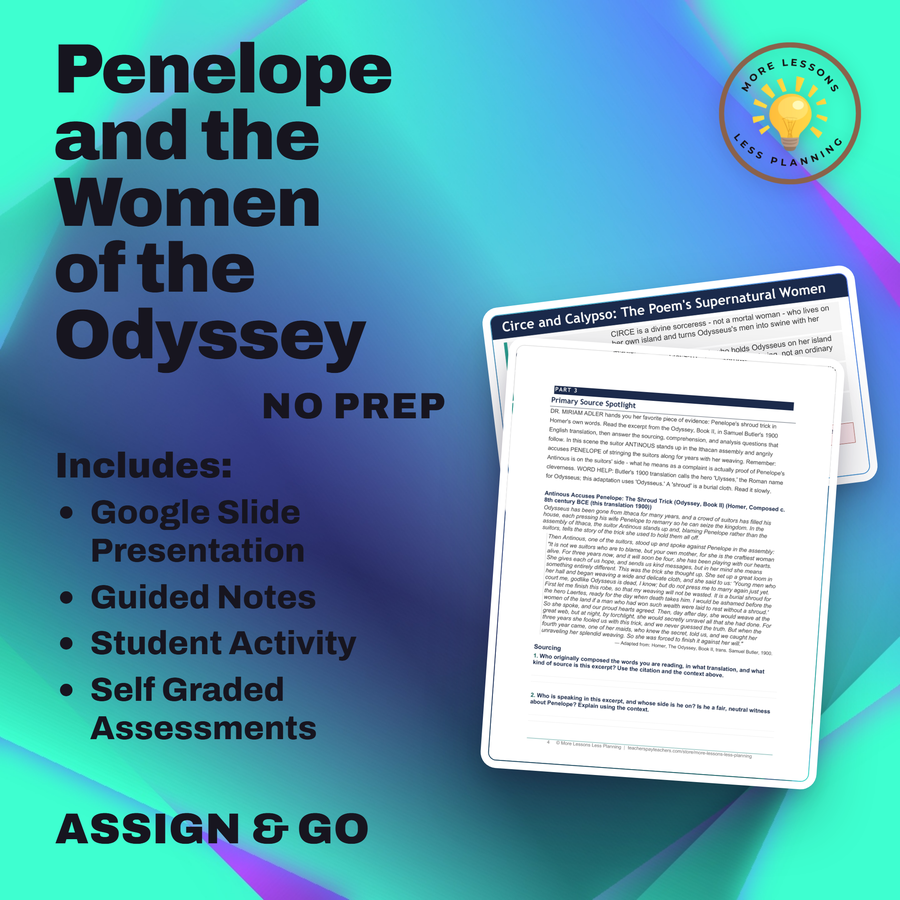
Penelope and the Women of the Odyssey

Schliemann Digs Up Troy
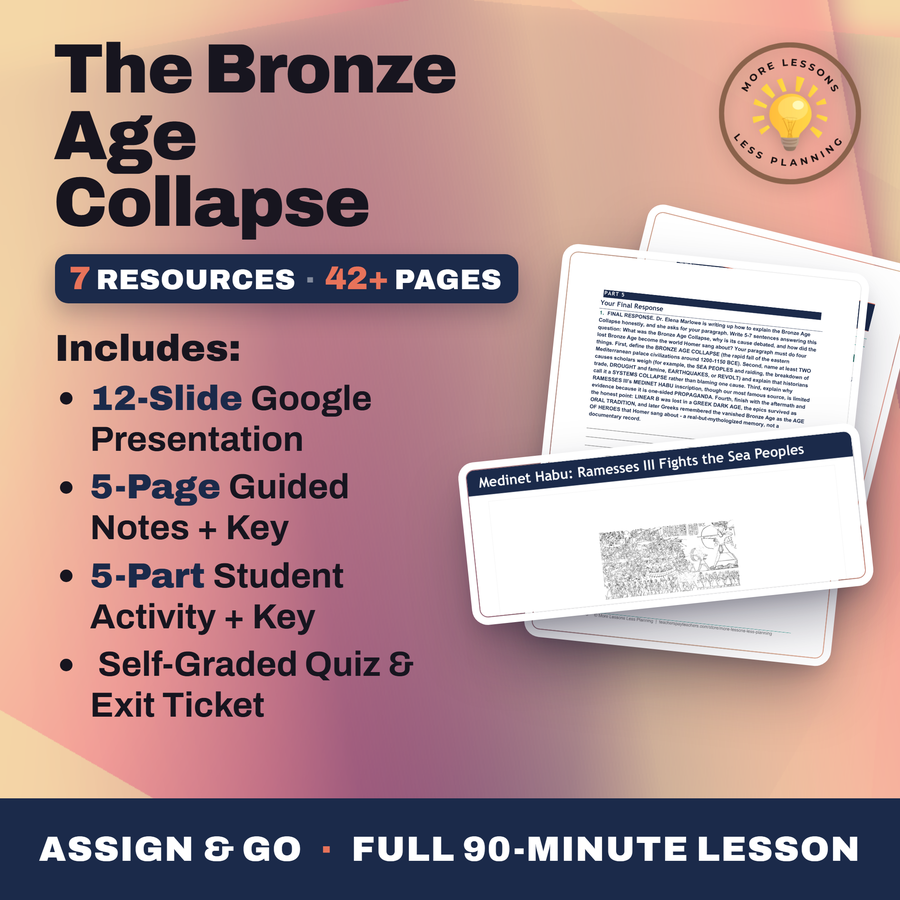
The Bronze Age Collapse
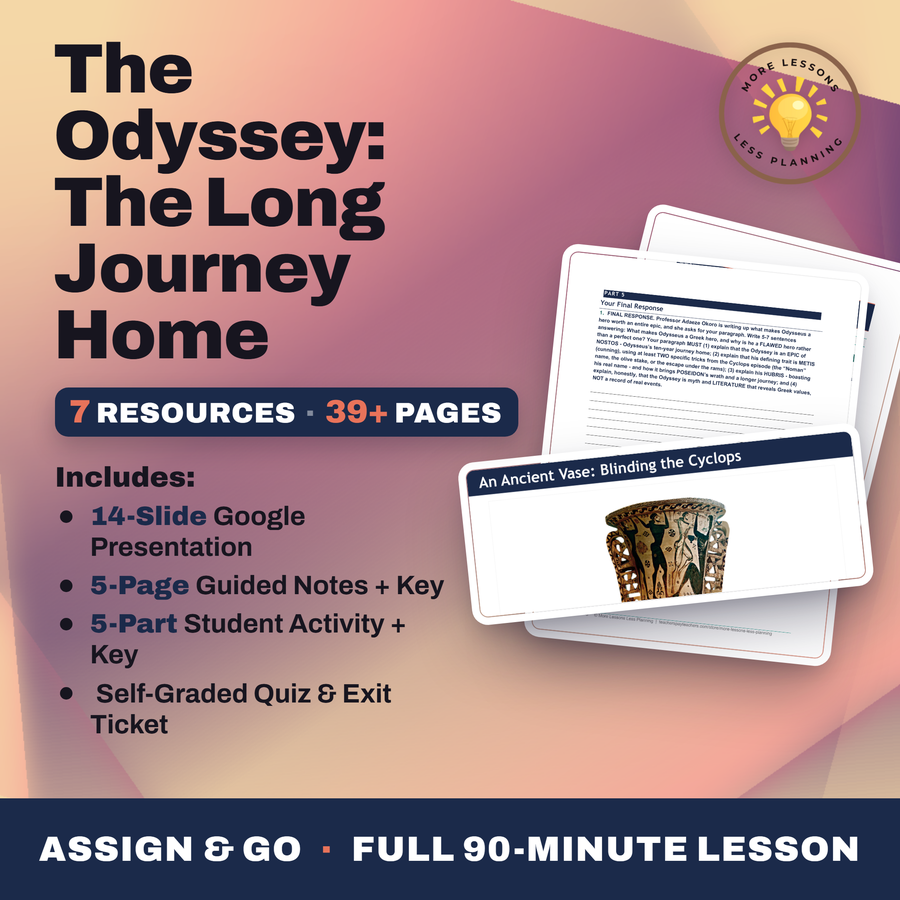
The Odyssey - The Long Journey Home
Every lesson on this site is free to download and use. If one of them saved you a prep period, you can chip in a few bucks toward my three kids' daycare fund. That's genuinely where tips go.