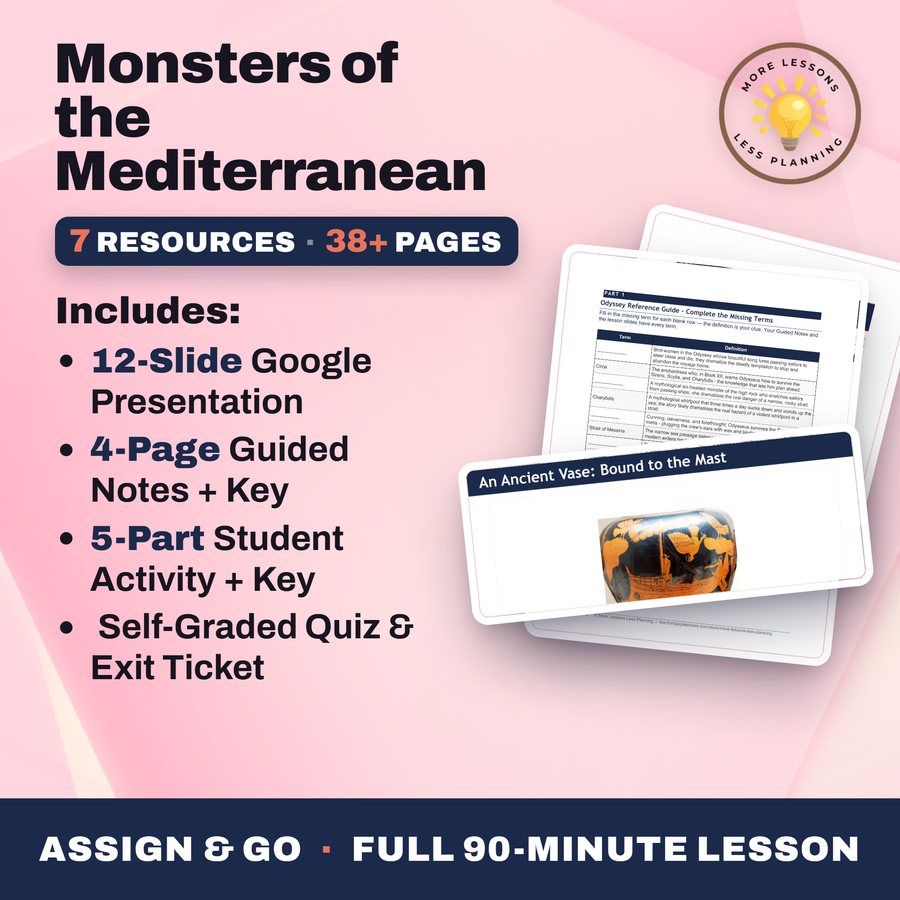
Monsters of the Mediterranean
Quality reviewed September 2026
- Subject
- World History
- Grades
- Grades 9-12
- Time
- About two 50-minute class periods
- Includes
- 11 ready-to-teach files
- Format
- Word (.docx) · PowerPoint (.pptx)
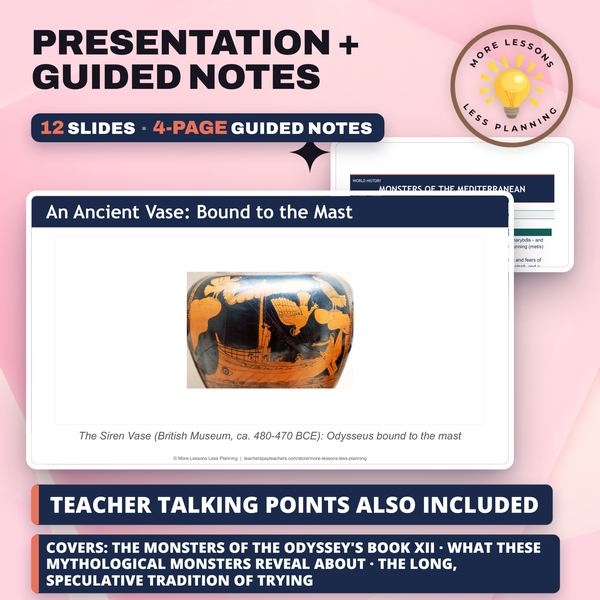
- Slide deck
- Guided notes
- Guided notes teacher key
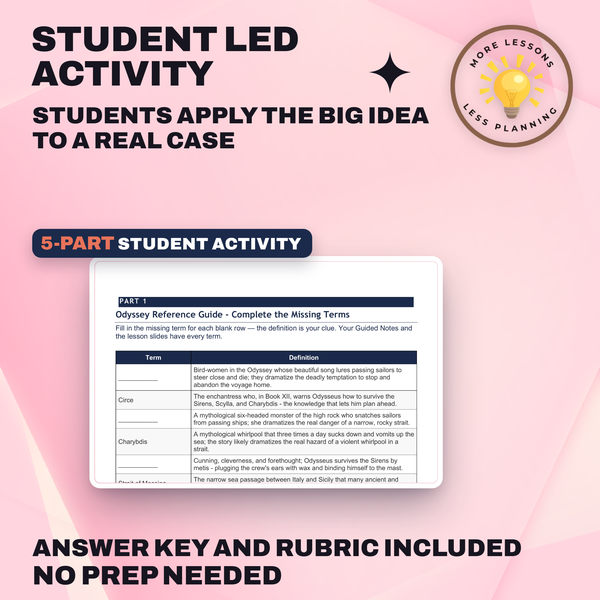
- Activity + answer key
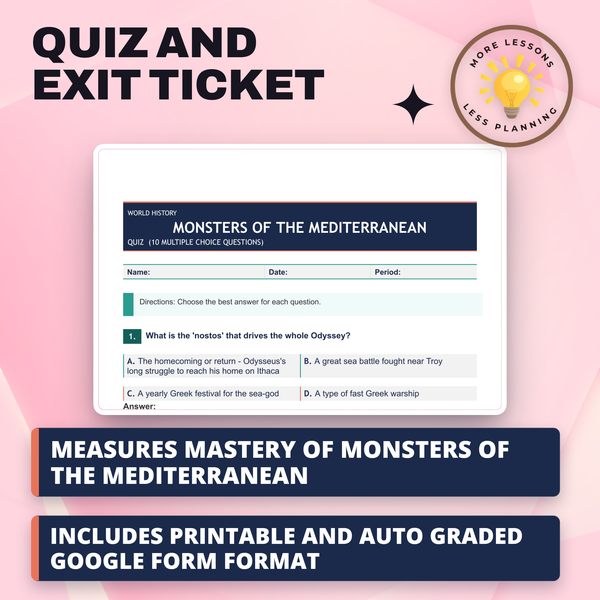
- Quiz + answer key
- Exit ticket + answer key
- Teacher guide
- Teacher presentation notes
What students do
- Identify the Sirens, Scylla, and Charybdis from Book XII and explain Circe's warning
- Explain what each monster reveals about the real dangers ancient sailors feared
- Evaluate the speculative tradition of mapping Odysseus's route onto the Strait of Messina
- Analyze how Odysseus survives the Sirens through metis rather than force
What it covers
- The wax-and-mast plan, and why it counts as cunning rather than caution
- Why Scylla and Charybdis dramatize a narrow strait and a real whirlpool
- Why the monsters are myth that reveals Greek fears, not a historical record
Learning targets
- Identify the monsters of the Odyssey's Book XII - the Sirens, Scylla, and Charybdis - and explain how the enchantress Circe's warning shows Odysseus surviving by cunning (metis) rather than force
- Explain what these mythological monsters REVEAL about the real dangers and fears of ancient Greek sailors: the deadly lure to abandon the voyage, a narrow rocky strait, and a violent whirlpool
- Evaluate the long, SPECULATIVE tradition of trying to map Odysseus's route onto real Mediterranean geography, and explain why the Odyssey is myth and literature that reveals Greek fears and values - not a historical record
Peek inside
Who Is Circe?
CIRCE is the enchantress who warns Odysseus how to survive the dangers ahead
In Book XII she tells him about the Sirens, Scylla, and Charybdis
Her warning is knowledge - it lets Odysseus plan before he sails
The Goal Is Still Home
The Warning and the Goal
is the enchantress who warns Odysseus how to survive the Sirens, Scylla, and Charybdis - the knowledge that lets him plan ahead.
is the Greek word for the homecoming or return; the whole Odyssey is Odysseus’s struggle to reach his home on Ithaca.
is the island home Odysseus is struggling to reach; every monster in Book XII stands between him and it.
1. Who composed the words you are reading, in what translation, and what kind of source is this excerpt? Use the citation and context above.
Why this matters
Circe warns Odysseus about every monster in Book XII before he meets one, which makes this stretch of the Odyssey different from almost anywhere else in the epic: nothing here is a surprise. He sails toward the Sirens anyway, bound to the mast instead of steering clear, and that choice matters more than any monster's teeth.
Knowing what is coming raises a different question than being surprised by it, namely why go looking for danger once you have already been told what it costs. Reading Circe's warning against Odysseus's actual choices turns Book XII into a lesson about curiosity and control, not just a list of dangers.
From one teacher to another
None of Book XII's monsters were ever real, and I tell students that up front so they can spend the lesson on the more interesting question: what fear does each one turn into a story. Scylla and Charybdis map, loosely and speculatively, onto a real strait, which gives students a live debate about how far that kind of reading can go. I keep coming back to the wax-and-mast plan because it's the clearest proof in the whole epic that Odysseus wins by his mind, not his sword.
Every file in this toolkit
Download
Where should I send the next one?
Everything here is free and it stays that way. Leave your email and I'll send you the new lessons as they go up. You can unsubscribe from any one of them.
Related resources
Homer and the Oral Tradition
Penelope and the Women of the Odyssey
Schliemann Digs Up Troy
The Bronze Age Collapse
The Odyssey - The Long Journey Home
The Odyssey Goes to Hollywood
Every lesson on this site is free to download and use. If one of them saved you a prep period, you can chip in a few bucks toward my three kids' daycare fund. That's genuinely where tips go.