
Penelope and the Women of the Odyssey
Quality reviewed September 2026
- Subject
- World History
- Grades
- Grades 9-12
- Time
- About two 50-minute class periods
- Includes
- 11 ready-to-teach files
- Format
- Word (.docx) · PowerPoint (.pptx)
- Slide deck
- Guided notes
- Guided notes teacher key
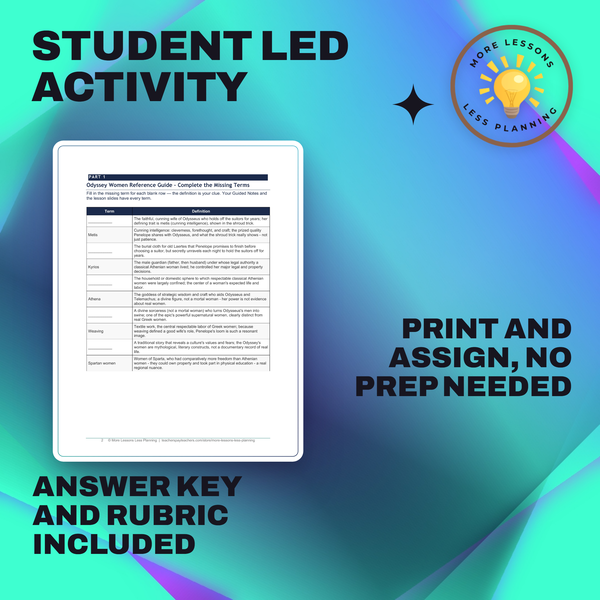
- Activity + answer key
- Quiz + answer key
- Exit ticket + answer key
- Teacher guide
- Teacher presentation notes
What students do
- Explain metis and identify it in Penelope's shroud trick, based on Samuel Butler's 1900 translation of Book II
- Distinguish the Odyssey's women as literary constructs from documentary evidence of real Greek women's lives
- Describe the kyrios and oikos system that governed a classical Athenian woman's legal and daily life
- Compare Athenian women's restrictions to the comparatively greater freedoms of Spartan women
What it covers
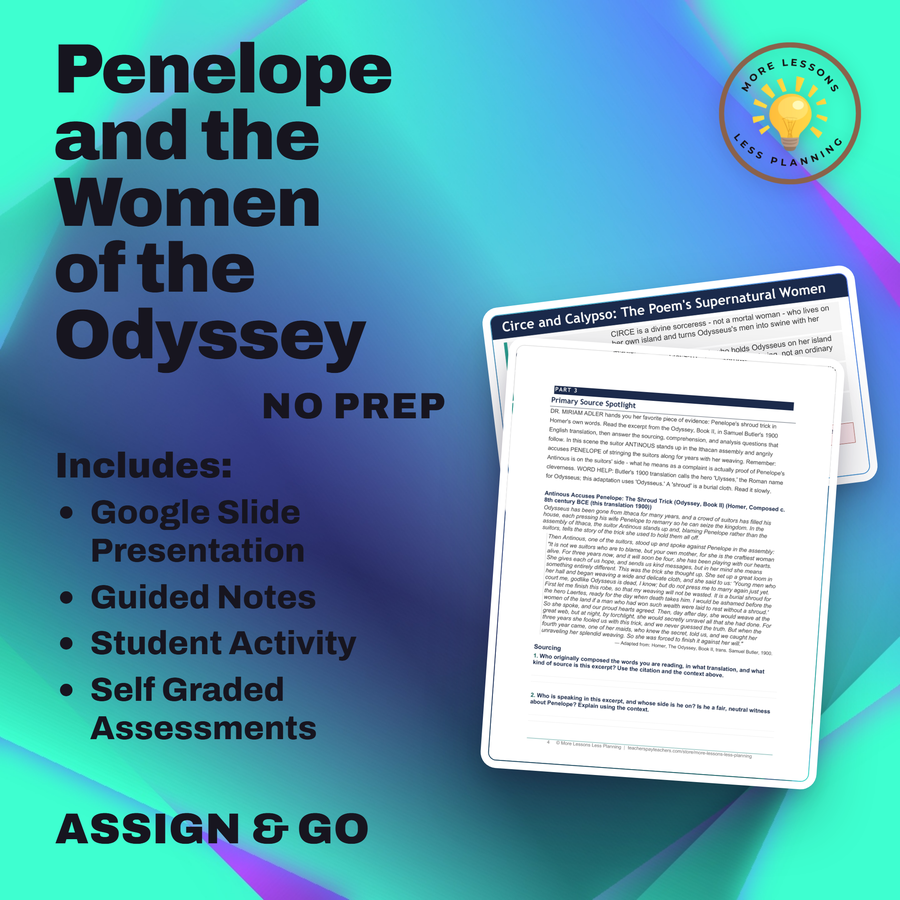
- Penelope's shroud trick (weave by day, unravel by night) as an example of metis, cunning intelligence, not just patience
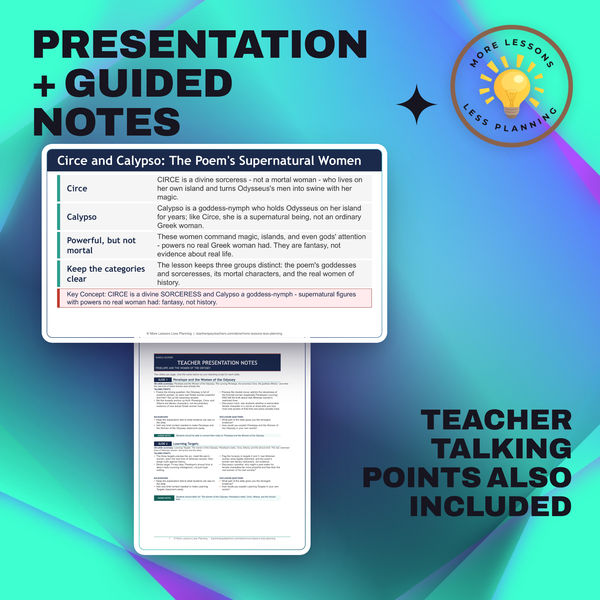
- Why Circe and Athena are divine figures whose power says nothing about real mortal women's lives
- Core vocabulary: kyrios, oikos, metis, weaving, myth, Spartan women
- A retelling of Penelope's shroud trick based on Samuel Butler's 1900 translation of the Odyssey, Book II
Learning targets
- Identify the powerful women of the Odyssey - Penelope, Circe, Athena, Calypso, and Nausicaa - and explain how Penelope's shroud trick shows her defining trait of metis (cunning intelligence), the same quality prized in Odysseus
- Contrast the epic's memorable women, who are literary characters, with the real, restricted lives of classical Athenian women, who lived under a male guardian (kyrios), were largely confined to the household (oikos), and had sharply limited legal and property standing
- Explain the central myth-vs-history move - that the Odyssey's women are literary constructs that reveal Greek values, not documentary evidence of how real women lived - and account for the real regional nuance that Spartan women had comparatively more freedom than Athenian women
Peek inside
A Cast of Powerful Women
PENELOPE outwits the suitors; CIRCE is a sorceress; ATHENA is a goddess
CALYPSO and NAUSICAA - a goddess-nymph and a princess - fill out the cast
On the page these women are clever, magical, and powerful
But They Are Literary Constructs
Powerful Characters, Not Real History
is a traditional story that reveals a culture’s values; the Odyssey’s women are literary constructs of this kind, not documentary evidence of real life.
is what the Odyssey’s powerful women really are - literary creations in a poem, not proof of how real Greek women lived.
is what these characters do about Greek values - the honest question is what they show us, not whether they were real.
1. What ancient story is this retelling based on, whose 1900 translation is it adapted from, and what kind of source is it? Use the citation and the context above.
Why this matters
Spartan women owned property and moved through public life in ways that would have been impossible for their Athenian neighbors, confined under a kyrios inside the oikos with little legal standing of their own. Two Greek city-states, one era, and two different answers to what a woman was allowed to do.
A single story about ancient Greek women falls apart once Athens and Sparta sit side by side, and I put that comparison on the table because it does more work than any one example alone. With that contrast in front of them, a character like Penelope reads less like evidence of anything and more like a reminder to ask which Greece a claim describes.
From one teacher to another
I built this one around a distinction I wanted students to actually hold onto: the Odyssey's women are unforgettable characters, but they're literature, not evidence for how real Greek women lived. Penelope's shroud trick, weaving by day and secretly unraveling it by night to hold off her suitors, is the centerpiece, and students read a retelling based on Samuel Butler's 1900 translation of Book II and work out that her real defining trait is metis, cunning intelligence, not just patience. From there the lesson turns to the historical record: a classical Athenian woman lived under a male guardian, the kyrios, and was largely confined to the household, the oikos, with limited legal standing, while Spartan women had comparatively more freedom. Circe and Athena get named for what they are, divine figures, not stand-ins for mortal women. It's a strong companion to any Odyssey reading, since it gives students a way to enjoy the epic without mistaking it for a history lesson.
Every file in this toolkit
Download
Where should I send the next one?
Everything here is free and it stays that way. Leave your email and I'll send you the new lessons as they go up. You can unsubscribe from any one of them.
Related resources
Homer and the Oral Tradition
Monsters of the Mediterranean
Schliemann Digs Up Troy
The Bronze Age Collapse
The Odyssey - The Long Journey Home
The Odyssey Goes to Hollywood
Every lesson on this site is free to download and use. If one of them saved you a prep period, you can chip in a few bucks toward my three kids' daycare fund. That's genuinely where tips go.