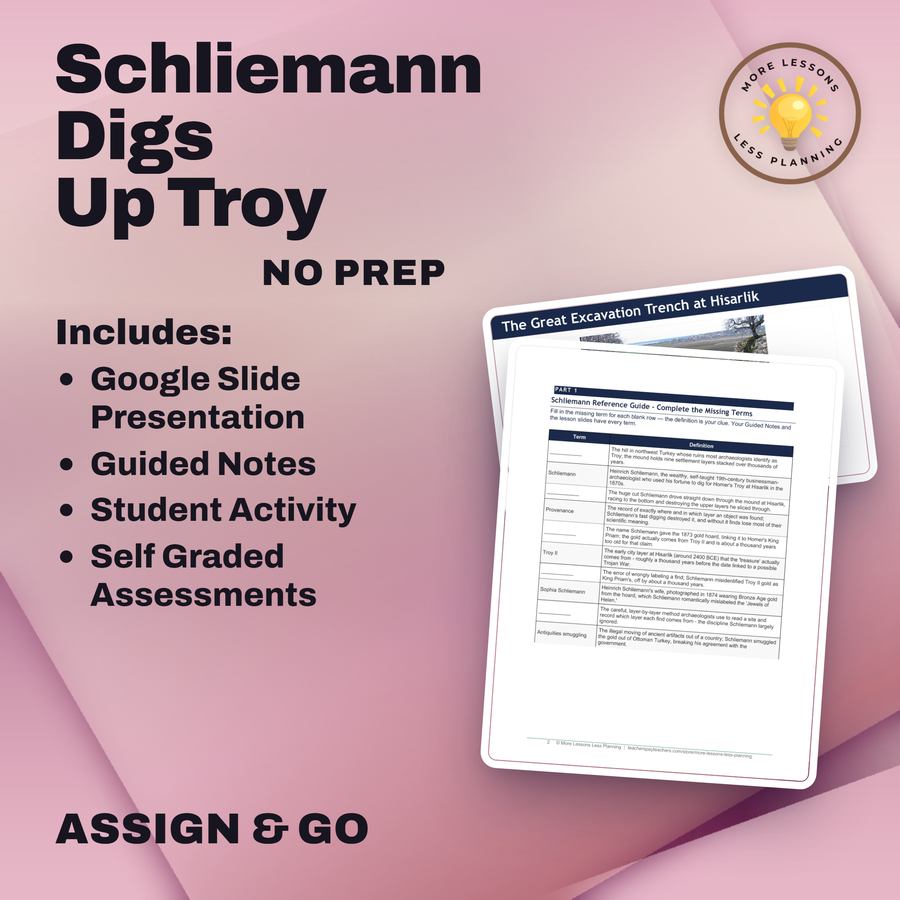
Schliemann Digs Up Troy
Quality reviewed September 2026
- Subject
- World History
- Grades
- Grades 9-12
- Time
- About two 50-minute class periods
- Includes
- 11 ready-to-teach files
- Format
- Word (.docx) · PowerPoint (.pptx)
- Slide deck
- Guided notes
- Guided notes teacher key
- Activity + answer key
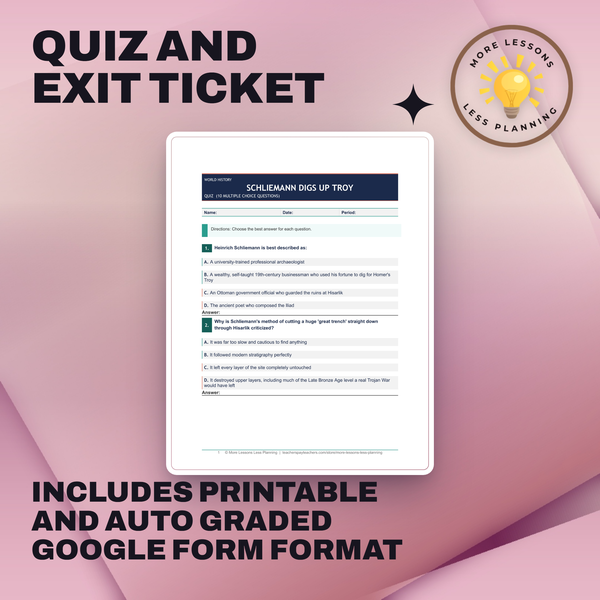
- Quiz + answer key
- Exit ticket + answer key
- Teacher guide
- Teacher presentation notes
What students do
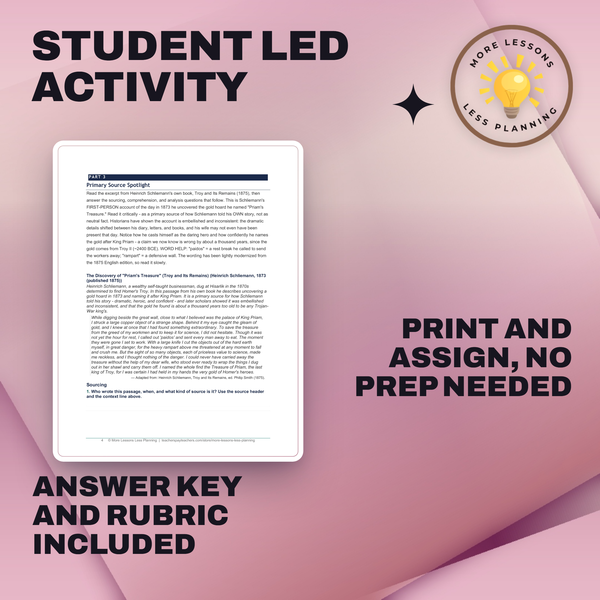
- Read Schliemann's own 1875 account of unearthing "Priam's Treasure" and catch him overselling it
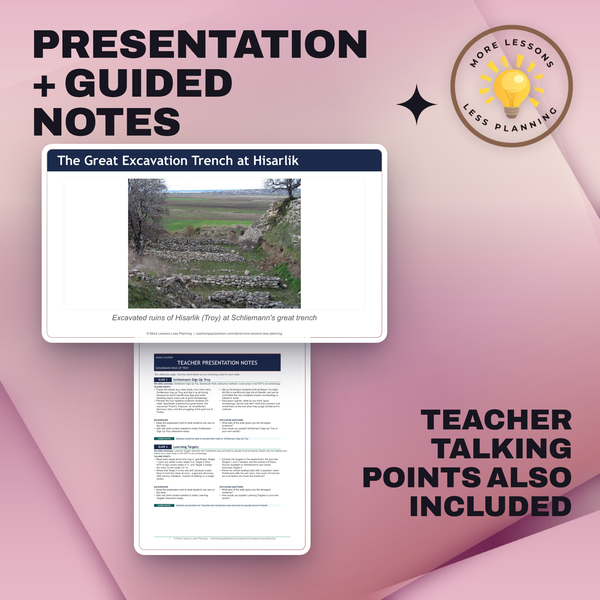
- Explain why his great trench, cut straight down through Hisarlik, destroyed the evidence it passed through
- Work out why gold from the Troy II layer is about a thousand years too old to be Priam's
- Weigh Schliemann's real contribution against his destructive methods and self-mythologizing
What it covers
- The great trench that wrecked upper layers and any record of where finds came from
- Priam's Treasure, and why Troy II gold predates a possible Trojan War by roughly a thousand years
- The 1874 photograph of Sophia Schliemann, romantically mislabeled the "Jewels of Helen"
- How Schliemann still proved a real Bronze Age city sat under the mound at Hisarlik
Learning targets
- Describe who Heinrich Schliemann was and what he actually found during his 1870s excavation of Hisarlik
- Explain why Schliemann's methods and claims - the destructive great trench, the misidentified 'Priam's Treasure,' and the smuggling - make his dig a case study in how NOT to do archaeology
- Weigh Schliemann's genuine contribution against his flaws, using his own account from Troy and Its Remains as a model of self-mythologizing to read critically
Peek inside
The Self-Made Treasure Hunter
SCHLIEMANN was a wealthy 19th-century businessman
He was self-taught, with no formal archaeology training
He was obsessed with proving Homer's Troy was real
He used his own fortune to fund his digs
The Self-Made Treasure Hunter
was the wealthy, self-taught 19th-century businessman-archaeologist who used his own fortune to dig for Homer's Troy at Hisarlik.
was the poet whose epic, the Iliad, Schliemann treated as a map to a real Troy.
- the ambition to be famous as the man who found Troy - shaped how Schliemann dug and how he told the story.
1. Who wrote this passage, when, and what kind of source is it? Use the source header and the context line above.
Why this matters
In 1874, Schliemann photographed his wife Sophia wearing gold from the dig and called it the "Jewels of Helen," even though that gold came from a layer roughly a thousand years too old for any Trojan War queen. A staged photograph shaped public memory of this discovery more than the archaeology did.
The great trench is the part I linger on longest, since it did not just damage the site, it erased the record of where within Hisarlik each object was found. That loss matters more than the treasure itself, since an object without context tells archaeologists far less than one properly recorded.
From one teacher to another
I put Schliemann's own words in front of my students before I tell them what's wrong with them, because his 1875 account of finding "Priam's Treasure" reads like he's the hero of his own story. Then I show them the math: the gold is real, but it's Troy II gold, roughly a thousand years too old for any Trojan War king. My students end up running an audit on a guy who cut a trench straight through his own evidence and still get to credit him for proving a real Bronze Age city was down there. It's a good lesson in holding credit and criticism about the same person at once, instead of picking a side too early.
Every file in this toolkit
Download
Where should I send the next one?
Everything here is free and it stays that way. Leave your email and I'll send you the new lessons as they go up. You can unsubscribe from any one of them.
Related resources
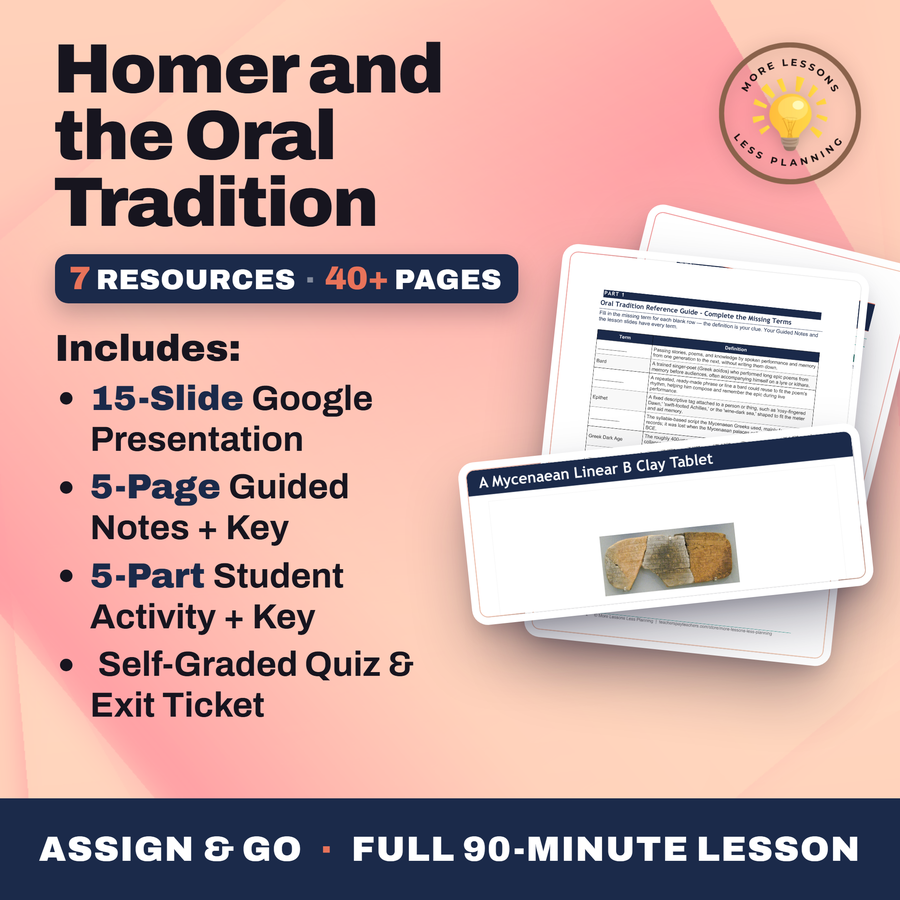
Homer and the Oral Tradition
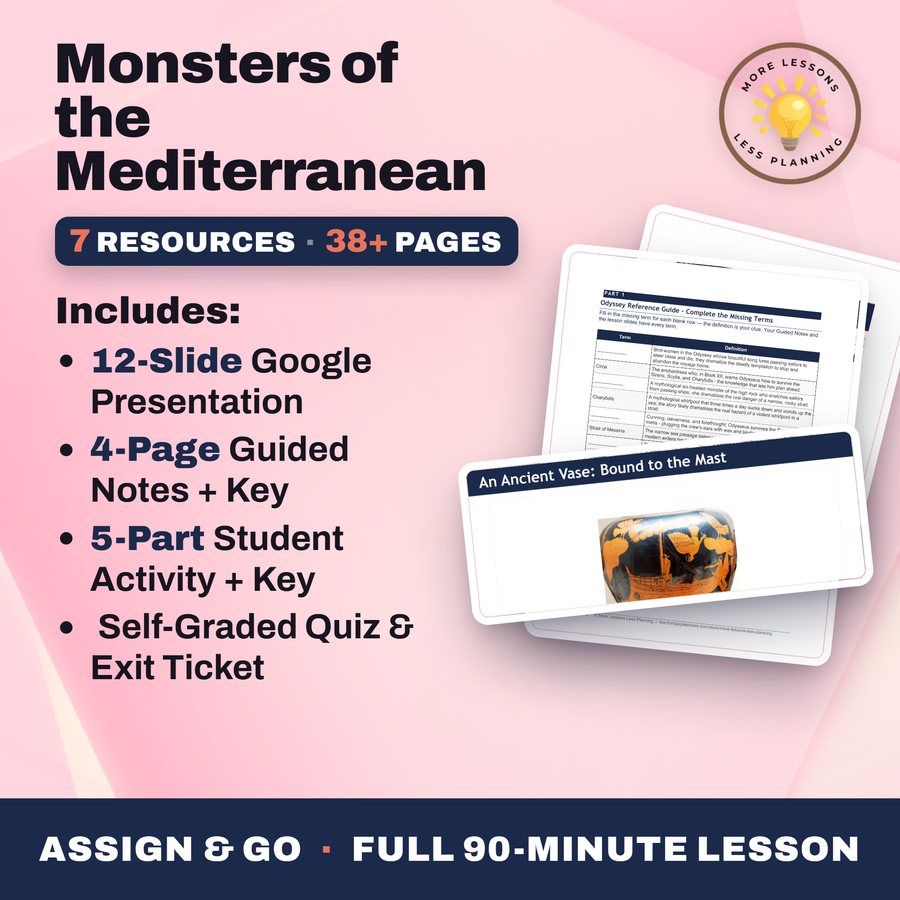
Monsters of the Mediterranean
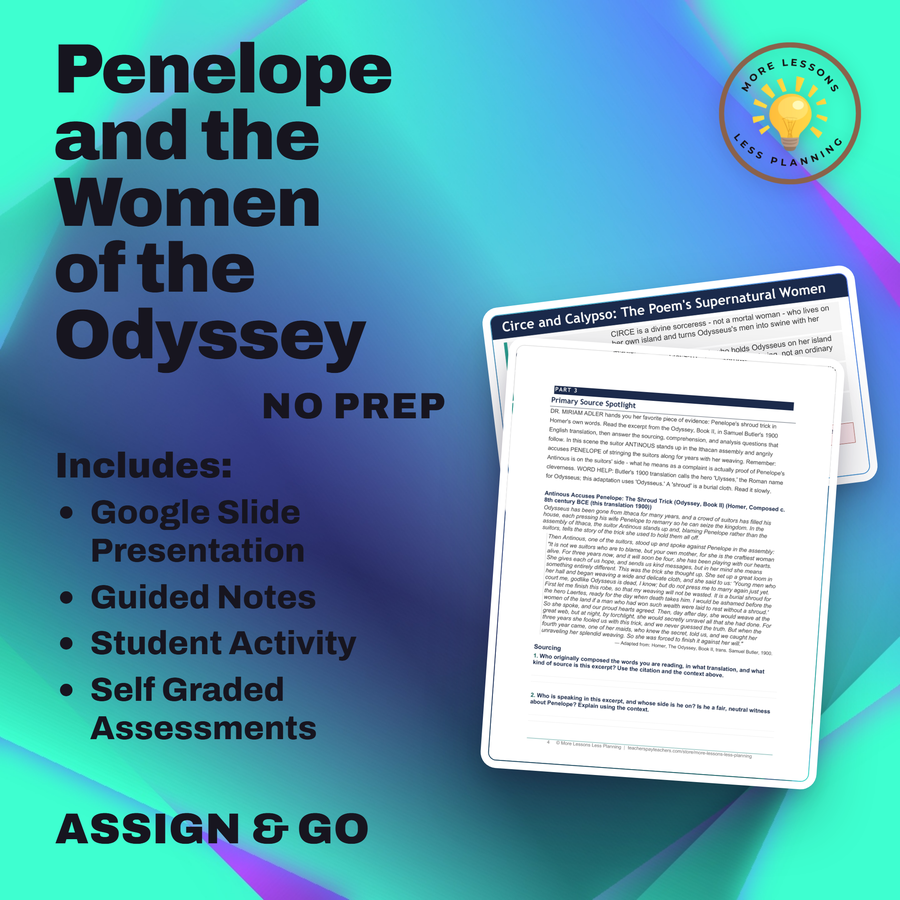
Penelope and the Women of the Odyssey
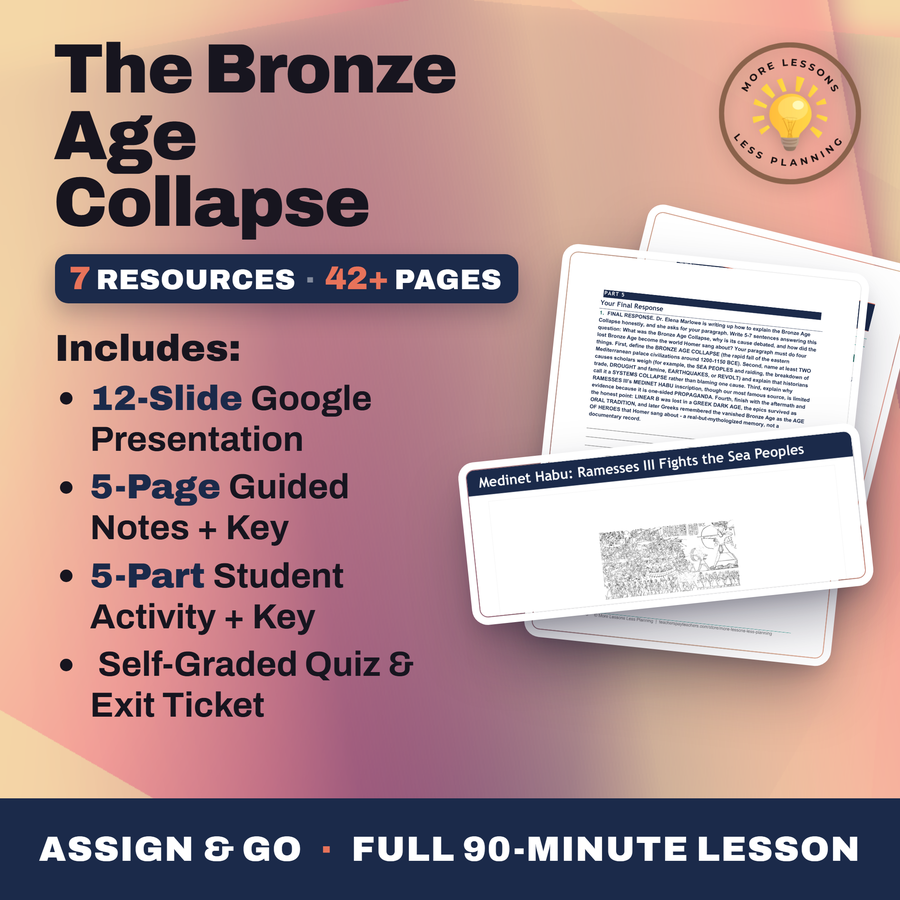
The Bronze Age Collapse
The Odyssey - The Long Journey Home
The Odyssey Goes to Hollywood
Every lesson on this site is free to download and use. If one of them saved you a prep period, you can chip in a few bucks toward my three kids' daycare fund. That's genuinely where tips go.