Homer and the Oral Tradition
Quality reviewed September 2026
- Subject
- World History
- Grades
- Grades 9-12
- Time
- About two 50-minute class periods
- Includes
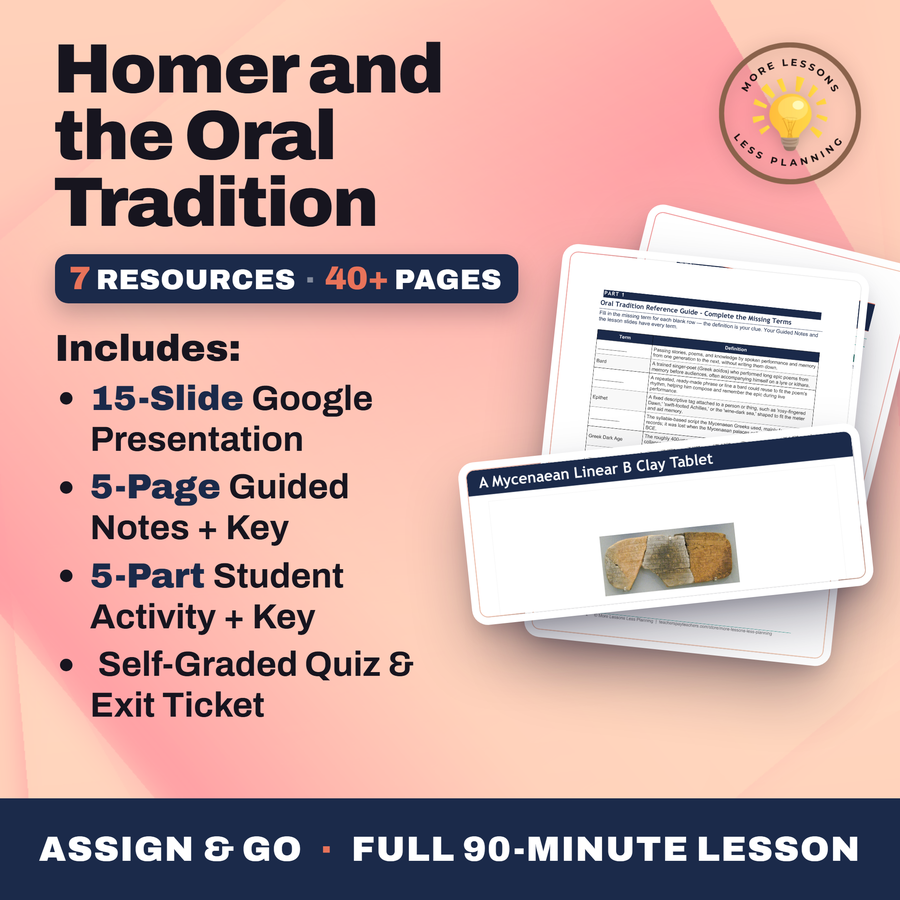
- 11 ready-to-teach files
- Format
- Word (.docx) · PowerPoint (.pptx)
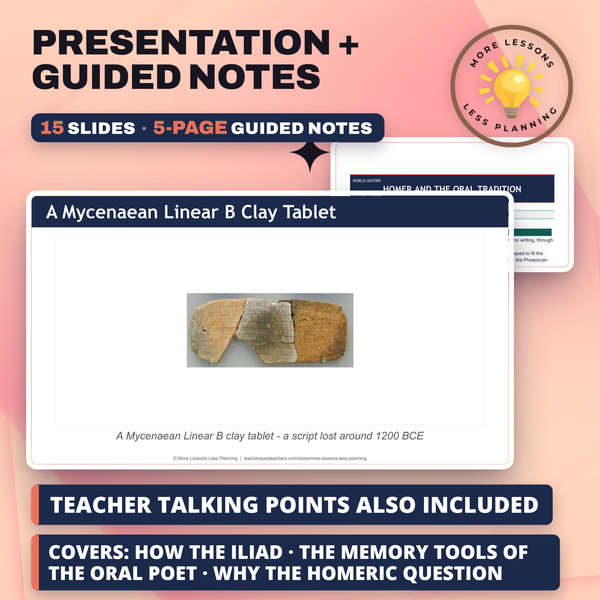
- Slide deck
- Guided notes
- Guided notes teacher key
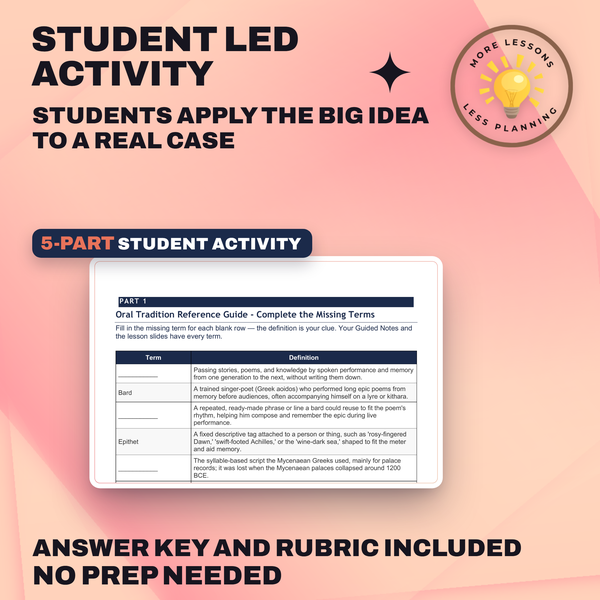
- Activity + answer key
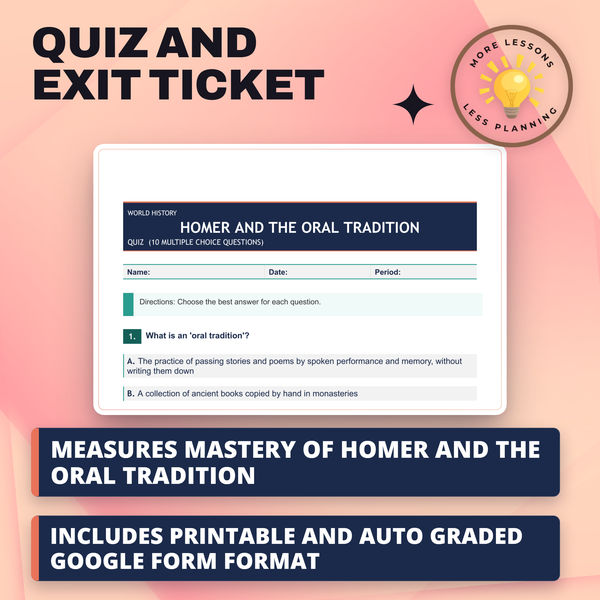
- Quiz + answer key
- Exit ticket + answer key
- Teacher guide
- Teacher presentation notes
What students do
- Explain how the Iliad and the Odyssey survived roughly 400 years with no writing
- Describe how bards used formulas and fixed epithets shaped to fit dactylic hexameter
- Trace how Linear B was lost and the Greek alphabet was later adapted from Phoenician
- Analyze the bard Demodokos inside the Odyssey as evidence of the oral tradition itself
What it covers
- The roughly 400-year Greek Dark Age between the Bronze Age collapse and the alphabet's return
- Epithets like "rosy-fingered Dawn" and "swift-footed Achilles," and why they fit the meter
- Why the Homeric Question, who "Homer" actually was, is still genuinely open
Learning targets
- Explain how the Iliad and the Odyssey survived for roughly 400 years with no writing, through oral performance by bards
- Describe the memory tools of the oral poet - formulas and fixed epithets shaped to fit the meter - and how Linear B was lost and the Greek alphabet later adapted from the Phoenician alphabet
- Explain why the Homeric Question - who 'Homer' was and how the epics were composed - is genuinely open, using the Odyssey's own bard Demodokos as evidence of the oral tradition
Peek inside
Stories Kept Alive by Voice
TRADITION is passing stories and poems by spoken performance and memory, without writing them down.
(Greek aoidos) is the trained singer-poet who performed long epic poems from memory, often to a lyre.
poems like the Iliad and the Odyssey tell of heroes, gods, and great deeds and were performed aloud, not read.
1. Who composed the words you are reading, in what translation, and what kind of source is this excerpt? Use the citation and context above.
Why this matters
No one has ever proven a single poet named Homer existed, and that open question has its own name: the Homeric Question. Whoever composed these epics did it without writing anything down, carrying two of the longest stories in the Western world across roughly four hundred years on memory alone.
A ninth grader trusts writing to keep anything intact for centuries, so a story that survives on memory alone needs an explanation. Naming the redundancy built into an oral system, the same lines trained into a performer's memory, turns a strange fact into something students can describe instead of just admire.
From one teacher to another
How does an epic survive four hundred years before anyone writes it down? I show students it's a toolkit, not a mystery, formulas and fixed epithets shaped to fit a six-beat meter, with Linear B's loss carrying that same toolkit through centuries of silence until a borrowed Phoenician alphabet finally let the epics get written down. The detail that gets them every time is Demodokos, the bard the Odyssey shows performing inside its own story, which means the epic is telling us how it survived.
Every file in this toolkit
Download
Where should I send the next one?
Everything here is free and it stays that way. Leave your email and I'll send you the new lessons as they go up. You can unsubscribe from any one of them.
Related resources
Monsters of the Mediterranean
Penelope and the Women of the Odyssey
Schliemann Digs Up Troy
The Bronze Age Collapse
The Odyssey - The Long Journey Home
The Odyssey Goes to Hollywood
Every lesson on this site is free to download and use. If one of them saved you a prep period, you can chip in a few bucks toward my three kids' daycare fund. That's genuinely where tips go.