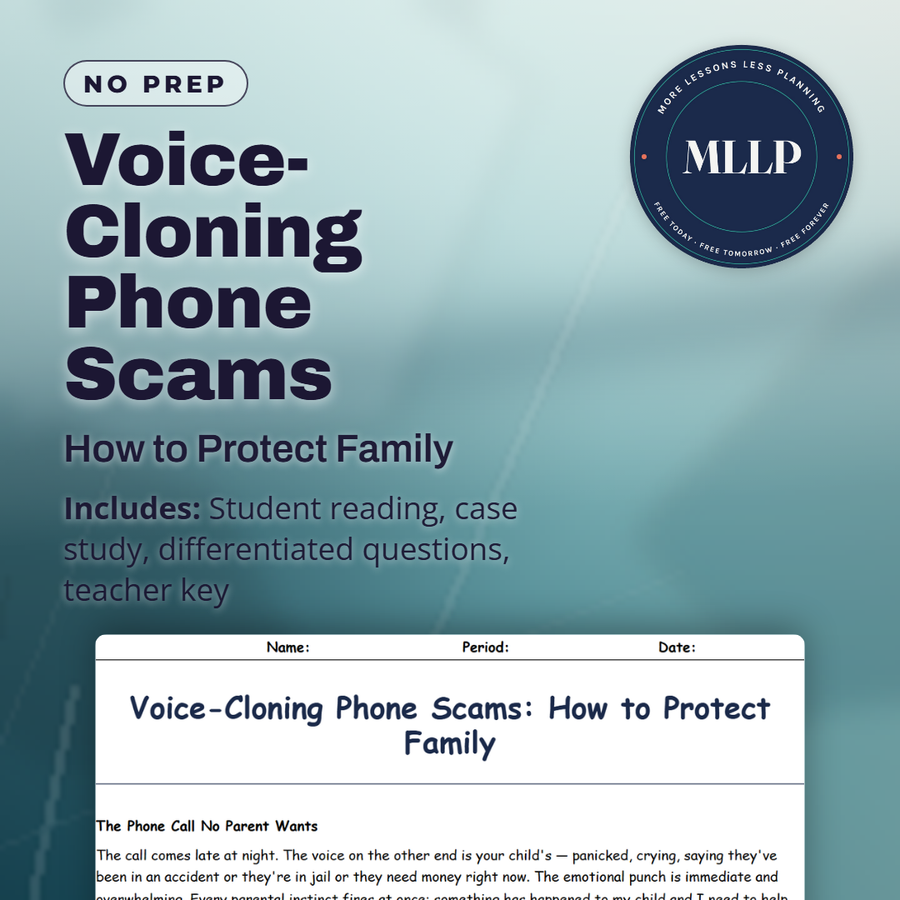
Voice-Cloning Phone Scams: How to Protect Family
Quality reviewed September 2026
Facts verified September 20, 2026
- Subject
- Career & Life Skills
- Grades
- Grades 9-12
- Length
- 9-page student worksheet
- Time
- About one 50-minute class period
- Great for
- Sub plans and independent work
- Includes
- Reading passage, comprehension questions + full answer key
- Format
- Print-and-go PDF
What students do
- Rose's phone call from a cloned 'Emma' gets checked against the reading's warning signs
- Match key terms, from vocal fingerprint to real-time cloning, to their definitions
- Three key-term blanks get filled using facts on the FCC ruling and how little audio cloning needs
- Short answer questions explain why teenagers who post often put family members at risk
What it covers
- Five reading passages on voice cloning technology, the grandparent scam, and family protection strategies
- A case study where Grandma Rose uses a family code word to catch a cloned-voice scam call
- Vocal fingerprints, real-time cloning, and the family code word strategy
Start reading this worksheet
The Phone Call No Parent Wants
The call comes late at night. The voice on the other end is your child's: panicked, crying, saying they've been in an accident or they're in jail or they need money right now. The emotional punch is immediate and overwhelming. Every parental instinct fires at once: something has happened to my child and I need to help them. Except the child is safe at home, asleep. The voice was artificial, generated in seconds by an AI system trained on nothing more than a few minutes of audio scraped from a social media video. Voice cloning has turned one of the most emotionally manipulative scams in history, the 'grandparent scam', into a far more believable and widespread threat. Understanding how it works is the first step in making sure you and your family are never fooled by it.
How Voice Cloning Technology Works
Voice cloning is a category of AI called voice synthesis. The technology takes audio samples of a real person's voice and uses machine learning to build a model that can generate new speech in that person's exact vocal pattern: same pitch, same rhythm, same accent, same emotional coloring. Early versions of this technology required hours of audio to produce convincing results. Today, commercially available tools can clone a voice with as little as three seconds of sample audio. The audio samples used to clone someone's voice don't have to come from private recordings. Public social media posts (TikTok videos, Instagram stories, YouTube clips) provide more than enough material. A teenager who posts regularly online has, without realizing it, given the world a detailed vocal fingerprint. Any bad actor with internet access and a free or cheap AI tool can use that fingerprint to generate speech that sounds exactly like the teenager saying anything at all. The cloned voice is then used in real-time phone calls or in pre-recorded messages. In the most sophisticated attacks, scammers use software that lets them type what they want the cloned voice to say and it plays live during a phone call, so the 'conversation' can respond to whatever the victim says, making it even harder to detect.
The Grandparent Scam Goes High-Tech
The grandparent scam has existed for decades. The traditional version worked like this: a caller pretends to be a grandchild in trouble (arrested, in a hospital, involved in an accident) and needs money wired immediately. A second caller, pretending to be a lawyer or police officer, reinforces the story. The scam exploited the emotional vulnerability of older adults who feared for their family members and might act without thinking. What AI voice cloning added to this scheme is terrifying in its simplicity: instead of an impersonator who sounds nothing like the grandchild, the caller now sounds exactly like them. The voice, the speech patterns, and the emotional quality all match. Victims who might have hesitated when the voice 'didn't sound right' now have no such hesitation. The emotional manipulation lands with full force because the evidence supporting it seems unambiguous. In 2023, a high-profile case involved an Arizona woman who received a call that appeared to come from her daughter, in tears, saying she had been kidnapped. The voice sounded exactly like her daughter. The 'kidnapper' then got on the phone and demanded a ransom. The woman's daughter was, in fact, on a ski trip and completely fine. The cloned voice had been generated from the daughter's social media videos.
Like what you read? The full reading, the case study, and every question set are in the free download below, along with the answer key.
Why this matters
Nearly every teenager in this classroom has posted enough video of themselves online to give a stranger the raw material for a voice clone, which makes this less a story about elderly relatives being careless and more a story about how a student's own social media habits can put a grandparent or parent at risk. The reading's fix, a family code word set up in a calm moment rather than a crisis, is something students can actually go home and do that same day. It also reframes a scary technology into a specific, rehearsable behavior instead of vague advice to be careful, which the reading notes is exactly the kind of concrete practice that has measurably lowered victim rates in communities where it gets taught and rehearsed rather than only described.
From one teacher to another
Rose picked up the phone to a voice that sounded exactly like her granddaughter Emma, crying, saying she'd been arrested and needed $3,000 by the end of the day. This worksheet uses Rose's story to teach how AI voice cloning has turned the decades-old grandparent scam into something far harder to spot, since modern tools can clone a voice from as little as three seconds of audio pulled off a public social media video. Students read how the technology works, why teenagers who post regularly online are unknowingly handing scammers a usable vocal fingerprint, and why a real, documented 2023 case involved an Arizona woman who received a ransom demand from what sounded exactly like her kidnapped daughter's voice, though the daughter turned out to be safely on a ski trip the whole time. The reading's central defense is a family code word, agreed on before any emergency, that a scammer can never know no matter how convincing the voice sounds. When the caller claiming to be Emma couldn't say pineapple, Rose hung up and called her granddaughter's real number instead.
What you get
Download
Where should I send the next one?
Everything here is free and it stays that way. Leave your email and I'll send you the new lessons as they go up. You can unsubscribe from any one of them.
Related resources
AI Phishing Emails: Spotting the New Tricks
AI Safety Research: The Effort to Keep AI Aligned With Humans
AI and Election Misinformation
AI-Powered Scams: The New Wave of Fraud
Being a Responsible AI Citizen: A Personal Code of Use
Open Source vs. Closed Source AI: Why It Matters
Every lesson on this site is free to download and use. If one of them saved you a prep period, you can chip in a few bucks toward my three kids' daycare fund. That's genuinely where tips go.