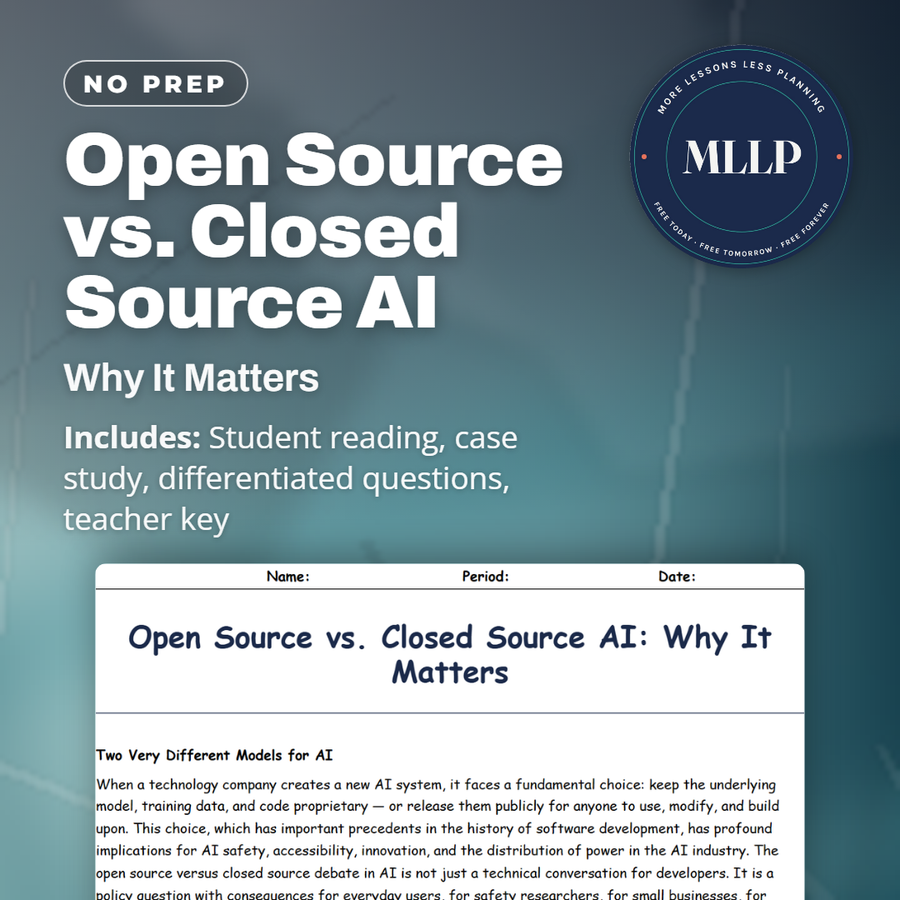
Open Source vs. Closed Source AI: Why It Matters
Quality reviewed September 2026
Facts verified September 20, 2026
- Subject
- Career & Life Skills
- Grades
- Grades 9-12
- Length
- 9-page student worksheet
- Time
- About one 50-minute class period
- Great for
- Sub plans and independent work
- Includes
- Reading passage, comprehension questions + full answer key
- Format
- Print-and-go PDF
What students do
- Meta's Llama models get compared to closed systems like GPT-4, Claude, and Gemini
- Match five terms, from model weights to local deployment, to their definitions
- Answer short-answer questions on why open weights help safety research and also help bad actors
- A rural clinic's choice between a costly closed API and a free open source model gets worked through step by step
What it covers
- Five reading passages on open source AI, closed source AI, and the safety tradeoffs of each
- A case study on a rural health clinic choosing between a closed API and an open source model
- Model weights, local deployment, and fine-tuning as the practical differences between the two approaches
Start reading this worksheet
Two Very Different Models for AI
When a technology company creates a new AI system, it faces a fundamental choice: keep the underlying model, training data, and code proprietary, or release them publicly for anyone to use, modify, and build upon. This choice, which has important precedents in the history of software development, has profound implications for AI safety, accessibility, innovation, and the distribution of power in the AI industry. The open source versus closed source debate in AI is not just a technical conversation for developers. It is a policy question with consequences for everyday users, for safety researchers, for small businesses, for authoritarian governments, and for the long-term character of an increasingly AI-dependent society. Understanding the tradeoffs requires looking at both the benefits each model offers and the risks each creates.
What Open Source AI Means
In traditional software development, 'open source' means the source code is publicly available: anyone can read it, modify it, contribute to it, and use it. Open source software has been enormously successful: Linux powers most of the world's servers, Android phones, and cloud computing infrastructure; Apache powers most of the world's websites; Firefox and Chrome are built on open source code. The open source model accelerates innovation by allowing the global developer community to identify bugs, suggest improvements, and build new applications on existing foundations. Applied to AI, 'open source' typically means releasing the model weights: the numerical parameters that encode what an AI system has learned during training. When model weights are public, any researcher, company, or individual can download and run the model, fine-tune it for specific applications, examine its behavior in detail, or build applications on top of it. Meta's Llama models are the most prominent example: released publicly, they have been downloaded millions of times and used to build thousands of applications worldwide. The distinction between truly open source and 'open weights' (releasing the model without all training data and code) matters technically, but for most practical purposes, releasing model weights provides the accessibility benefits associated with open source development.
What Closed Source AI Means
Closed source AI keeps the model architecture, training data, and weights proprietary. Users interact with the AI through an API or application interface but cannot examine, modify, or run the underlying system themselves. The leading closed source AI systems include OpenAI's GPT-4 and its successors, Anthropic's Claude models, and Google's Gemini. These companies argue that keeping models closed allows them to implement consistent safety measures, prevent misuse, and maintain the quality control that large-scale deployment requires. Closed source AI generates revenue through access fees; users pay to use the model through an API or subscription. This business model funds the enormous compute costs required to train frontier AI systems, which can run to hundreds of millions of dollars. Without the ability to monetize the model, companies argue, the investment required to develop the most capable AI systems would be unavailable.
Like what you read? The full reading, the case study, and every question set are in the free download below, along with the answer key.
Why this matters
The choice between open and closed AI shapes what tools a small business, a rural clinic, or a student in a low-income district can actually afford to use, and that gap is only growing as the leading closed models get more capable and more expensive. Students who understand why Meta gives Llama away for free, and why Anthropic and OpenAI keep their strongest models locked behind a subscription, are better equipped to evaluate the AI products they will be sold for the rest of their working lives. The clinic case study makes the tradeoff concrete: a real decision between patient privacy and raw capability, made by people with a fraction of a tech company's budget. That is the kind of judgment call this generation of students will keep making long after they leave this classroom.
From one teacher to another
Two roads exist for any company that builds a major AI model, and this worksheet lays out both of them without picking a side. Meta released its Llama models publicly, weights and all, so anyone can download and run them. OpenAI, Anthropic, and Google keep GPT-4, Claude, and Gemini closed, accessible only through an API. Students read the real arguments on each side, from independent safety research that only works on open models to the fear that a published model can never be recalled once its safety measures are stripped out. The case study drops students into a rural health clinic deciding between a $2,400-a-month closed system and a free open one their own IT volunteer can inspect. It is a genuinely hard call, and the reading gives students the vocabulary to argue it either way.
What you get
Download
Where should I send the next one?
Everything here is free and it stays that way. Leave your email and I'll send you the new lessons as they go up. You can unsubscribe from any one of them.
Related resources
AI Phishing Emails: Spotting the New Tricks
AI Safety Research: The Effort to Keep AI Aligned With Humans
AI and Election Misinformation
AI-Powered Scams: The New Wave of Fraud
Being a Responsible AI Citizen: A Personal Code of Use
Romance Scams Using AI Personas
Every lesson on this site is free to download and use. If one of them saved you a prep period, you can chip in a few bucks toward my three kids' daycare fund. That's genuinely where tips go.