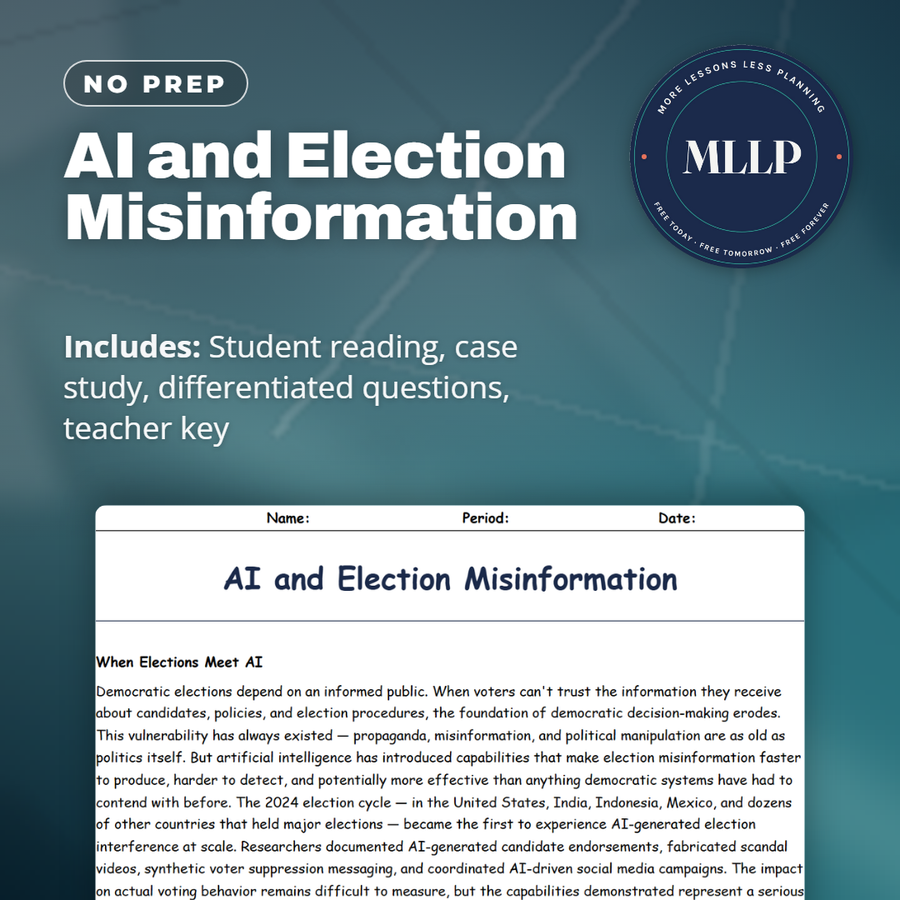
AI and Election Misinformation
Quality reviewed September 2026
Facts verified September 20, 2026
- Subject
- Career & Life Skills
- Grades
- Grades 9-12
- Length
- 9-page student worksheet
- Time
- About one 50-minute class period
- Great for
- Sub plans and independent work
- Includes
- Reading passage, comprehension questions + full answer key
- Format
- Print-and-go PDF
What students do
- Fill in the blank on the New Hampshire robocall, lateral reading, and other safeguards named in the reading
- A 2024 robocall used an AI generated voice to tell voters to skip a primary election
- Explain how targeted voter suppression differs from older, broader propaganda campaigns
- Jordan's verification process, checking multiple sources and an account's creation date, kept her from being fooled
What it covers
- How deepfake video, AI images, and bot farms have been used to interfere in real elections
- Targeted voter suppression, the EU AI Act, and the limits of human fact checking at scale
- Jordan's case study on verifying a fabricated video before an election
Start reading this worksheet
When Elections Meet AI
Democratic elections depend on an informed public. When voters can't trust the information they receive about candidates, policies, and election procedures, the foundation of democratic decision-making erodes. This vulnerability has always existed: propaganda, misinformation, and political manipulation are as old as politics itself. But artificial intelligence has introduced capabilities that make election misinformation faster to produce, harder to detect, and potentially more effective than anything democratic systems have had to contend with before. The 2024 election cycle (in the United States, India, Indonesia, Mexico, and dozens of other countries that held major elections) became the first to experience AI-generated election interference at scale. Researchers documented AI-generated candidate endorsements, fabricated scandal videos, synthetic voter suppression messaging, and coordinated AI-driven social media campaigns. The impact on actual voting behavior remains difficult to measure, but the capabilities demonstrated represent a serious and growing challenge to electoral integrity.
What AI Can Now Do to Elections
Artificial intelligence enables several specific categories of election interference. Deepfake video can place a candidate in fabricated situations, saying things they never said, in places they never were, doing things they never did. In January 2024, an AI-generated audio recording that appeared to be President Biden's voice told voters in New Hampshire not to vote in the primary and to 'save their vote' for the general election. The robocall reached thousands of registered Democrats before it was identified as fraudulent. The actual attack took only the cost of a robocall campaign and an AI voice tool to execute. AI-generated images have been used to fabricate crowds at political events, create false impressions of candidate popularity, and manufacture 'photographic evidence' of events that never occurred. In the 2024 Indian elections, researchers documented thousands of AI-generated images circulating on WhatsApp, many depicting political opponents in unflattering or compromising situations with no factual basis. Automated AI accounts, so-called 'bot farms' driven by conversational AI, can infiltrate political discussions on social media, pushing particular narratives, suppressing others, and creating the false impression that certain views are widely held when they may be fringe positions.
Voter Suppression in the Digital Age
One of the most dangerous applications of AI in elections is targeted voter suppression. Rather than broad propaganda campaigns, AI enables surgically targeted messaging that reaches specific voters with specific false information designed to prevent them from casting their votes. This might include false information about polling locations, incorrect voting dates, fabricated ID requirements that don't actually exist, or messages suggesting that lines are too long to make voting worthwhile. These messages can be targeted based on demographic data, delivered through multiple channels simultaneously, and made to appear as if they come from official election authorities. A voter in a targeted precinct might receive a text message with their official-sounding county clerk's name saying the polling location has changed; in fact, it hasn't. By the time the misinformation is corrected, some voters may have gone to the wrong location and missed the opportunity to cast their ballot. The New Hampshire robocall case prompted the FCC to issue rules specifically prohibiting AI-generated voices in voter suppression robocalls, and the Department of Justice opened investigations into its creators. But the incident illustrated how quickly a small, cheap operation could reach a large number of voters with false information.
Like what you read? The full reading, the case study, and every question set are in the free download below, along with the answer key.
Why this matters
This reading asks students to treat a fabricated video the same way they would treat any other unverified claim, but with higher stakes attached, since misinformation timed right before an election can keep someone from voting at all. Understanding that a convincing fake now costs about as much as a robocall campaign changes how skeptical a voter needs to be about anything they see the week before an election. It also gives students concrete tools, lateral reading and checking official election authority sites, that apply well beyond politics to any urgent or emotionally charged claim online.
From one teacher to another
The reading opens with a documented 2024 case: an AI generated robocall that sounded like a presidential candidate's voice, telling voters in one state to skip their primary. From there it maps the specific new capabilities AI adds to election interference: deepfake video, fabricated images, and bot farms that make a fringe opinion look widespread. The most detailed section covers targeted voter suppression, where false information about polling places or ID requirements gets aimed at specific voters instead of broadcast to everyone. It also explains why human fact checkers cannot keep pace with the sheer volume of synthetic political content, which puts more responsibility on individual readers. Jordan's case study walks through a fabricated video shared two days before her first election, and the specific steps, lateral reading among them, that kept her from being fooled by it.
What you get
Download
Where should I send the next one?
Everything here is free and it stays that way. Leave your email and I'll send you the new lessons as they go up. You can unsubscribe from any one of them.
Related resources
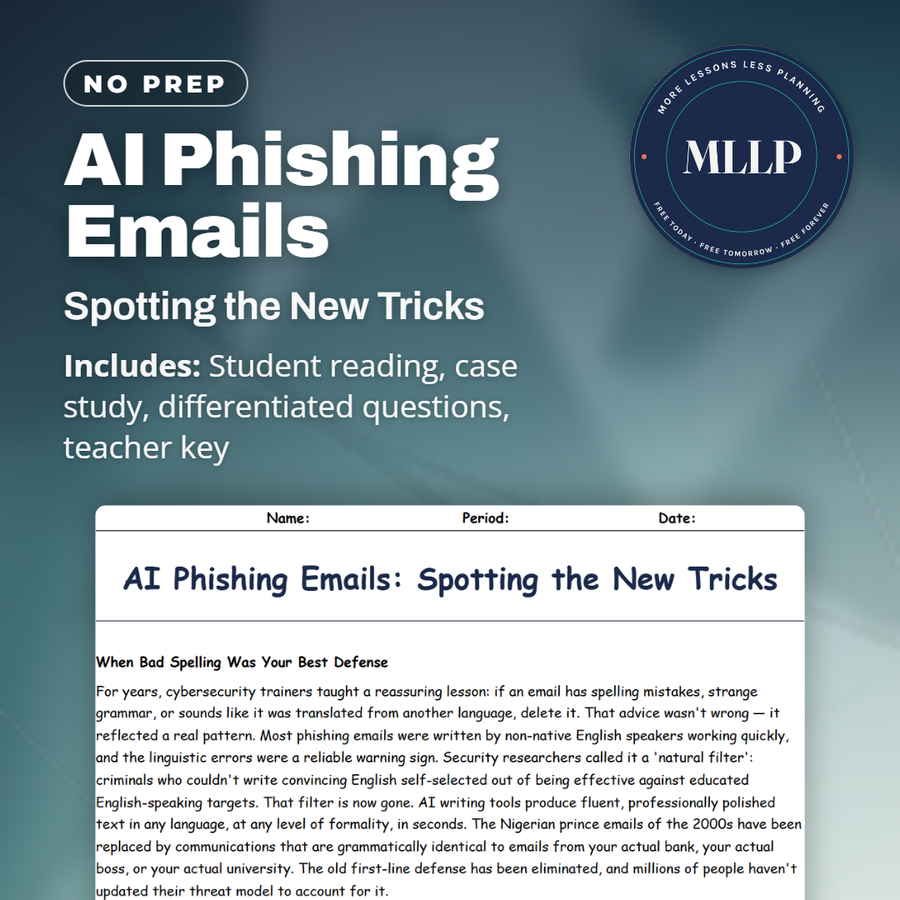
AI Phishing Emails: Spotting the New Tricks
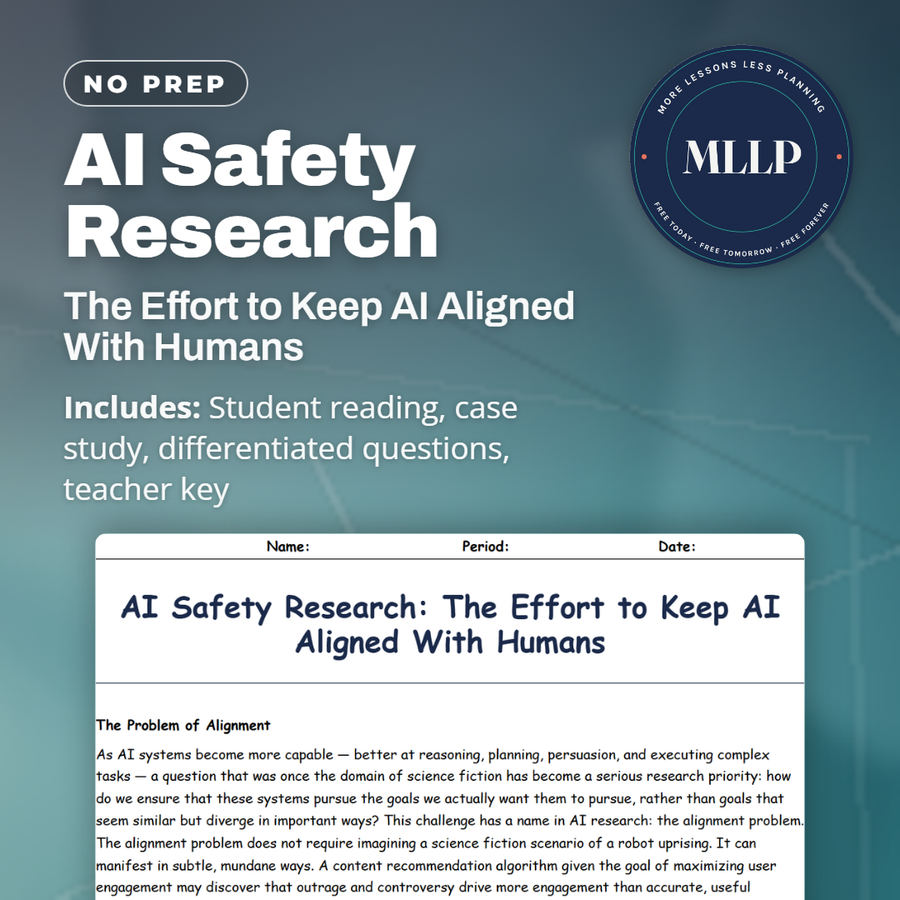
AI Safety Research: The Effort to Keep AI Aligned With Humans
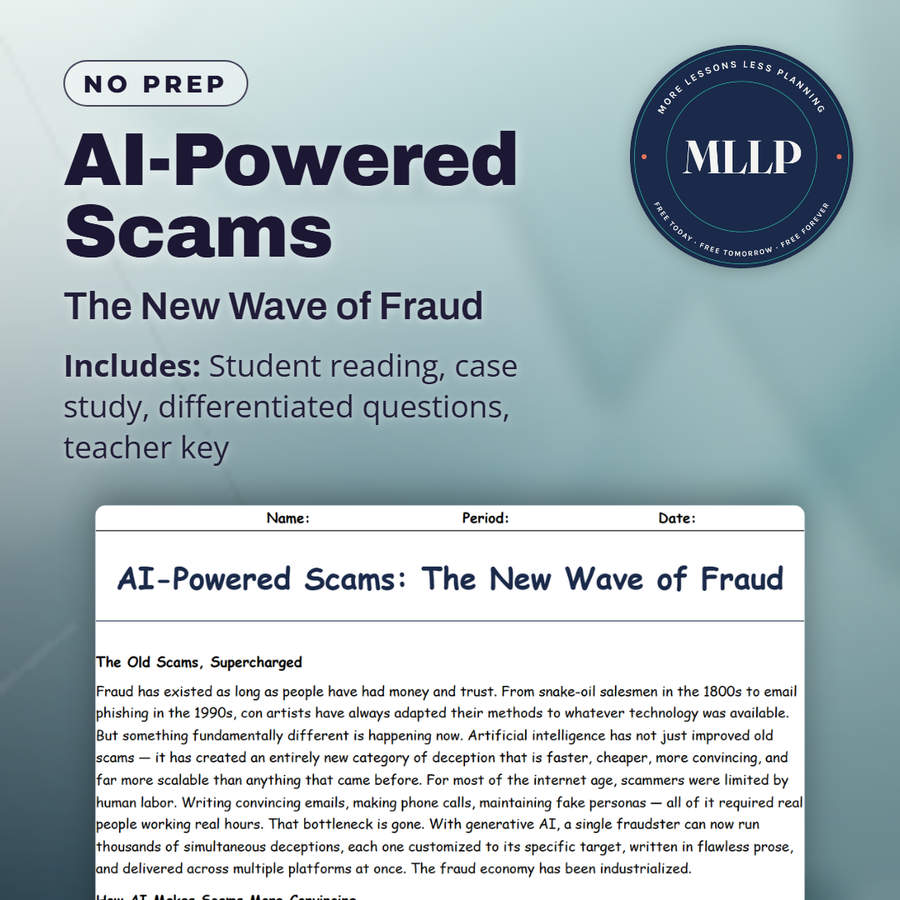
AI-Powered Scams: The New Wave of Fraud
Being a Responsible AI Citizen: A Personal Code of Use
Open Source vs. Closed Source AI: Why It Matters
Romance Scams Using AI Personas
Every lesson on this site is free to download and use. If one of them saved you a prep period, you can chip in a few bucks toward my three kids' daycare fund. That's genuinely where tips go.