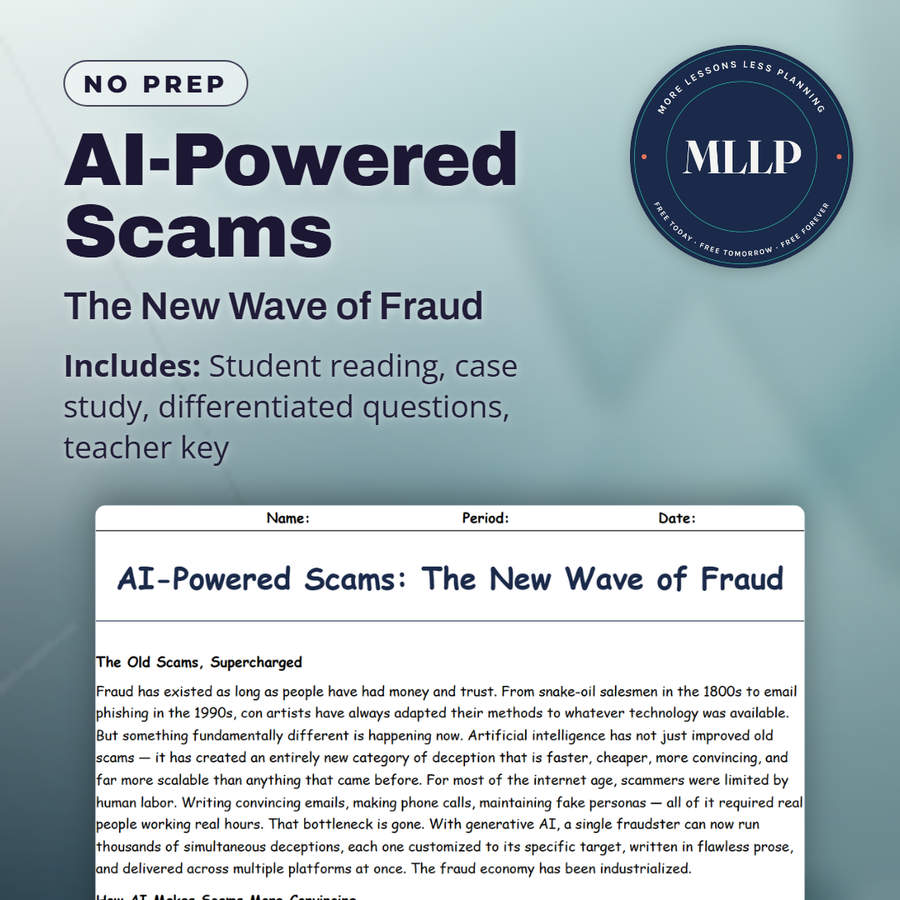
AI-Powered Scams: The New Wave of Fraud
Quality reviewed September 2026
Facts verified September 20, 2026
- Subject
- Career & Life Skills
- Grades
- Grades 9-12
- Length
- 9-page student worksheet
- Time
- About one 50-minute class period
- Great for
- Sub plans and independent work
- Includes
- Reading passage, comprehension questions + full answer key
- Format
- Print-and-go PDF
What students do
- Sort the four stages of an AI powered scam, from reconnaissance to extraction, in the order they happen
- Fraud that once required a team of writers and callers can now run at scale through one person with AI tools
- Explain why older adults, people in life transitions, and small business owners each face distinct scam risks
- Marcus's fake wire request named his real accountant and referenced a real project, but one phone call exposed it
What it covers
- How AI personalizes scams at scale using scraped social media and public records
- The four stages of an AI powered scam and who gets targeted most and why
- Marcus's case study on a fake wire request that used real details about his business
Start reading this worksheet
The Old Scams, Industrialized
Fraud has existed as long as people have had money and trust. From snake-oil salesmen in the 1800s to email phishing in the 1990s, con artists have always adapted their methods to whatever technology was available. But something fundamentally different is happening now. Artificial intelligence has not just improved old scams: it has created an entirely new category of deception that is faster, cheaper, more convincing, and far more scalable than anything that came before. For most of the internet age, scammers were limited by human labor. Writing convincing emails, making phone calls, and maintaining fake personas all required real people working real hours. That bottleneck is gone. With generative AI, a single fraudster can now run thousands of simultaneous deceptions, each one customized to its specific target, written in flawless prose, and delivered across multiple platforms at once. The fraud economy has been industrialized.
How AI Makes Scams More Convincing
The core advantage AI gives scammers is personalization at scale. Traditional phishing emails were generic: 'Dear Customer, your account has been compromised.' Anyone who looked carefully could spot the warning signs (awkward phrasing, strange grammar, a sender address that didn't match the company). AI eliminates most of these giveaways. Modern AI can scrape a target's social media accounts, professional profiles, and public records to build a detailed picture of who they are. It knows their employer, their interests, their recent life events, even the names of their family members. It can then craft a message that references specific, accurate details, making the victim believe the sender genuinely knows them. A scam email might mention your actual boss by name, reference a real project you're working on, and use the exact writing style your company typically uses for internal communications. AI also removes the language barrier that once flagged many overseas scams. Bad grammar and unusual idioms were classic red flags. Now, AI writes with native-level fluency in any language, and it can adapt tone, formality, and style to match whatever context seems most trustworthy to the target.
The Anatomy of a Modern AI Scam
AI-powered scams typically unfold in predictable stages. The first is reconnaissance: gathering information about the target. AI tools can process enormous amounts of public data quickly, building profiles that would have taken a human investigator days to compile. The second stage is contact, where the scammer reaches out through whatever channel seems most effective: email, text, phone call, or social media message. The third stage is trust-building. AI-powered chatbots can maintain consistent, believable personas over weeks or months, responding to questions, sharing details that check out, and developing what feels like a genuine relationship. This is particularly effective in romance scams and investment fraud, where victims often need time to be convinced before they part with large sums of money. The fourth and final stage is the extraction, the moment the scammer asks for money, credentials, or sensitive information. By this point, the victim's defenses are usually down. They believe they know who they're talking to, they trust them, and they often have emotional or financial reasons to want the transaction to succeed.
Like what you read? The full reading, the case study, and every question set are in the free download below, along with the answer key.
Why this matters
AI powered fraud already costs Americans more than ten billion dollars a year, and the reading makes clear that number is climbing because tools that once required real technical skill are now available to almost anyone. Students are already a target audience themselves, since scammers increasingly work through the social media platforms where teenagers spend the most time. The independent contact rule from Marcus's case study, verifying any request for money through a channel the scammer does not control, is one of the few defenses that works regardless of how convincing the fake message looks, which makes it worth actually remembering rather than just reading.
From one teacher to another
Fraud is an old problem, but the reading argues AI has industrialized it: a single scammer can now run thousands of personalized deceptions at once, each one written in fluent, targeted prose instead of the generic, error filled messages that used to give scams away. It breaks a modern scam into four stages, reconnaissance, contact, trust building, and extraction, and shows how AI accelerates every one of them, from scraping a target's public records in minutes to maintaining a convincing fake relationship over months. Certain groups face elevated risk for specific reasons the reading names directly: older adults for their savings, people in life transitions for their emotional state, and small business owners for the wire transfers they routinely approve. Marcus's case study shows how far personalization has come. A fake email from his accountant referenced a real project and matched her usual writing style closely enough that only a direct phone call, not the email itself, exposed it as fraud. Students finish by weighing how much of the defense against this belongs to companies and how much belongs to individual judgment.
What you get
Download
Where should I send the next one?
Everything here is free and it stays that way. Leave your email and I'll send you the new lessons as they go up. You can unsubscribe from any one of them.
Related resources
AI Phishing Emails: Spotting the New Tricks
AI Safety Research: The Effort to Keep AI Aligned With Humans
AI and Election Misinformation
Being a Responsible AI Citizen: A Personal Code of Use
Open Source vs. Closed Source AI: Why It Matters
Romance Scams Using AI Personas
Every lesson on this site is free to download and use. If one of them saved you a prep period, you can chip in a few bucks toward my three kids' daycare fund. That's genuinely where tips go.