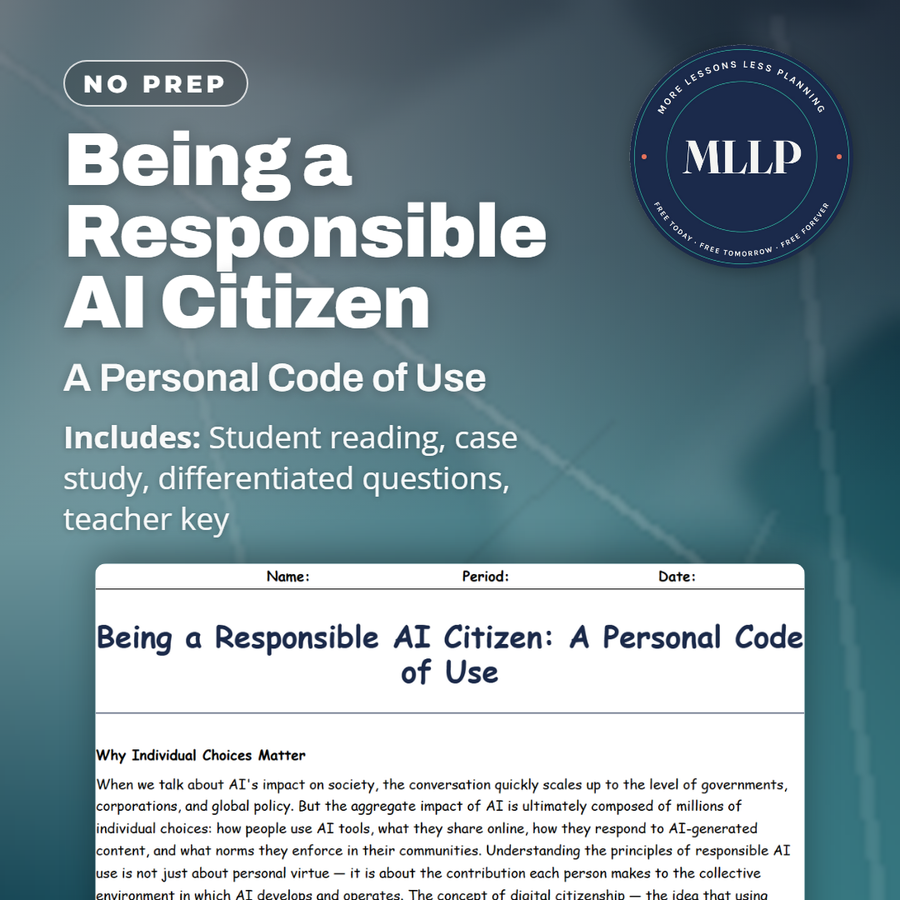
Being a Responsible AI Citizen: A Personal Code of Use
Quality reviewed September 2026
Facts verified September 20, 2026
- Subject
- Career & Life Skills
- Grades
- Grades 9-12
- Length
- 9-page student worksheet
- Time
- About one 50-minute class period
- Great for
- Sub plans and independent work
- Includes
- Reading passage, comprehension questions + full answer key
- Format
- Print-and-go PDF
What students do
- Five AI citizenship terms, from data hygiene to the verify-before-share rule, get matched to their definitions
- Three key-term blanks get filled in using definitions pulled straight from the reading
- Answer short-answer questions on why the share-before-verify reflex matters most
- Explain why Jaylen's disclosure passes the reading's test and Marcus's silence fails it
What it covers
- Five reading passages on AI citizenship, disclosure, verification, data privacy, and human oversight
- A case study contrasting a student who disclosed AI use with one who didn't
- Data hygiene, disclosure obligations, and what the reading counts as a substantive AI contribution
Start reading this worksheet
Why Individual Choices Matter
When we talk about AI's impact on society, the conversation quickly scales up to the level of governments, corporations, and global policy. But the aggregate impact of AI is ultimately composed of millions of individual choices: how people use AI tools, what they share online, how they respond to AI-generated content, and what norms they enforce in their communities. Understanding the principles of responsible AI use is not just about personal virtue; it is about the contribution each person makes to the collective environment in which AI develops and operates. The concept of digital citizenship, the idea that using online spaces comes with responsibilities as well as rights, has been part of technology education for two decades. AI citizenship extends this concept into a new domain. It asks: given what you know about how AI works, what it can do, what it gets wrong, and how it is misused, what does responsible use look like? What do you owe to other people in how you engage with AI-generated content? What do you owe to yourself?
Honesty About AI Use
One of the most frequently contested questions in AI citizenship involves disclosure: when you use AI to generate or substantially assist with work that you present to others, do you have an obligation to say so? The debate around academic AI use (whether students should be permitted to use AI for essays, and whether they should disclose when they do) is the most visible version of this question, but it extends well beyond school. A professional who submits AI-generated work without disclosure may be misrepresenting their own capabilities or the labor involved. An author who publishes AI-generated text under their own name is making a claim about authorship that may mislead readers. A person who shares AI-generated images, audio, or video without labeling them as synthetic is potentially deceiving their audience about the reality of what they're seeing. The principle of honest disclosure does not require labeling every AI-assisted spellcheck or grammar suggestion. It does require transparency about substantive AI contribution: when AI generated the core content, reasoning, or creative work that you are presenting as your own. The test is whether the recipient of your work would feel deceived if they knew the extent of AI's contribution. If yes, disclosure is warranted.
Verify Before You Share
AI-generated content (text, images, audio, video) can be convincing and wrong simultaneously. Large language models produce confident, fluent statements about topics they actually know nothing about. AI image generators can create photorealistic images of events that never occurred. AI voice and video can produce convincing impersonations of real people saying things they never said. The responsible AI citizen treats AI-generated information with the same skepticism they would apply to a confident stranger on the street: plausibly knowledgeable, but requiring verification before being acted on or shared. This means checking AI factual claims against primary sources when the stakes are significant, conducting reverse image searches on suspicious images, and being particularly cautious about emotionally charged political content where the incentives to deceive are highest. The 'share before you verify' reflex (the impulse to immediately forward something alarming, outrageous, or surprising) is precisely what AI misinformation is designed to exploit. Slowing down even briefly before sharing political content, surprising news, or anything that triggers a strong emotional response is one of the highest-impact individual behaviors for reducing the spread of AI misinformation.
Like what you read? The full reading, the case study, and every question set are in the free download below, along with the answer key.
Why this matters
Every student already faces the disclosure question this worksheet is built around, whether it is a history paper, a job application, or a text message translated by AI before they send it. The reading's test, whether the other person would feel deceived if they knew how much AI actually did, gives students something more useful than a school policy to memorize: a question they can carry into situations no policy anticipated. The data privacy passage matters just as much. Teenagers share more with chatbots than they realize, and the voice-cloning risk the reading names, audio pulled from a public video and used to fake a phone call, is a real threat their own social media habits can create.
From one teacher to another
This worksheet walks through five short readings on what it actually means to use AI responsibly. It opens with the case of Jaylen, a junior who used AI to outline and proofread a history paper and disclosed it in a footnote, and Marcus, who let AI write most of his paper and said nothing. Students work out why one disclosure passed the reading's test and the other failed it. The rest of the passages cover verifying AI content before sharing it, protecting personal data in AI chats, and supporting human oversight instead of undermining it. I like this one because it hands students a concrete test they can apply to their own AI use going forward.
What you get
Download
Where should I send the next one?
Everything here is free and it stays that way. Leave your email and I'll send you the new lessons as they go up. You can unsubscribe from any one of them.
Related resources
AI Phishing Emails: Spotting the New Tricks
AI Safety Research: The Effort to Keep AI Aligned With Humans
AI and Election Misinformation
AI-Powered Scams: The New Wave of Fraud
Open Source vs. Closed Source AI: Why It Matters
Romance Scams Using AI Personas
Every lesson on this site is free to download and use. If one of them saved you a prep period, you can chip in a few bucks toward my three kids' daycare fund. That's genuinely where tips go.