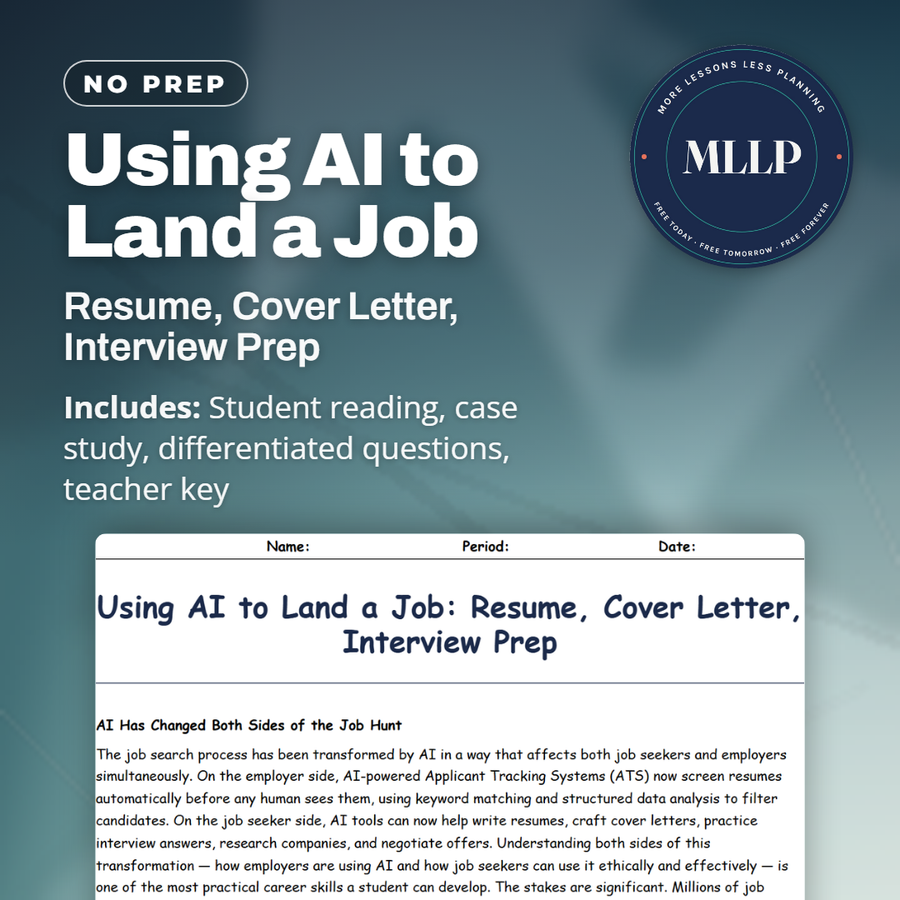
Using AI to Land a Job: Resume, Cover Letter, Interview Prep
Quality reviewed September 2026
Facts verified September 20, 2026
- Subject
- Career & Life Skills
- Grades
- Grades 9-12
- Length
- 9-page student worksheet
- Time
- About one 50-minute class period
- Great for
- Sub plans and independent work
- Includes
- Reading passage, comprehension questions + full answer key
- Format
- Print-and-go PDF
What students do
- Match five terms, from ATS to quantified accomplishment, to their correct definitions
- Three blanks pull the 75 percent ATS filter rate, a cover letter draft, and interview questions from the text
- Three multiple choice questions cover ATS formatting rules, cover letter strategy, and what makes AI interview prep useful
- Work through Ramon's resume rewrite and explain why he verified the AI's numbers before using them
What it covers
- Five passages on ATS screening, AI assisted resume writing, cover letters, and interview preparation
- A key info table on ATS prevalence, keyword strategy, and using AI for company research
- Ramon's case study fact checking an AI generated resume line, plus a PDF answer key
Start reading this worksheet
AI Has Changed Both Sides of the Job Hunt
The job search process has been transformed by AI in a way that affects both job seekers and employers simultaneously. On the employer side, AI-powered Applicant Tracking Systems (ATS) now screen resumes automatically before any human sees them, using keyword matching and structured data analysis to filter candidates. On the job seeker side, AI tools can now help write resumes, craft cover letters, practice interview answers, research companies, and negotiate offers. Understanding both sides of this transformation, how employers are using AI and how job seekers can use it ethically and effectively, is one of the most practical career skills a student can develop. The stakes are significant. Millions of job applications are submitted electronically each year, and at major companies, the probability that a human will read a resume that fails ATS screening is very low. Some estimates suggest that 75 percent or more of resumes submitted to major employers are filtered out before a human reviewer sees them. Conversely, candidates who understand how ATS systems work and use AI tools effectively to prepare strong applications have a measurable advantage in getting past this first filter and into the human-reviewed stage of hiring.
Understanding Applicant Tracking Systems
An Applicant Tracking System is software that employers use to manage the flow of job applications. Basic ATS functions include storing applications, enabling keyword searches, and flagging candidates who meet specific requirements. More sophisticated systems use AI to rank candidates based on how well their resumes match the job description, screen for specific credentials and experience patterns, and even analyze writing style and structure for signals of candidate quality. For job seekers, the practical implication is that a resume must be readable by a machine before it can impress a human. This means avoiding fancy formatting, tables, graphics, and unusual fonts that ATS parsers often misread. It means including the specific keywords and phrases from the job description in the resume and cover letter: not to stuff them in dishonestly, but because a candidate who actually has the relevant experience should describe it using the same language the employer uses. It also means structuring the resume clearly with standard section headers (Work Experience, Education, Skills) that ATS systems recognize.
Using AI to Write a Better Resume
AI tools (including ChatGPT, Claude, and specialized resume tools like Teal, Kickresume, and Resume.io) can significantly improve the quality of a resume when used correctly. The most effective use is not to have AI write your resume from scratch (which produces generic, impersonal results) but to use AI to improve, tailor, and optimize a resume you have already drafted. You provide the raw material (your actual experience, accomplishments, and skills) and AI helps you present it more effectively. Specific ways AI adds value to resume writing include: converting vague job descriptions into specific, quantified accomplishments ('helped with customer service' becomes 'resolved an average of 45 customer inquiries per shift with a 97% satisfaction rating'); identifying keywords in a job posting and suggesting where to incorporate them naturally; reformatting content to match ATS-friendly structure; and identifying gaps or inconsistencies that might concern a reviewer. Many professional resume writers now use AI tools as part of their workflow, and there is no ethical problem with job seekers doing the same, as long as the underlying facts are accurate.
Like what you read? The full reading, the case study, and every question set are in the free download below, along with the answer key.
Why this matters
Most students will hit an Applicant Tracking System before they ever meet a hiring manager, and this reading gives them a concrete reason to care: an estimated three out of four resumes at major companies get filtered before a human ever opens them. Learning to verify an AI drafted resume line against reality, the way Ramon does with his old supervisor, is a habit that protects them from a mistake that could cost them a job offer down the road.
From one teacher to another
Ramon is twenty and applying for his first real logistics job when an AI tool turns "helped with receiving and inventory" into a sharper, quantified line about inbound shipments and error rates. He does not paste it in blind. He messages his old supervisor to check the numbers first, which is exactly the habit this reading is built to teach: AI can sharpen how you present real experience, but it cannot invent that experience for you. The same reading covers why ATS software rejects fancy resume formatting, why an unedited AI cover letter can hurt more than it helps, and how students can use AI to run themselves through mock interview questions before the real one.
What you get
Download
Where should I send the next one?
Everything here is free and it stays that way. Leave your email and I'll send you the new lessons as they go up. You can unsubscribe from any one of them.
Related resources
AI in Construction and the Skilled Trades
AI in Office Work: What Junior Roles Look Like Now
AI in Retail, Food Service, and Hospitality
How to Make Yourself AI-Proof: Skills That Still Matter
Jobs AI Will Change in the Next 10 Years
_COVER.png)
New Jobs That Didn't Exist 5 Years Ago (Prompt Engineer, AI Trainer)
Every lesson on this site is free to download and use. If one of them saved you a prep period, you can chip in a few bucks toward my three kids' daycare fund. That's genuinely where tips go.