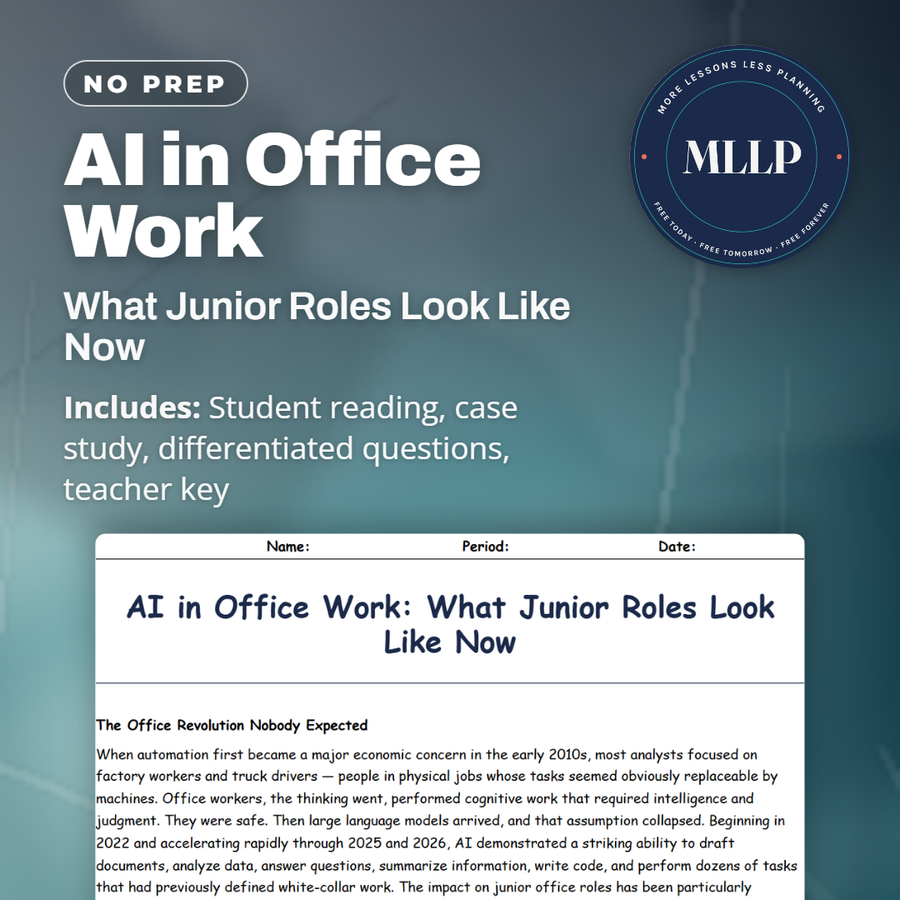
AI in Office Work: What Junior Roles Look Like Now
Quality reviewed September 2026
Facts verified September 20, 2026
- Subject
- Career & Life Skills
- Grades
- Grades 9-12
- Length
- 10-page student worksheet
- Time
- About one 50-minute class period
- Great for
- Sub plans and independent work
- Includes
- Reading passage, comprehension questions + full answer key
- Format
- Print-and-go PDF
What students do
- The reading's efficiency math gets tested, since what used to take three or four analysts a week now takes one
- Explain Sofia's shift from anxious first drafts to directing the AI confidently over her first two months
- Researchers' fear about a coming "junior employee crisis" gets broken down in plain terms
- Answer multiple choice questions on which industries have cut entry-level hiring the fastest
What it covers
- Why one analyst with AI tools now does the work that used to take three or four
- The hiring freeze hitting junior office roles and the "junior employee crisis" it raises
- Sofia's case study on directing AI content instead of writing every draft herself
Start reading this worksheet
The Office Revolution Nobody Expected
When automation first became a major economic concern in the early 2010s, most analysts focused on factory workers and truck drivers, people in physical jobs whose tasks seemed obviously replaceable by machines. Office workers, the thinking went, performed cognitive work that required intelligence and judgment. They were safe. Then large language models arrived, and that assumption collapsed. Beginning in 2022 and accelerating rapidly through 2025 and 2026, AI demonstrated a striking ability to draft documents, analyze data, answer questions, summarize information, write code, and perform dozens of tasks that had previously defined white-collar work. The impact on junior office roles has been particularly significant and, in some ways, surprising. Entry-level white-collar positions (the first jobs that college graduates in business, communications, law, and finance have historically relied on to enter their professions) are precisely the roles where AI performs most impressively. A first-year analyst at a consulting firm, a junior associate at a law firm, or a new marketing coordinator at a company historically spent much of their time doing research, compiling reports, drafting first versions of documents, and summarizing information for senior colleagues. These are exactly the tasks AI handles well.
What Junior Analysts Used to Do, and What AI Does Now
Consider a business analyst whose job involved gathering market research, building financial models in Excel, drafting executive summaries, and presenting findings to managers. In 2019, this might take three or four junior analysts a week working full-time. By 2025, the same work could be completed by one analyst working with AI tools in a fraction of the time. The analyst now spends less time gathering and formatting data and more time interpreting results, checking AI outputs for accuracy, and translating findings into recommendations that require business judgment AI cannot fully provide. The same pattern appears across fields. Junior paralegals who spent hours researching case precedents now use AI legal research tools that return relevant citations in seconds; they must then evaluate whether those citations are accurate and applicable. Junior communications professionals who drafted press releases, social media copy, and internal communications now direct AI tools to produce first drafts and focus their time on editing, brand voice, and strategic judgment. The ratio of time spent on mechanical production versus judgment and review has shifted dramatically.
The Hiring Freeze Problem
This efficiency gain has a significant downside for workers entering the workforce: companies need fewer junior employees than before. If one person with AI tools can do the work that previously required three, employers are hiring one person, or sometimes none, relying on AI tools managed by senior staff. Several major professional services firms, law firms, and media companies announced reduced hiring of entry-level positions in 2023 and 2024, citing AI-driven productivity gains as a contributing factor. This creates what some researchers call the 'junior employee crisis': senior professionals still exist because they developed their expertise over years of doing junior work. But if junior work is automated away, where do the next generation of senior professionals come from? The answer is not yet clear. Some argue that junior roles will evolve rather than disappear; they will focus more on AI management, quality control, and the kind of learning-by-doing that still requires human engagement. Others worry that critical on-the-job learning pathways are being disrupted in ways that will affect professional development for a generation.
Like what you read? The full reading, the case study, and every question set are in the free download below, along with the answer key.
Why this matters
Most of these students are two to four years from applying for exactly the kind of entry-level office job this reading describes, and several major firms have already cut back on hiring for those roles because AI tools make one employee do what three used to. That isn't abstract for a junior in this class. It's the job market they're about to enter. Sofia's story gives students a concrete picture of what a surviving entry-level role actually looks like now, directing and editing AI output instead of producing everything by hand, which is a different skill than the one their older siblings needed. Understanding the "junior employee crisis" the reading names, the worry that automating junior work cuts off the path to becoming a senior professional, helps students think harder about which first jobs are worth taking.
From one teacher to another
Three or four junior analysts used to spend a week building a market report by hand. The reading walks through how one analyst working with AI tools now does the same job in a fraction of the time, and what that means for who gets hired next. Students see how paralegals, marketing coordinators, and business analysts have all shifted from producing first drafts to checking and directing AI output, then hit the harder question: if one person can do the work of three, why would a company hire three new graduates at all? The case study follows Sofia, a new marketing coordinator whose manager hands her an AI content platform on day one and tells her the team used to be three people. By month two, Sofia isn't writing every post from scratch anymore. She's directing the AI and fixing what it gets wrong about her company's voice.
What you get
Download
Where should I send the next one?
Everything here is free and it stays that way. Leave your email and I'll send you the new lessons as they go up. You can unsubscribe from any one of them.
Related resources
AI in Construction and the Skilled Trades
AI in Retail, Food Service, and Hospitality
How to Make Yourself AI-Proof: Skills That Still Matter
Jobs AI Will Change in the Next 10 Years
_COVER.png)
New Jobs That Didn't Exist 5 Years Ago (Prompt Engineer, AI Trainer)
The 2030 Workplace: What Your First Real Job Will Look Like
Every lesson on this site is free to download and use. If one of them saved you a prep period, you can chip in a few bucks toward my three kids' daycare fund. That's genuinely where tips go.