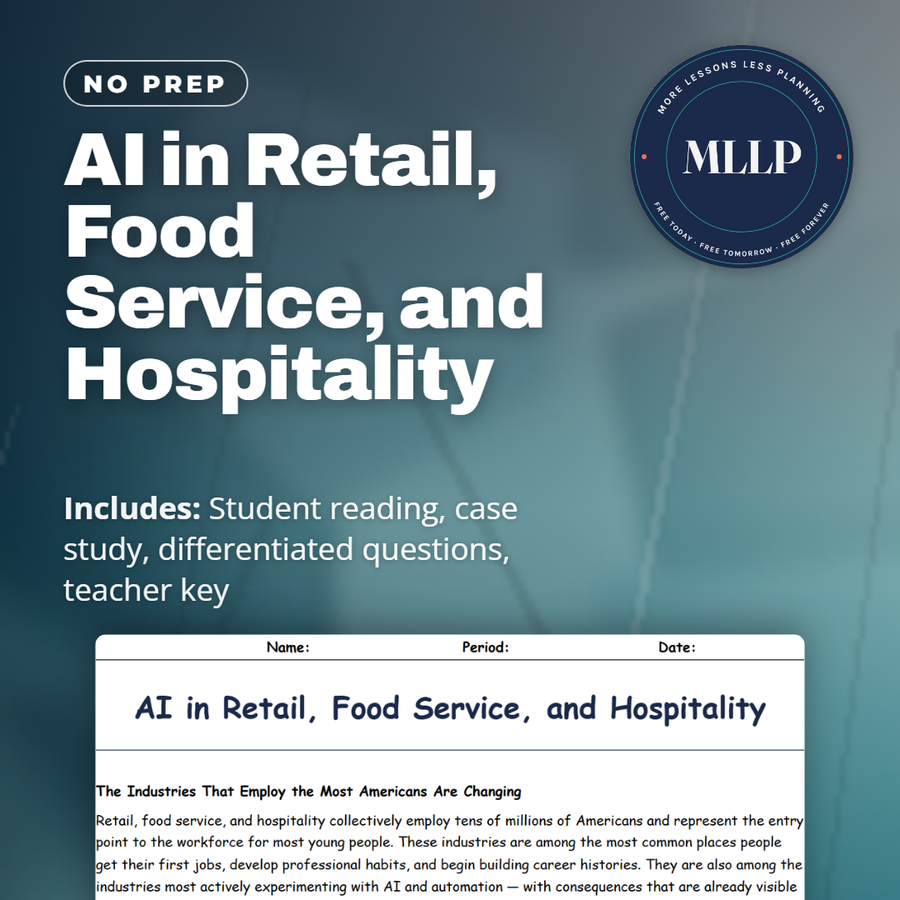
AI in Retail, Food Service, and Hospitality
Quality reviewed September 2026
Facts verified September 20, 2026
- Subject
- Career & Life Skills
- Grades
- Grades 9-12
- Length
- 10-page student worksheet
- Time
- About one 50-minute class period
- Great for
- Sub plans and independent work
- Includes
- Reading passage, comprehension questions + full answer key
- Format
- Print-and-go PDF
What students do
- Flippy the burger-flipping robot and Amazon Go's cashierless stores get compared for what actually worked
- Trace how self-checkout economics work against the labor they're supposed to save
- Tyler's case study explains why his supervisor job is safer than his friends' register jobs
- Write short answers on why Amazon Go's cashierless format never scaled the way headlines predicted
What it covers
- Self-checkout, computer vision inventory, and loss-prevention AI already running in stores
- Flippy the robot cook and why Amazon Go's cashierless format never scaled up
- Tyler's case study on which fast food jobs are safer from automation and why
Start reading this worksheet
The Industries That Employ the Most Americans Are Changing
Retail, food service, and hospitality collectively employ tens of millions of Americans and represent the entry point to the workforce for most young people. These industries are among the most common places people get their first jobs, develop professional habits, and begin building career histories. They are also among the industries most actively experimenting with AI and automation; the consequences are already visible in daily life and will become significantly more pronounced over the next decade. Unlike factory automation, which largely happened in spaces hidden from consumers, AI and automation in retail, food service, and hospitality is happening where customers can see it: self-checkout kiosks replacing cashiers, automated ordering screens replacing servers, robotic arms making food, and AI-powered inventory systems running silently behind the scenes. Understanding what these changes actually mean for workers requires separating hype from reality and looking at which tasks are genuinely being automated and which are proving harder to replace than expected.
Retail: Self-Checkout, Inventory AI, and Cashierless Stores
The most visible AI transformation in retail is the self-checkout kiosk, which has become standard in most major grocery and retail chains over the past decade. From an automation standpoint, self-checkout transfers a cashier's primary function, scanning items and processing payment, to the customer. This has reduced the number of cashier hours needed per transaction, though it has not eliminated cashier jobs entirely: stores still need attendants to handle errors, verify ages for alcohol purchases, and assist confused customers. More significant and less visible is AI's role in inventory management and loss prevention. Computer vision systems scan store shelves and automatically detect when items are running low, generating restocking alerts without human monitoring. AI systems analyze purchase patterns to predict which products will sell when and in what quantities, reducing waste and out-of-stock events. Loss prevention AI uses computer vision to detect shoplifting patterns at a scale no human security team could achieve. Amazon Go stores, which use ceiling-mounted cameras and weight sensors to allow customers to pick up items and walk out without any checkout interaction at all, represent the most extreme current expression of this vision, though the technology has proven expensive and the format has had limited expansion.
Food Service: Robots in the Kitchen and at the Counter
Fast food and fast casual restaurants have been among the most aggressive adopters of automation, driven by rising minimum wages, labor shortages, and the economics of high-volume, standardized food preparation. Flippy, a robotic arm deployed by White Castle and other chains, cooks burgers and fries with consistent results and without the worker safety issues associated with hot oil. Sweetgreen and Chipotle have both experimented with robotic food prep for specific menu items. Automated pizza-making systems, sushi robots, and robot-operated coffee bars have all reached commercial deployment. Front-of-house automation has also expanded. Digital ordering kiosks at McDonald's, Panera, and Shake Shack reduce the need for order-taking staff while capturing more data about customer preferences. Drive-through AI systems now use natural language processing to take orders via voice, with some chains reporting significant accuracy improvements over human order-takers in noisy environments. These technologies have reduced labor needs at the margins (a drive-through that once required two order-takers might now run with one), but full automation of food service remains a distant goal because the physical variation and human interaction required in most restaurant settings is difficult to replicate.
Like what you read? The full reading, the case study, and every question set are in the free download below, along with the answer key.
Why this matters
A huge share of these students will get their first paycheck at a restaurant, retail counter, or hotel front desk, so this reading is describing their own first job market rather than someone else's future. Tyler's situation, watching register jobs shrink while his supervisor role holds steady because it requires judgment a kiosk can't fake, is the exact fork in the road a lot of these students will face within a year or two. The reading's point about building toward supervisory and specialized roles instead of staying in the most routine position is practical advice a sixteen-year-old bagging groceries can actually use this summer. Knowing why Amazon Go's cashierless format never scaled the way headlines predicted also gives students a more grounded sense of how automation actually spreads, slower and messier than the hype suggests.
From one teacher to another
Self-checkout lines are the most visible piece of AI in stores, but the reading spends more time on what customers never see: computer vision systems restocking shelves, loss-prevention cameras spotting shoplifting patterns, and yield-management software changing a hotel room's price by the hour. Students read about Flippy, the robotic arm frying burgers at White Castle, and about Amazon Go's cashierless stores, which turned out too expensive to expand the way early coverage predicted. The reading is honest about the economics too: a self-checkout kiosk that still needs an attendant standing next to it to handle errors isn't always the money-saver it looks like on paper. The case study follows Tyler, a shift supervisor at a fast food restaurant, watching three of his six counter positions disappear through attrition while his own job, the one that requires solving problems, stays put.
What you get
Download
Where should I send the next one?
Everything here is free and it stays that way. Leave your email and I'll send you the new lessons as they go up. You can unsubscribe from any one of them.
Related resources
AI in Construction and the Skilled Trades
AI in Office Work: What Junior Roles Look Like Now
How to Make Yourself AI-Proof: Skills That Still Matter
Jobs AI Will Change in the Next 10 Years
_COVER.png)
New Jobs That Didn't Exist 5 Years Ago (Prompt Engineer, AI Trainer)
The 2030 Workplace: What Your First Real Job Will Look Like
Every lesson on this site is free to download and use. If one of them saved you a prep period, you can chip in a few bucks toward my three kids' daycare fund. That's genuinely where tips go.