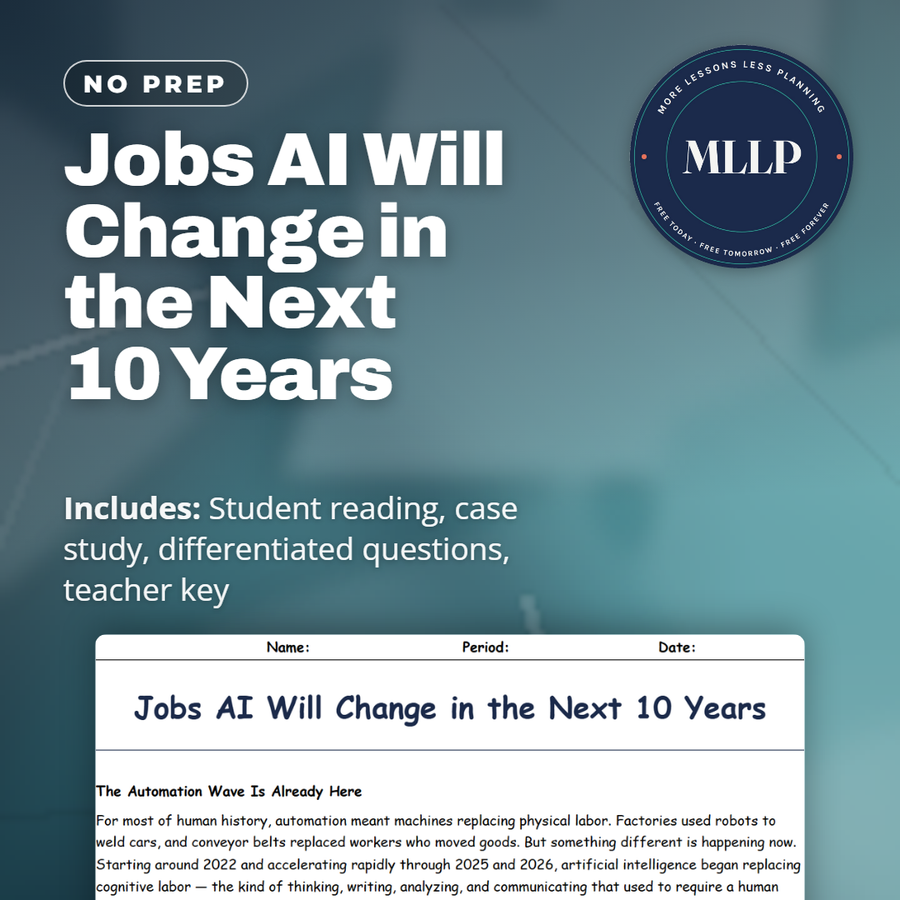
Jobs AI Will Change in the Next 10 Years
Quality reviewed September 2026
Facts verified September 20, 2026
- Subject
- Career & Life Skills
- Grades
- Grades 9-12
- Length
- 9-page student worksheet
- Time
- About one 50-minute class period
- Great for
- Sub plans and independent work
- Includes
- Reading passage, comprehension questions + full answer key
- Format
- Print-and-go PDF
What students do
- McKinsey, Goldman Sachs, and Oxford's competing estimates on job automation get compared side by side
- Explain why routine, information-heavy jobs face more automation risk than physical or judgment-based ones
- Marcus's case study shows why his dad's billing job is changing even without an official layoff
- Fill in blanks naming the percentage of work hours McKinsey says could be automated by 2030
What it covers
- Competing estimates from McKinsey, Goldman Sachs, and Oxford on how many jobs AI will change
- The difference between jobs disappearing and jobs changing shape, with radiologist and paralegal examples
- Marcus's case study on his dad's billing job shrinking to part-time hours
Start reading this worksheet
The Automation Wave Is Already Here
For most of human history, automation meant machines replacing physical labor. Factories used robots to weld cars, and conveyor belts replaced workers who moved goods. But something different is happening now. Starting around 2022 and accelerating rapidly through 2025 and 2026, artificial intelligence began replacing cognitive labor (the kind of thinking, writing, analyzing, and communicating that used to require a human brain). This shift is reshaping the job market faster than almost any economic change in recent memory, and it is touching nearly every industry at once. The consulting firm McKinsey & Company estimated that by 2030, up to 30 percent of hours currently worked in the United States could be automated using technology that already exists today. That does not mean 30 percent of people will lose their jobs immediately, but it does mean that 30 percent of what people do each day at work could be handed off to a machine. The difference matters: most workers will see their jobs change rather than disappear, but the change will be significant and will require new skills.
Which Jobs Are Most at Risk?
Researchers who study automation look at two main factors when predicting which jobs are most vulnerable. The first is routineness: how much of the job involves doing the same task over and over in a predictable way. The second is the degree to which the work involves processing information versus interacting physically with the world. Jobs that score high on both of those factors (routine, information-based work) face the greatest pressure from AI. Data entry clerks, billing specialists, insurance underwriters, loan processors, and bookkeepers are among the roles that economists most frequently flag as highly automatable. A study by researchers at Oxford University identified that about 47 percent of U.S. jobs were at high risk of computerization over a 20-year window, and that estimate was made before the large language model revolution that began in late 2022. More recent analyses suggest the timeline is shortening. Goldman Sachs estimated in 2023 that generative AI alone could disrupt 300 million full-time jobs globally.
Jobs That Are Changing, Not Disappearing
The more nuanced story, and the more accurate one for most workers, is that AI is changing jobs rather than eliminating them outright. A radiologist, for example, still reads medical images. But AI now pre-screens those images and flags the most suspicious areas, which means the radiologist handles a higher volume of cases and focuses attention differently. A paralegal still researches legal questions, but AI tools now draft the first version of a brief or pull relevant case law in seconds, so the paralegal spends more time reviewing and less time searching. This pattern of augmentation, humans working alongside AI rather than being replaced by it, is visible across dozens of fields. Architects use AI to generate preliminary designs. Financial analysts use AI to model scenarios. Customer service representatives handle only the complex or emotional calls that AI cannot resolve. In each case, the human role shifts upward toward judgment, creativity, relationship-building, and oversight: precisely the skills that AI handles least well.
Like what you read? The full reading, the case study, and every question set are in the free download below, along with the answer key.
Why this matters
Every number in this reading, McKinsey's 30 percent, Goldman Sachs' estimate of 300 million jobs disrupted globally, Oxford's earlier 47 percent figure, is the kind of statistic students will hear thrown around without context for the rest of their working lives, so learning what each one actually measures matters more than memorizing it. Marcus watching his dad's hours get cut because of an AI billing system is not a hypothetical for a lot of students in this class. It's already happening in their own households. The reading's core distinction, between jobs that are disappearing and jobs that are changing shape, gives students a more useful lens than the doom-or-hype framing they usually get from social media. That distinction is the one I keep coming back to when students ask me if a specific career is safe.
From one teacher to another
By 2030, McKinsey estimates up to 30 percent of U.S. work hours could be automated with technology that already exists, and this reading spends its five passages unpacking what that number actually means for real jobs. Students see the difference between routine, information-heavy work like data entry and underwriting, which economists flag as most at risk, and jobs built on physical presence or unpredictable judgment, which are holding up better. A radiologist and a paralegal both show up as examples of augmentation rather than replacement: the job changes shape instead of disappearing outright. The case study follows Marcus, whose dad has processed medical billing for twelve years and just watched a new AI system do a week's worth of his team's work in two hours.
What you get
Download
Where should I send the next one?
Everything here is free and it stays that way. Leave your email and I'll send you the new lessons as they go up. You can unsubscribe from any one of them.
Related resources
AI in Construction and the Skilled Trades
AI in Office Work: What Junior Roles Look Like Now
AI in Retail, Food Service, and Hospitality
How to Make Yourself AI-Proof: Skills That Still Matter
_COVER.png)
New Jobs That Didn't Exist 5 Years Ago (Prompt Engineer, AI Trainer)
The 2030 Workplace: What Your First Real Job Will Look Like
Every lesson on this site is free to download and use. If one of them saved you a prep period, you can chip in a few bucks toward my three kids' daycare fund. That's genuinely where tips go.