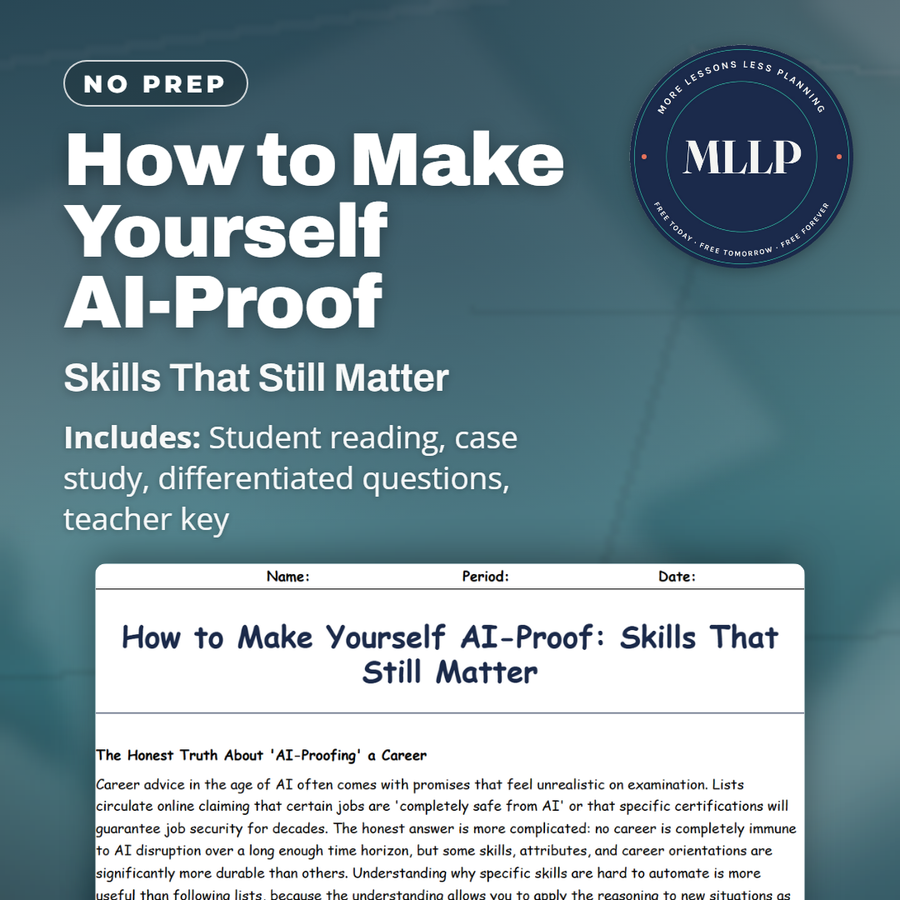
How to Make Yourself AI-Proof: Skills That Still Matter
Quality reviewed September 2026
Facts verified September 20, 2026
- Subject
- Career & Life Skills
- Grades
- Grades 9-12
- Length
- 9-page student worksheet
- Time
- About one 50-minute class period
- Great for
- Sub plans and independent work
- Includes
- Reading passage, comprehension questions + full answer key
- Format
- Print-and-go PDF
What students do
- The four traits behind AI-resistant work, unpredictability, real relationships, ethical judgment, and creative synthesis, get broken down one at a time
- Darnell's case study shows what he means by optimizing for speed instead of judgment
- Match five terms, including tacit knowledge and emotional intelligence, to their definitions
- Write short answers on why AI can simulate empathy but can't replicate genuine trust
What it covers
- Four traits that make a skill hard for AI to replace, from judgment to creative synthesis
- Darnell's case study on an insurance job losing 40 percent of its routine casework to AI
- New AI employment laws and rights, including EEOC guidance and bias-audit requirements
Start reading this worksheet
The Honest Truth About 'AI-Proofing' a Career
Career advice in the age of AI often comes with promises that feel unrealistic on examination. Lists circulate online claiming that certain jobs are 'completely safe from AI' or that specific certifications will guarantee job security for decades. The honest answer is more complicated: no career is completely immune to AI disruption over a long enough time horizon, but some skills, attributes, and career orientations are significantly more durable than others. Understanding why specific skills are hard to automate is more useful than following lists, because the understanding allows you to apply the reasoning to new situations as technology continues to evolve. The skills that have proven most resistant to AI displacement share certain underlying characteristics. They tend to involve unpredictable, variable environments where no two situations are exactly alike. They require genuine interpersonal trust built through ongoing relationships rather than single transactions. They depend on physical presence and embodied dexterity that robots still struggle to match. They involve ethical judgment in genuinely ambiguous situations where rules don't fully specify the right answer. And they require creative synthesis, combining existing ideas in new ways to solve novel problems, rather than retrieving and recombining existing patterns.
Critical Thinking and Complex Problem-Solving
Of all the cognitive skills studied by researchers analyzing AI's limitations, critical thinking and complex problem-solving appear most durably human. This is not because AI cannot perform certain reasoning tasks. Large language models are impressive reasoners in many contexts. It is because real-world problems are embedded in context that AI systems struggle to fully grasp: the organizational politics that affect which solution will actually be implemented, the relationship history between two parties that explains why a technically correct answer will be rejected, the tacit knowledge of how a specific industry actually works that only comes from years of direct experience. Students develop critical thinking by practicing it in conditions of genuine uncertainty: not by answering questions with predetermined correct answers, but by analyzing messy situations where reasonable people disagree, where evidence is incomplete, and where the stakes are real enough to require careful reasoning. Seeking out these situations in school, in work, and in personal life (rather than avoiding them in favor of tasks with clear right answers) is the most reliable way to develop the kind of thinking AI cannot yet replicate.
Interpersonal Skills and Emotional Intelligence
AI can recognize emotional states from text with reasonable accuracy, generate empathetic-sounding responses, and maintain consistent conversational personas. What it cannot do is form genuine relationships that involve mutual trust, shared history, and real stakes on both sides. Human professionals who build genuine long-term relationships with clients, patients, students, or colleagues (where those people come back because of who the professional is, not just what the professional knows) possess a competitive advantage that AI cannot replicate. Emotional intelligence, the ability to understand one's own emotional responses and to read and respond to others' emotional states effectively, has been consistently identified as one of the most AI-resistant professional competencies. In management, client services, healthcare, education, and virtually every field involving human interaction, the capacity to recognize what someone really needs (not just what they say they need), to navigate conflict with care, and to provide genuine support rather than technically correct information is extraordinarily valuable and stubbornly difficult to automate.
Like what you read? The full reading, the case study, and every question set are in the free download below, along with the answer key.
Why this matters
Students hear "develop soft skills" so often that the phrase stops meaning anything, so this reading replaces the vague advice with a specific list: unpredictable situations, genuine relationships, ethical judgment, and creative synthesis are the four things AI still handles badly, and each one is something a student can actually practice this year. Darnell's realization, that he'd been optimizing for speed instead of judgment, is the exact trap a lot of routine-minded students fall into without meaning to. The reading's sharpest line is that the highest-risk workers are not the ones in automatable jobs but the ones who stopped updating their skills, which reframes the whole question from what to major in to what to keep doing.
From one teacher to another
This reading skips the listicle version of career advice, the kind that promises a certain major is "totally safe" from AI, and instead breaks down why certain skills actually resist automation. Students work through four categories: critical thinking in messy, unresolved situations, emotional intelligence and real relationships, original creative synthesis instead of recombined patterns, and adaptability as an ongoing habit rather than a one-time credential. The case study follows Darnell, two years into processing insurance claims, who learns that an AI pilot is about to take over 40 percent of his routine casework. He realizes he's spent two years getting fast at exactly the part of his job a computer can now do, and starts paying closer attention to how his supervisor handles the parts that still need a person.
What you get
Download
Where should I send the next one?
Everything here is free and it stays that way. Leave your email and I'll send you the new lessons as they go up. You can unsubscribe from any one of them.
Related resources
AI in Construction and the Skilled Trades
AI in Office Work: What Junior Roles Look Like Now
AI in Retail, Food Service, and Hospitality
Jobs AI Will Change in the Next 10 Years
_COVER.png)
New Jobs That Didn't Exist 5 Years Ago (Prompt Engineer, AI Trainer)
The 2030 Workplace: What Your First Real Job Will Look Like
Every lesson on this site is free to download and use. If one of them saved you a prep period, you can chip in a few bucks toward my three kids' daycare fund. That's genuinely where tips go.