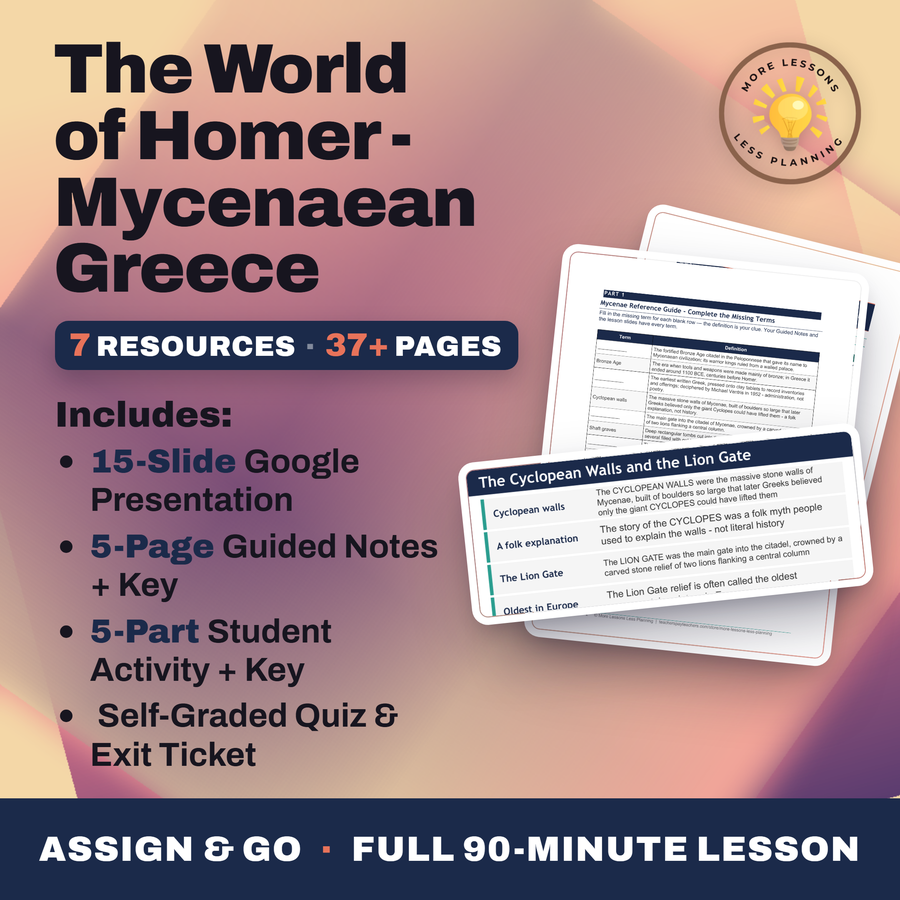
The World of Homer - Mycenaean Greece
Quality reviewed September 2026
- Subject
- World History
- Grades
- Grades 9-12
- Time
- About two 50-minute class periods
- Includes
- 11 ready-to-teach files
- Format
- Word (.docx) · PowerPoint (.pptx)
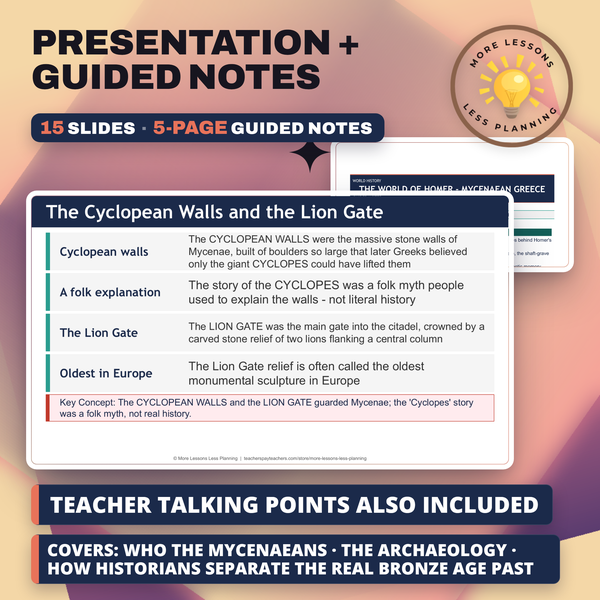
- Slide deck
- Guided notes
- Guided notes teacher key
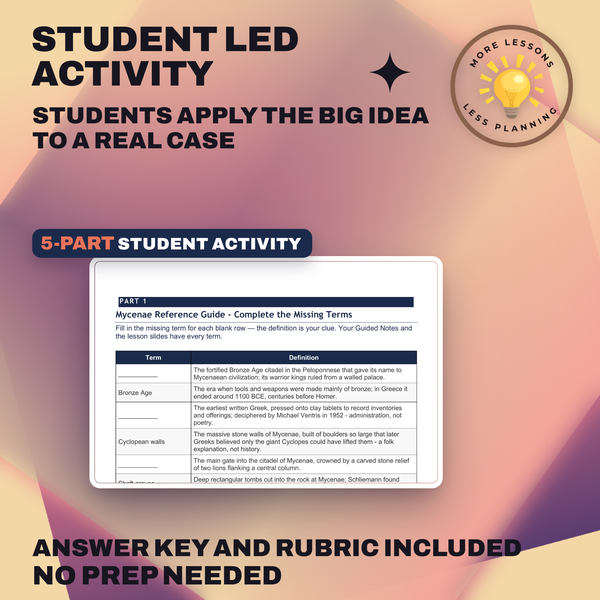
- Activity + answer key
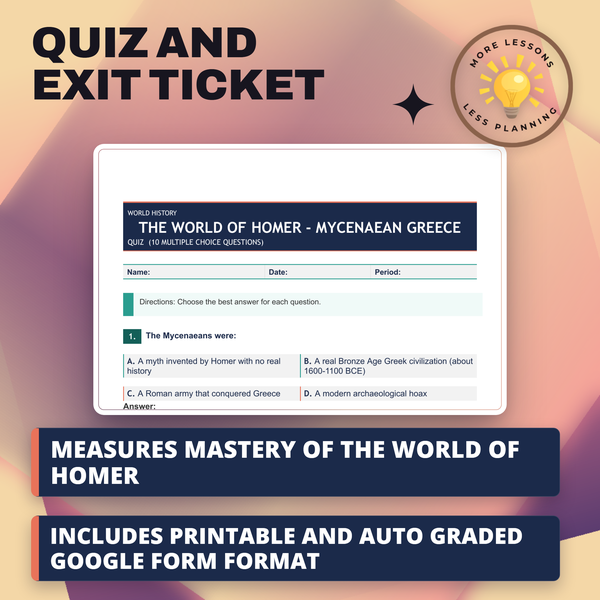
- Quiz + answer key
- Exit ticket + answer key
- Teacher guide
- Teacher presentation notes
What students do
- Explain who the Mycenaeans were and how their real Bronze Age world lies behind Homer's epics
- Describe the Cyclopean walls, the Lion Gate, and the shaft-grave gold at Mycenae
- Analyze what the Linear B tablets do and do not tell us about the Mycenaean world
- Read an excerpt of Pausanias' Description of Greece as a primary source on the ruins
What it covers
- Why the "Mask of Agamemnon" predates any Trojan-War-era king by roughly 300 years
- What Schliemann's 1876 excavation found at Mycenae, and what he got wrong
- How historians separate the real Bronze Age past from Homer's later poetic memory
Learning targets
- Explain who the Mycenaeans were and how their real Bronze Age world lies behind Homer's epics
- Describe the archaeology of Mycenae - the Cyclopean walls and Lion Gate, the shaft-grave gold, and the Linear B tablets - and what each does and does not tell us
- Analyze how historians separate the real Bronze Age past from the later poetic memory preserved in myth
Peek inside
Homer and the Epics
HOMER: the poet credited with the Iliad and the Odyssey
The epics were composed around the 8th century BCE
That is centuries AFTER the Mycenaean world fell
The poems are a distant, poetic memory
1. Who described the ruins of Mycenae in this passage, when did he do it, and how do we know what he saw? Use the source information and the context line above.
Why this matters
Pausanias walked among these ruins and wrote about them centuries before Schliemann picked up a shovel, so visiting Mycenae as a historical site is nothing new. Reading his account puts students in the position of a tourist looking at a past that was already ancient to him too.
Schliemann's 1876 excavation gives students practice separating a real discovery from a flawed interpretation: he found an actual Bronze Age site, walls, gold, a citadel, and still got parts of the story wrong. Holding one person's work as both genuine and mistaken is a harder skill than it sounds.
From one teacher to another
I used to let the Mask of Agamemnon sit on a slide without mentioning it's roughly 300 years too old for any Trojan War king, and this lesson is where I finally correct that. Students spend most of the class with the real Mycenae instead: the walls, the Lion Gate, the shaft graves, and a Linear B tablet that turns out to record inventories, not epics. I want the myth-versus-history habit to start here, before the unit ever reaches Troy.
Every file in this toolkit
Download
Where should I send the next one?
Everything here is free and it stays that way. Leave your email and I'll send you the new lessons as they go up. You can unsubscribe from any one of them.
Related resources

Homer and the Oral Tradition
Monsters of the Mediterranean
Penelope and the Women of the Odyssey
Schliemann Digs Up Troy
The Bronze Age Collapse
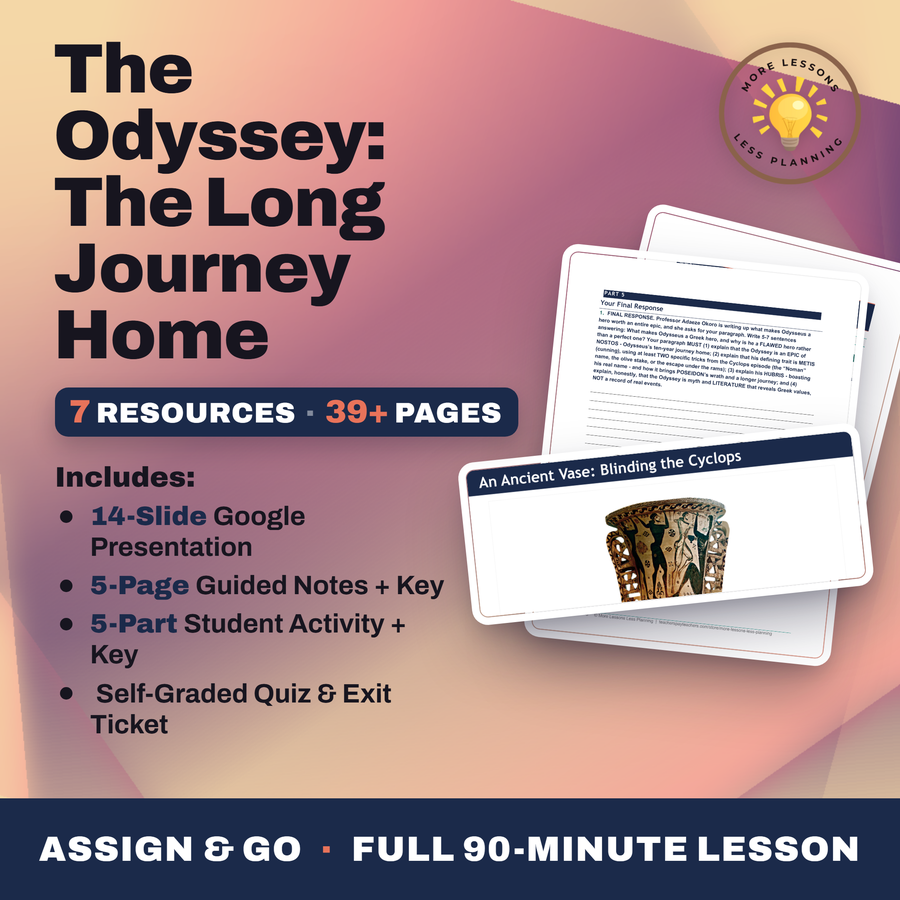
The Odyssey - The Long Journey Home
Every lesson on this site is free to download and use. If one of them saved you a prep period, you can chip in a few bucks toward my three kids' daycare fund. That's genuinely where tips go.