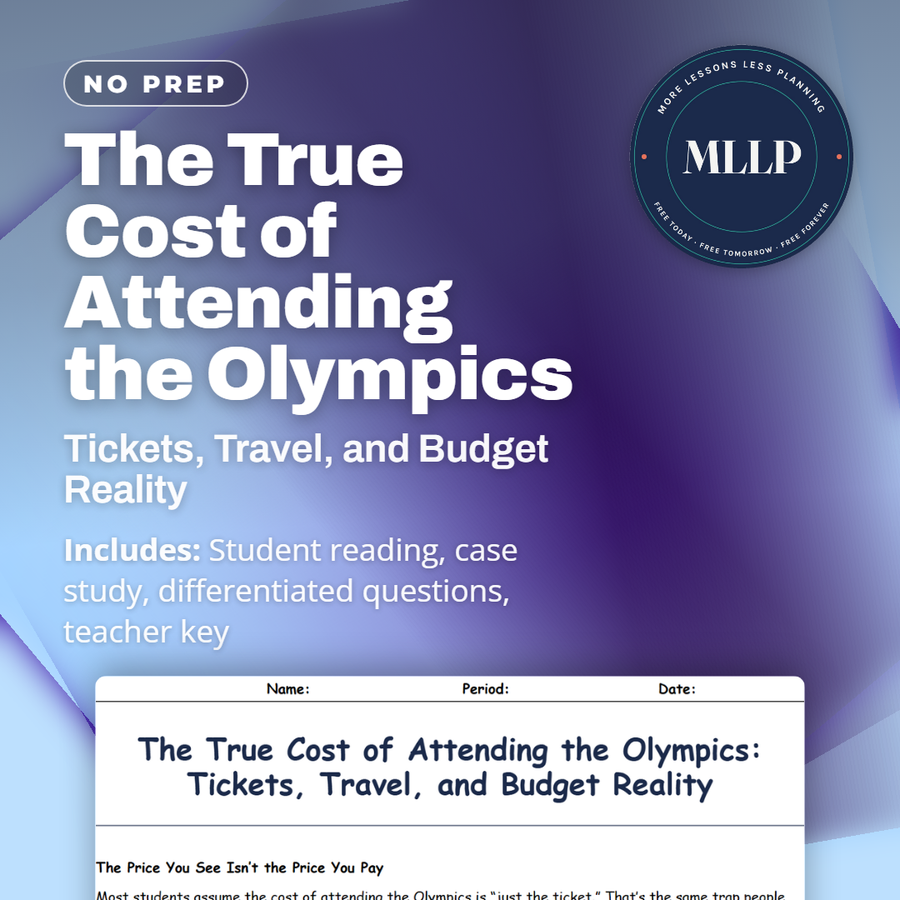
The True Cost of Attending the Olympics: Tickets, Travel, and Budget Reality
Quality reviewed September 2026
Facts verified September 9, 2026
- Subject
- Career & Life Skills
- Grades
- Grades 9-12
- Length
- 9-page student worksheet
- Time
- About one 50-minute class period
- Great for
- Sub plans and independent work
- Includes
- Reading passage, comprehension questions + full answer key
- Format
- Print-and-go PDF
What students do
- Distinguish between fixed costs and variable costs in event travel
- Calculate true trip expenses once fees, taxes, and surge pricing are included
- Evaluate opportunity cost when choosing between dream events and lower-cost sessions
- Design a realistic 3-bucket budget that protects both experience and financial health
What it covers
- Dynamic pricing and demand surge
- Opportunity cost in travel planning
- Budget buffers and hidden expenses
Start reading this worksheet
The Price You See Isn’t the Price You Pay
Most students assume the cost of attending the Olympics is “just the ticket.” That’s the same trap people fall into with concerts, theme parks, and big trips. There’s a headline price, and then there’s the real total once everything else is added. The Olympics are a perfect example because demand is intense, dates are fixed, and host cities get crowded fast. That combination creates scarcity, which pushes prices up across an entire region. Even if you find a ticket that looks reasonable, you still have to deal with flights or long-distance travel, lodging, food, local transportation, and all the “small” expenses that pile up. A big reason costs spike is demand surge. When thousands of visitors arrive at the same time, hotels raise rates, rideshare prices climb, and restaurants may increase prices or add special-event fees. Some costs also change because of dynamic pricing: prices that rise when demand rises. Ticket sellers, airlines, and hotels often use it. It’s not always unfair; it’s a business strategy. But it does mean you can’t budget by guessing. You need a plan. Another hidden factor is timing. When you buy matters. Flights often become more expensive as the date gets closer, especially when travel dates are limited (you can’t just “go next month” because the Games are on a schedule). Ticket options also vary: some are premium, some are cheaper, and many have restrictions. Students are surprised by how many costs are “fees,” not “prices”: service fees, processing fees, resort fees, baggage fees, transit passes, and taxes. Those can turn a decent plan into an overspent plan quickly. If you take one lesson from this reading, it’s this: attending the Olympics isn’t only a sports decision. It’s a budgeting and decision-making challenge.
Tickets and Pricing: Why Two People Pay Different Amounts
Olympic tickets are a classic example of price discrimination, which sounds negative but simply means the same event can be sold at different price levels to different buyers. Seats closer to the action cost more. Session timing matters (finals are more expensive than early rounds). Venue popularity matters (a gold medal hockey game is not priced like a preliminary curling match). Even location matters, because events with limited seating create higher competition for tickets. Ticket pricing is also shaped by the “once-in-a-lifetime” mindset. People are willing to pay more because they don’t want to miss the experience. That increases demand and encourages sellers to offer premium packages. Some tickets are sold as bundles with hospitality or guaranteed seating. Those can be great for convenience, but they can also inflate costs dramatically. Students often think bundles “save money,” but many bundles mainly save time and stress, not dollars. Another important issue is risk. Some tickets are non-refundable or have strict transfer rules. Buyers need to read the refund policy and transfer terms carefully. When you’re building a budget, a risky purchase (non-refundable) needs a stronger plan, not a weaker one. If you gamble on a cheap flight with strict restrictions, a schedule change can become expensive later. Finally, a realistic Olympic budget includes priorities. Most people can’t attend every event. That means choosing what matters most: one dream event and a few lower-cost sessions, or multiple cheaper events with less “headline” excitement. This is where opportunity cost becomes real. If you spend $400 more for one premium event, what are you giving up: another event, a better hotel, or extra meals and transit? That tradeoff isn’t just math. It’s values.
Travel and Lodging: The Budget Breakers
For most people, the biggest cost looks like the ticket, but it is really travel and lodging. Flights during Olympic weeks tend to rise because travel dates are concentrated. Airlines know people are locked into specific timing, and that reduces flexibility. Even driving can get expensive because of fuel, parking, tolls, and the cost of time. Travel isn’t only money; it’s energy and scheduling, too. Lodging is often the biggest “budget breaker” because hotels and rentals adjust prices when cities are crowded. Some hosts also require minimum stays (for example, a 5-night minimum), which forces visitors to pay for nights they might not otherwise choose. On top of that, there can be cleaning fees, resort fees, and deposits. Students are often shocked that “$180 per night” can become $260 per night once all fees are included. This is also where geography matters. Staying near venues is convenient but expensive. Staying farther away can lower lodging costs but raise transportation costs and time. A smart plan compares the total: lodging + transit + time. A cheap place that requires two long commutes per day can turn into a miserable, expensive experience once you add rideshares or train tickets. International travel adds another layer: the exchange rate. When your currency is weaker, everything feels more expensive. Even small changes in exchange rates can make a noticeable difference for food and transit over several days. Add travel insurance and emergency planning, and costs rise further. Insurance isn’t required, but it reduces risk, especially for expensive trips with strict refund rules. The Olympics can be an incredible experience, but financially it rewards planning. The best budgets don’t assume everything will go perfectly. They include a buffer.
Like what you read? The full reading, the case study, and every question set are in the free download below, along with the answer key.
Why this matters
Jordan's story starts with a number that feels like the whole answer: a $200 ticket to the trip of a lifetime. It stops feeling like enough once flights lock to one date, lodging requires a mandatory stay, and rideshare prices surge right when everyone needs a ride.
The reading teaches the difference between tracking a price and tracking a total, which only lands once students build a 3-bucket budget and face Jordan's choice: one dream event, or two cheaper sessions for close to the same money. Framing it as a trade-off keeps them from giving up.
From one teacher to another
Jordan's story gives this one teeth. Most students think "if I find a $200 ticket, I can afford the trip," which is wrong. Once you add flights locked to one date, lodging with mandatory stays, rideshare during peak demand, and all the fees nobody mentions upfront, the real cost shocks them. The worksheet pushes them to track totals instead of prices, and to make actual tradeoffs. One dream event or two cheaper sessions, pick one.
What you get
Download
Where should I send the next one?
Everything here is free and it stays that way. Leave your email and I'll send you the new lessons as they go up. You can unsubscribe from any one of them.
Related resources
Altitude, Cold Stress, and Human Adaptation: How the Body Stays in Balance
Blueprint of Power: Muscles and Joints That Make Winter Sports Work
Doping Investigations: How Forensic Science Protects Sport Integrity

Gold Medals Need Geography: Why Some Places Can Host and Others Can’t
Luge and Skeleton: Extreme Speed, Risk Variables, and Safety Engineering
Nations, Boycotts, and Global Messages: When the Olympics Become Diplomacy
Every lesson on this site is free to download and use. If one of them saved you a prep period, you can chip in a few bucks toward my three kids' daycare fund. That's genuinely where tips go.