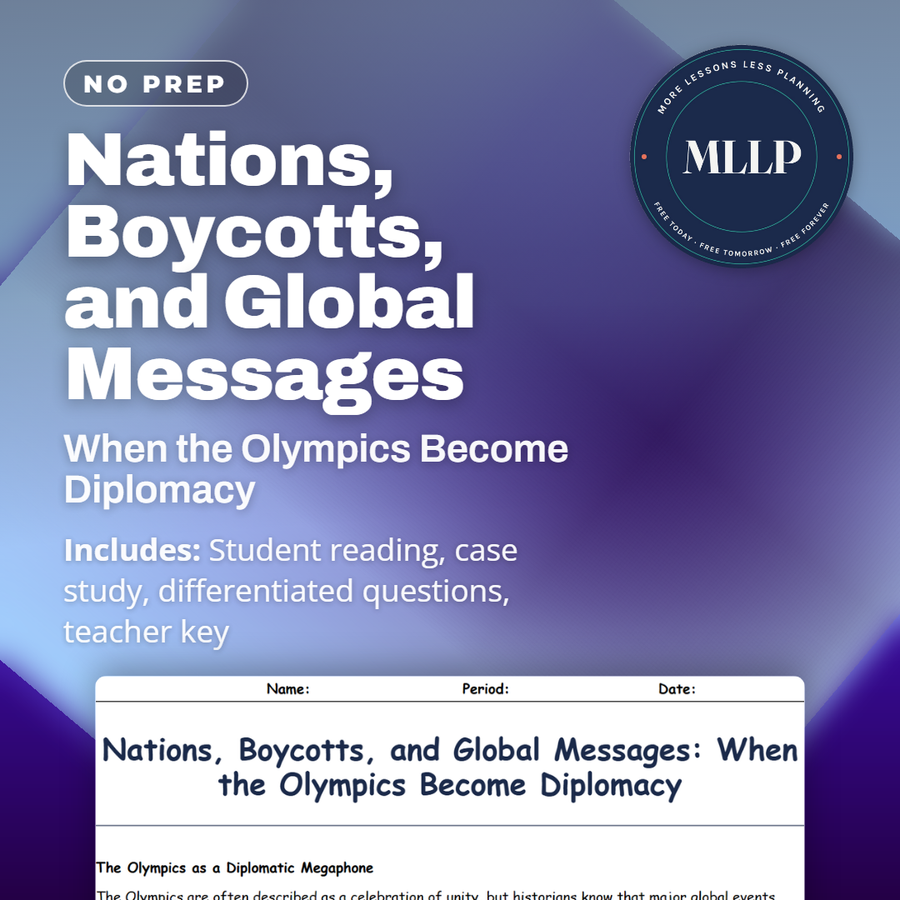
Nations, Boycotts, and Global Messages: When the Olympics Become Diplomacy
Quality reviewed September 2026
Facts verified September 9, 2026
- Subject
- Social Studies
- Grades
- Grades 9-12
- Length
- 8-page student worksheet
- Time
- About one 50-minute class period
- Great for
- Sub plans and independent work
- Includes
- Reading passage, comprehension questions + full answer key
- Format
- Print-and-go PDF
What students do
- Analyze how host nations use ceremonies and hosting for soft power
- Compare full boycotts vs diplomatic boycotts as political tools
- Evaluate tradeoffs between symbolism and practical impact
- Examine how legitimacy claims shape Olympic hosting narratives
What it covers
- Public diplomacy and soft power
- Boycotts and international relations
- Legitimacy and human rights debate
Start reading this worksheet
The Olympics as a Diplomatic Megaphone
The Olympics are often described as a celebration of unity, but historians know that major global events rarely stay “just sports.” The Games put countries on a bright stage, where symbols matter: flags, anthems, uniforms, and opening ceremonies. That visibility turns the Olympics into a form of public diplomacy, meaning governments use the event to shape how the world sees them. Hosting can signal stability, modernization, and national pride. Winning medals can signal investment, discipline, and national strength. Even the way a country welcomes visitors (transportation, security, media access) can send a message about competence and power. This doesn’t mean athletes compete with political goals in mind. Most athletes are focused on training, performance, and representing themselves well. But the international setting means their performances get interpreted through a national lens anyway. That interpretation is intensified by global media. A single image, such as an athlete crying during an anthem, a protest sign in the stands, or a controversial ceremony moment, can circulate worldwide within minutes. The Olympics become a giant storytelling engine, and nations care deeply about the stories being told. In world history, leaders have long used spectacle to communicate legitimacy. Ancient rulers staged parades and games to show strength. Modern states use mega-events. The Olympics are especially powerful because they feel “official” and global. Being chosen to host can be framed as recognition by the international community. That’s why countries compete fiercely to host, even when the costs and controversies are real. The Olympics offer something governments crave: attention that feels positive, orderly, and celebrated. And when that attention turns critical, the reaction can be intense, because the stakes aren’t only medals. They’re reputation.
Boycotts: Loud Silence and Quiet Participation
When countries disagree with a host nation’s actions, they have options: formal protests, sanctions, speeches at international organizations, and, sometimes, Olympic boycotts. A boycott is a political strategy designed to communicate, “We do not support what is happening,” while using the Olympics’ visibility to amplify the message. Historically, full boycotts, where countries refuse to send athletes, have been dramatic but also controversial, because they often punish athletes who trained for years. Over time, a newer approach has become more common: the diplomatic boycott, where a country sends athletes but does not send official government representatives to ceremonies and high-profile events. It’s meant to show disapproval while avoiding direct harm to athletes. A diplomatic boycott can look small (just an empty seat in the VIP section), but symbolism matters. Diplomatic presence is not only about watching sport; it’s about recognition and status. When officials stay away, they reduce the host’s ability to claim “everyone supports us.” At the same time, the strategy is limited. The Games still occur. The cameras still roll. The host still gets global attention. That’s why historians evaluate boycotts as messages, not guaranteed solutions. Boycotts also raise a key question in world history: does a symbolic action create real change, or does it simply help participants feel morally clear? Sometimes symbolism can pressure leaders by shaping public opinion. Sometimes it becomes background noise. Either way, it tells us what countries want to be seen doing.
Like what you read? The full reading, the case study, and every question set are in the free download below, along with the answer key.
Why this matters
How can a boycott matter if the athletes still show up and compete? That question sits at the center of a diplomatic boycott, where governments refuse to send officials but let athletes go anyway. Beijing 2022 turned that question into a real test, when countries announced they would skip official delegations without asking a single athlete to sit out.
There is no clean answer for whether that kind of protest works, and the reading refuses to hand students one. Weighing a symbolic gesture against its practical effect forces them to hold two ideas at once: a boycott can carry real meaning as a message, and still change nothing about who wins a medal that week.
From one teacher to another
The Olympics sit at the intersection of sport and politics in ways my students don't expect. A diplomatic boycott, where officials stay away but athletes compete, looks small until you understand it as a messaging tool. The worksheet walks through Beijing 2022, where countries announced they wouldn't send government delegations, and asks students to evaluate whether that move created real change or performative protest. By examining how symbolism functions in international relations, they see how mega-events become stages for competing narratives about values and power.
What you get
Download
Where should I send the next one?
Everything here is free and it stays that way. Leave your email and I'll send you the new lessons as they go up. You can unsubscribe from any one of them.
Related resources
Altitude, Cold Stress, and Human Adaptation: How the Body Stays in Balance
Blueprint of Power: Muscles and Joints That Make Winter Sports Work

Doping Investigations: How Forensic Science Protects Sport Integrity

Gold Medals Need Geography: Why Some Places Can Host and Others Can’t
Luge and Skeleton: Extreme Speed, Risk Variables, and Safety Engineering

Opening Ceremonies: The Night the Olympics Become a Global Story
Every lesson on this site is free to download and use. If one of them saved you a prep period, you can chip in a few bucks toward my three kids' daycare fund. That's genuinely where tips go.