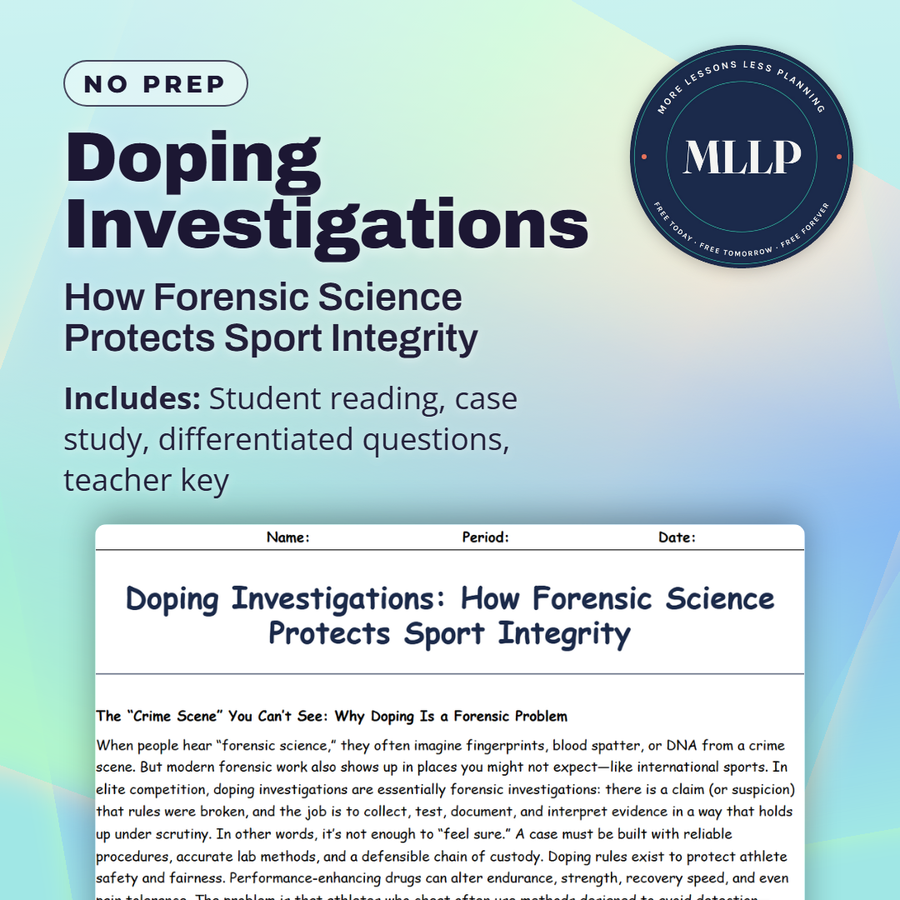
Doping Investigations: How Forensic Science Protects Sport Integrity
Quality reviewed September 2026
Facts verified September 9, 2026
- Subject
- Science
- Grades
- Grades 9-12
- Length
- 8-page student worksheet
- Time
- About one 50-minute class period
- Great for
- Sub plans and independent work
- Includes
- Reading passage, comprehension questions + full answer key
- Format
- Print-and-go PDF
What students do
- Explain why chain of custody protects investigations from contamination claims
- Analyze how the A and B sample system reduces false positives and appeals
- Describe how lab validation and quality controls ensure reliable results
- Evaluate why retesting stored samples changes the incentives for cheating
What it covers
- Chain of custody and evidence handling
- Forensic lab methods and validation
- Sample confirmation and retesting
Start reading this worksheet
The “Crime Scene” You Can’t See: Why Doping Is a Forensic Problem
When people hear “forensic science,” they often imagine fingerprints, blood spatter, or DNA from a crime scene. But modern forensic work also shows up in places you might not expect, such as international sports. In elite competition, doping investigations are essentially forensic investigations: there is a claim (or suspicion) that rules were broken, and the job is to collect, test, document, and interpret evidence in a way that holds up under scrutiny. In other words, it’s not enough to “feel sure.” A case must be built with reliable procedures, accurate lab methods, and a defensible chain of custody. Doping rules exist to protect athlete safety and fairness. Performance-enhancing drugs can alter endurance, strength, recovery speed, and even pain tolerance. The problem is that athletes who cheat often use methods designed to avoid detection. These methods include micro-dosing, masking agents, timing cycles, or using substances that leave the body quickly. That means anti-doping work is a constant scientific race between new methods of cheating and improved detection. Forensics is also about avoiding false accusations. A positive test can end careers, destroy reputations, and affect mental health. That’s why investigations must be evidence-based and consistent. A good doping case must answer three big questions: Was the substance present? Was the sample correctly linked to the athlete? Were lab methods valid and properly interpreted? If any of those links break, the case becomes questionable. In high-stakes sport, evidence has to be strong enough to survive appeals, public scrutiny, and legal challenges.
Chain of Custody: The Most Boring Step That Saves the Whole Case
If a sample is mishandled, even perfect lab testing can become meaningless. That’s why chain of custody is central. Chain of custody is the documented record showing who collected the sample, when it was collected, how it was sealed, how it was transported, who stored it, and who tested it. Each handoff must be recorded. Each seal must be intact. Each storage condition must match protocol. Think of it as evidence “receipts” from start to finish. In doping control, samples are often split into an A sample and B sample. The A sample is tested first. If it is positive, the athlete can request that the B sample be tested to confirm results. This reduces the chance that one error ruins the outcome. Forensic thinking also includes contamination risk. Could the sample have been exposed to another substance? Could labeling errors have occurred? Could storage conditions have degraded the sample and produced misleading results? These questions are not excuses. They’re necessary checks. Doping control is also designed to protect privacy and fairness. Athletes have identification procedures, witness rules, and documented time windows. The goal is to prevent tampering and reduce ambiguity. That’s why the collection environment can feel strict: it has to be strict. In a legal or disciplinary setting, strict procedure is how you protect the integrity of results. From a student perspective, this is a key lesson: forensic science isn’t only “the test.” It’s the system that makes the test meaningful.
Lab Methods: How Substances Are Detected and Confirmed
Most anti-doping labs use highly sensitive analytical techniques to identify banned substances or their metabolites (breakdown products). Methods often involve separating chemicals, identifying molecular signatures, and comparing them to reference standards. Two core ideas matter for students: sensitivity (finding tiny amounts) and specificity (correctly identifying what the substance is, not confusing it with something else). A test can be very sensitive but not specific enough, which can lead to false positives. The strongest lab work uses confirmatory methods and strict quality controls. Reliability also depends on calibration and controls. Labs run known samples to ensure instruments are functioning correctly. They follow standardized methods that have been validated. In forensic terms, validation means you have evidence that the method produces accurate results under known conditions, with known error rates. That matters because doping cases can go to arbitration, and the science must be explainable. Another reality is that rules are updated as science evolves. New substances appear, and detection methods improve. Some investigations also involve longitudinal tracking. This method compares an athlete’s biological data over time to detect unusual patterns. That doesn’t prove “what substance,” but it can signal manipulation. Forensics often works like that: sometimes you don’t find the “smoking gun” first. You find the pattern that points you to deeper testing.
Like what you read? The full reading, the case study, and every question set are in the free download below, along with the answer key.
Why this matters
A sealed sample sitting in a lab freezer for years only means something if every step that touched it got written down. Intact seals, matching identifiers, and calibration records are what let a retesting case hold up long after the fact, and the A and B sample system exists to keep one bad reading from ending a career.
What surprises my students most is how much of an investigation is paperwork, not chemistry. An athlete can claim contamination or a mislabeled vial, but documentation either holds up under appeal or it doesn't, and there is no argument against a broken chain of custody. That is the lesson I want them to take: boring procedures win in high stakes work.
From one teacher to another
This one matters because students often think forensic science is just running a test. But the retesting case shows how procedure is everything. Intact seals, matching identifiers, instrument calibration records. That's what makes a result defensible. The athlete can argue contamination or mislabeling all day, but the documentation tells a story that holds up under appeal. It's a lesson in why boring procedures win in high-stakes work.
What you get
Download
Where should I send the next one?
Everything here is free and it stays that way. Leave your email and I'll send you the new lessons as they go up. You can unsubscribe from any one of them.
Related resources
Altitude, Cold Stress, and Human Adaptation: How the Body Stays in Balance

Blueprint of Power: Muscles and Joints That Make Winter Sports Work

Gold Medals Need Geography: Why Some Places Can Host and Others Can’t
Luge and Skeleton: Extreme Speed, Risk Variables, and Safety Engineering
Nations, Boycotts, and Global Messages: When the Olympics Become Diplomacy

Opening Ceremonies: The Night the Olympics Become a Global Story
Every lesson on this site is free to download and use. If one of them saved you a prep period, you can chip in a few bucks toward my three kids' daycare fund. That's genuinely where tips go.