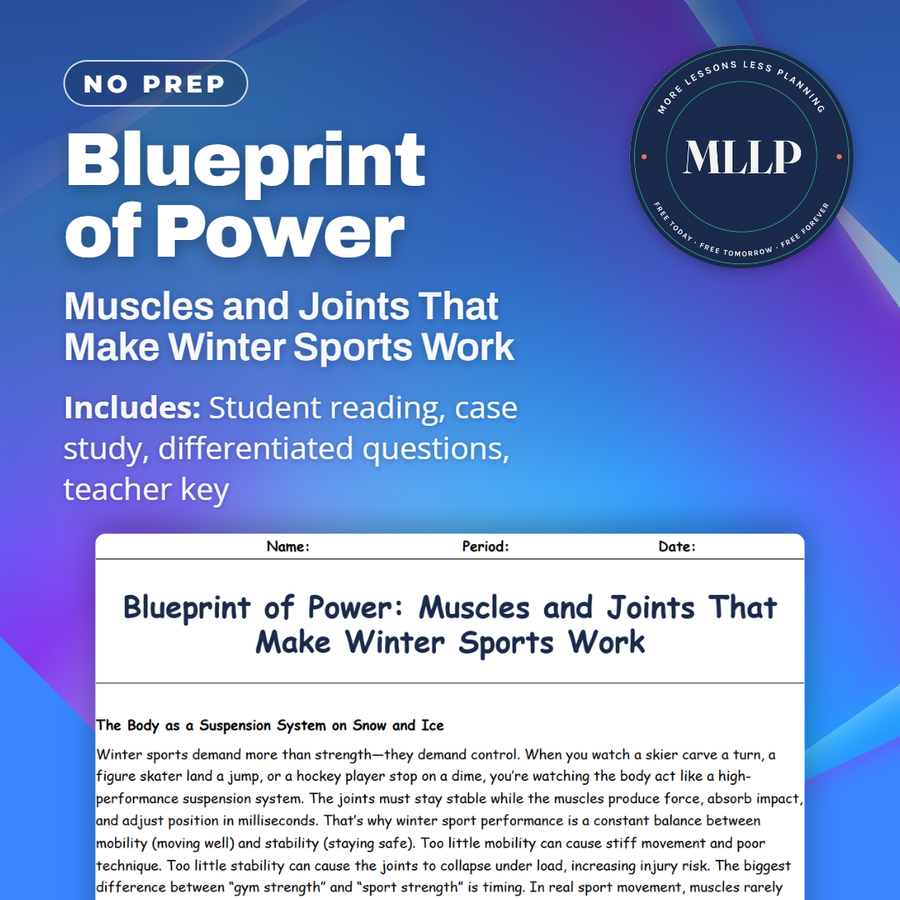
Blueprint of Power: Muscles and Joints That Make Winter Sports Work
Quality reviewed September 2026
Facts verified September 9, 2026
- Subject
- Science
- Grades
- Grades 9-12
- Length
- 8-page student worksheet
- Time
- About one 50-minute class period
- Great for
- Sub plans and independent work
- Includes
- Reading passage, comprehension questions + full answer key
- Format
- Print-and-go PDF
What students do
- Analyze how inward knee collapse increases ACL strain during landings
- Explain why hip stabilizers matter more than just leg strength
- Describe how core control transfers force and prevents injury
- Evaluate why technique training counts as injury prevention as much as performance training
What it covers
- Knee alignment and ligament safety
- Hip power and core stability
- Landing mechanics and force absorption
Start reading this worksheet
The Body as a Suspension System on Snow and Ice
Winter sports demand more than strength. They demand control. When you watch a skier carve a turn, a figure skater land a jump, or a hockey player stop on a dime, you’re watching the body act like a high-performance suspension system. The joints must stay stable while the muscles produce force, absorb impact, and adjust position in milliseconds. That’s why winter sport performance is a constant balance between mobility (moving well) and stability (staying safe). Too little mobility can cause stiff movement and poor technique. Too little stability can cause the joints to collapse under load, increasing injury risk. The biggest difference between “gym strength” and “sport strength” is timing. In real sport movement, muscles rarely work one at a time. They work in coordinated chains. A strong core helps transfer power from legs to upper body without leaking energy. Strong hips help control knee alignment. Strong ankles help the body respond to uneven ice or changing snow texture. When a skier hits a bump or a skater lands slightly off-axis, the body has to correct quickly. That correction depends on proprioception, the body’s sense of position and movement. It is trained through repetition, balance work, and sport-specific drills. Winter sports also challenge the body with cold and equipment. Boots, skates, and bindings can limit foot motion, shifting workload upward to the knees and hips. Heavy protective gear can change movement mechanics. The result is that athletes need strength where it matters most: hips, core, and stabilizers, especially the muscles that prevent dangerous twisting at the knee. Athletes don’t get injured simply because they’re “weak.” They get injured when force overwhelms control.
Knee Stability: Why the ACL Is Always in the Conversation
The knee is powerful but vulnerable because it sits between two big levers: the femur (thigh bone) and tibia (shin bone). It’s built for bending and straightening, but winter sports often force it into rotation, side-loading, and sudden deceleration. That’s where ligaments become crucial. The ACL (anterior cruciate ligament) helps stabilize forward movement and rotation of the tibia. In skiing, a sudden edge catch can twist the knee while the ski keeps moving. In hockey, a rapid stop or awkward collision can shift the knee into a risky alignment. In figure skating, a landing with inward knee collapse can spike stress through the joint. A key injury-prevention concept is alignment: when the knee collapses inward (often called knee valgus), the ACL is placed under more strain, especially if the athlete is landing, cutting, or rotating. That’s why strong hips matter so much. The gluteus medius and other hip stabilizers help keep the knee tracking over the toes. When those muscles fatigue or aren’t trained, the body “cheats” into unstable positions. Strength training helps, but technique training is equally important. Athletes need to practice “soft landings” with hips back, knees aligned, and core engaged. They also need single-leg stability, because many winter movements are essentially single-leg actions: one skate push, one ski edge, one-foot landing. Coaches often teach athletes to “own the position” before adding speed or tricks. That’s not being cautious; that’s building a foundation that protects ligaments when the sport gets chaotic.
Hip Power and Core Control: The Engine Behind Clean Technique
If the knee is the vulnerable link, the hips are the engine. Powerful winter athletes generate force from the hips and transfer it through a stable trunk. In skiing, hip power drives strong turns and controls edging. In speed skating, hip extension creates propulsion. In hockey, the hips power acceleration and lateral movement. In jumping sports, the hips help produce lift and also manage landings. When athletes rely too much on the knee instead of the hip, movement becomes less efficient and more stressful on the joint. The core is not just “abs.” The core includes deep muscles that stabilize the spine and pelvis, like the transverse abdominis and multifidus, plus bigger movers like the obliques. A stable trunk helps athletes keep balance when forces shift. Think about a skier absorbing bumps: the legs are moving constantly, but the torso remains controlled. That control allows precise movement rather than flailing. In figure skating, trunk control helps maintain rotation and alignment. In hockey, it keeps the athlete stable while battling along the boards. Core control also protects the back. Many winter athletes experience low-back irritation from repeated flexion, rotation, or bracing through the trunk. Strong, well-trained core muscles help distribute stress and reduce overload. The goal isn’t to become stiff; it’s to become stable enough to move freely. When the core is stable, the limbs can be powerful without throwing the athlete off balance.
Like what you read? The full reading, the case study, and every question set are in the free download below, along with the answer key.
Why this matters
Good landing technique looks like a strength issue from the stands, but slow the video down and it's a stability issue instead: knees caving inward under load raise ACL strain long before an athlete feels weak. Hips, not just quads and hamstrings, are what keep that collapse from happening.
Students assume the fix for a bad landing is more leg strength, so tracing the case study frame by frame changes the diagnosis: the coach doesn't call the athlete weak, she points to hip alignment, and the landings get quieter once force travels through the joint built to absorb it.
From one teacher to another
I pull this one out when we talk about why good form is literally protective. Tessa lands her tricks clean on video, but in slow motion her knees cave inward because her hips aren't doing the work. Her coach does not call her weak. She shows her the alignment issue and builds a plan. Within weeks, Tessa's landings are quieter and faster because the force flows through the right joints instead of stressing the wrong ones. It's a perfect example of how anatomy and mechanics combine.
What you get
Download
Where should I send the next one?
Everything here is free and it stays that way. Leave your email and I'll send you the new lessons as they go up. You can unsubscribe from any one of them.
Related resources
Altitude, Cold Stress, and Human Adaptation: How the Body Stays in Balance

Doping Investigations: How Forensic Science Protects Sport Integrity

Gold Medals Need Geography: Why Some Places Can Host and Others Can’t
Luge and Skeleton: Extreme Speed, Risk Variables, and Safety Engineering

Nations, Boycotts, and Global Messages: When the Olympics Become Diplomacy

Opening Ceremonies: The Night the Olympics Become a Global Story
Every lesson on this site is free to download and use. If one of them saved you a prep period, you can chip in a few bucks toward my three kids' daycare fund. That's genuinely where tips go.