
The Trojan War - Myth vs. History
Quality reviewed September 2026
- Subject
- World History
- Grades
- Grades 9-12
- Time
- About two 50-minute class periods
- Includes
- 11 ready-to-teach files
- Format
- Word (.docx) · PowerPoint (.pptx)
- Slide deck
- Guided notes
- Guided notes teacher key
- Activity + answer key
- Quiz + answer key
- Exit ticket + answer key
- Teacher guide
- Teacher presentation notes
What students do
- Weigh whether the Trojan War of Homer's epics really happened, using evidence rather than a verdict
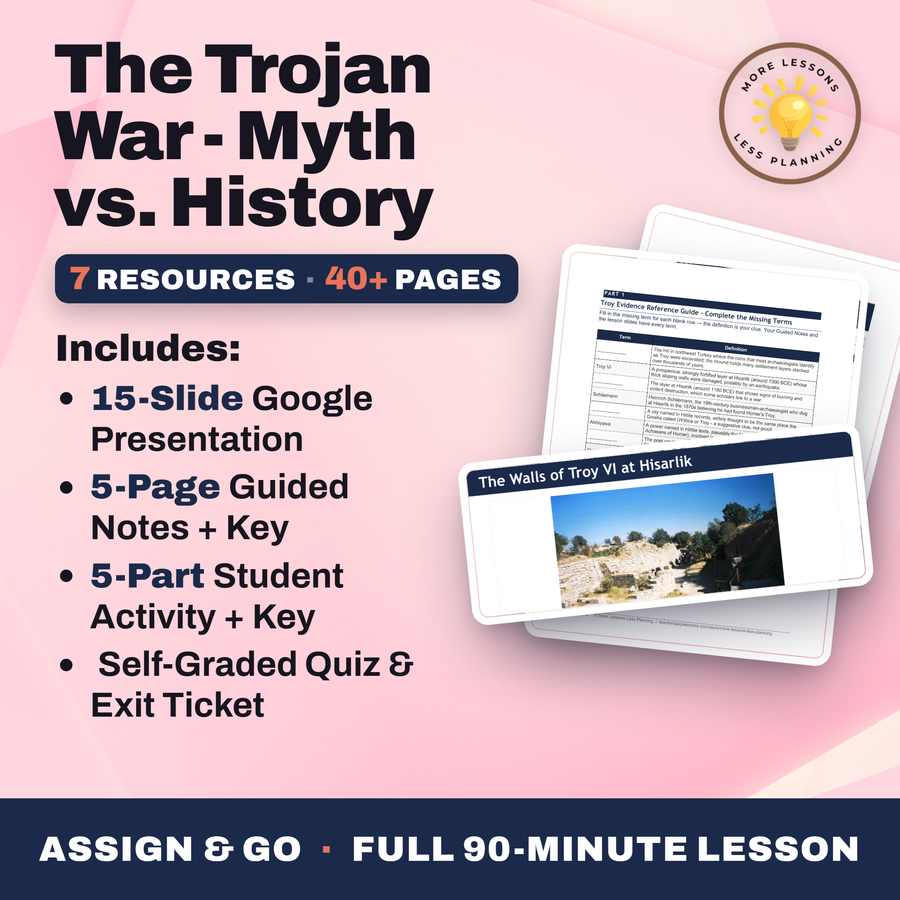
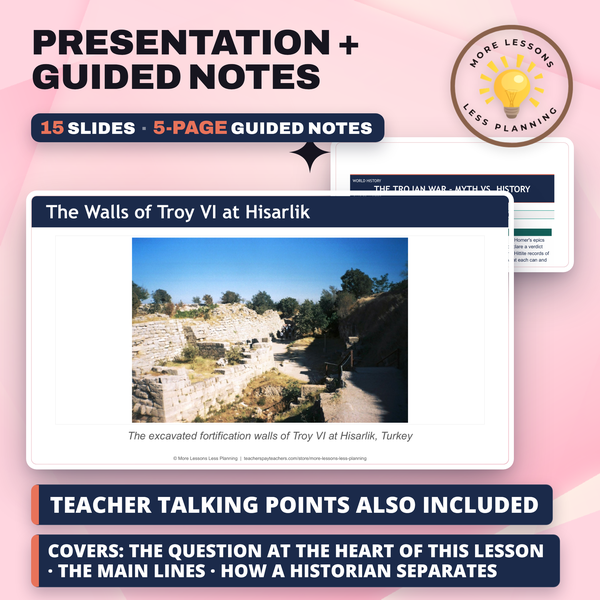
- Compare the destruction layers of Troy VI and Troy VIIa at Hisarlik
- Analyze Hittite records naming Wilusa and Ahhiyawa as clues to a real conflict
- Read Herodotus' account questioning whether Helen ever reached Troy
What it covers
- Why Schliemann's "Priam's Treasure" is more than a thousand years too old for the epic war
- What the Bronze Age collapse can and cannot prove about a ten-year siege
- How a historian separates a real, evidenced past from a later poetic memory
Learning targets
- Explain the question at the heart of this lesson - whether the Trojan War of Homer's epics really happened - and why the honest answer is to weigh evidence, not to declare a verdict
- Describe the main lines of evidence - the destruction layers at Hisarlik, the Hittite records of Wilusa and Ahhiyawa, the Bronze Age collapse, and Homer's epics - and what each can and cannot show
- Analyze how a historian separates a real, evidenced past from a later poetic memory, using Herodotus' inquiry into the Helen story as a model of source-checking
Peek inside
The Legend
TROJAN WAR: the legendary ten-year war in Homer's Iliad
The Greeks (Achaeans) besiege the city of Troy
It is one of the most famous stories ever told
But a famous story is not the same as proven history
1. Who wrote this passage, when, and where did he get his information about Helen? Use the source header and the context line above.
Why this matters
Hittite records from the same era mention a place called Wilusa and a people called Ahhiyawa, names close enough to Troy and the Achaeans that historians still argue whether they are the same places. A real empire's paperwork, not a poem, is the closest thing to outside evidence this war has.
A burned city proves a city burned, nothing more about who did it or why, and Troy VI's layer against Troy VIIa's is where students run into that limit. The gap between what the ruins prove and what a ten-year siege would require is the point of treating this as a real question, not trivia.
From one teacher to another
Students walk in assuming this lesson will finally tell them whether the Trojan War really happened, and I don't correct that assumption right away. Hisarlik gives them a real destroyed city, more than once, which is exactly the kind of complication that makes the case interesting instead of settled. Herodotus does the modeling for them, questioning Homer's story centuries before any modern historian did.
Every file in this toolkit
Download
Where should I send the next one?
Everything here is free and it stays that way. Leave your email and I'll send you the new lessons as they go up. You can unsubscribe from any one of them.
Related resources
Homer and the Oral Tradition
Monsters of the Mediterranean
Penelope and the Women of the Odyssey
Schliemann Digs Up Troy
The Bronze Age Collapse
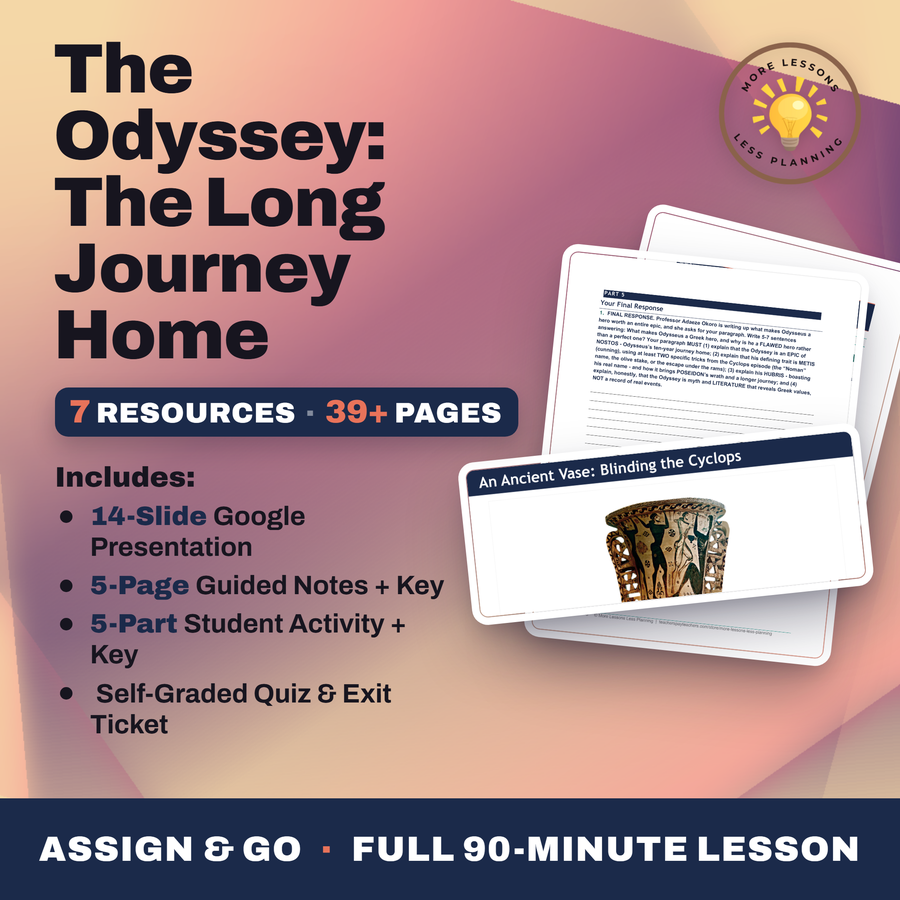
The Odyssey - The Long Journey Home
Every lesson on this site is free to download and use. If one of them saved you a prep period, you can chip in a few bucks toward my three kids' daycare fund. That's genuinely where tips go.