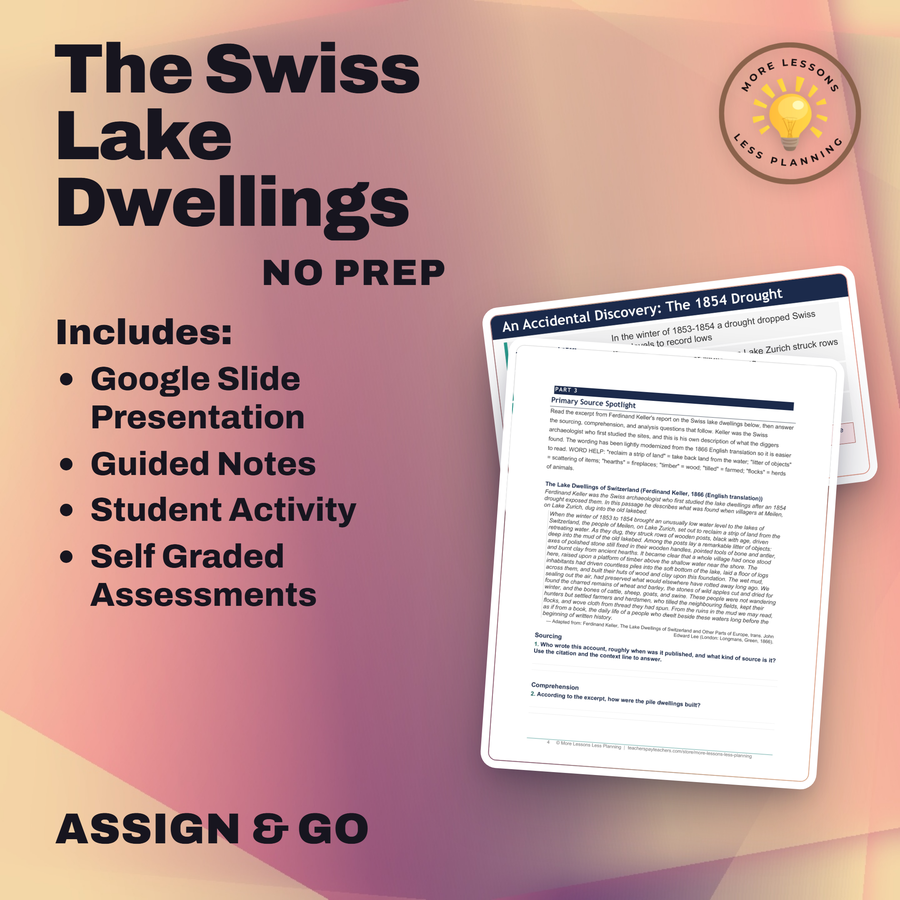

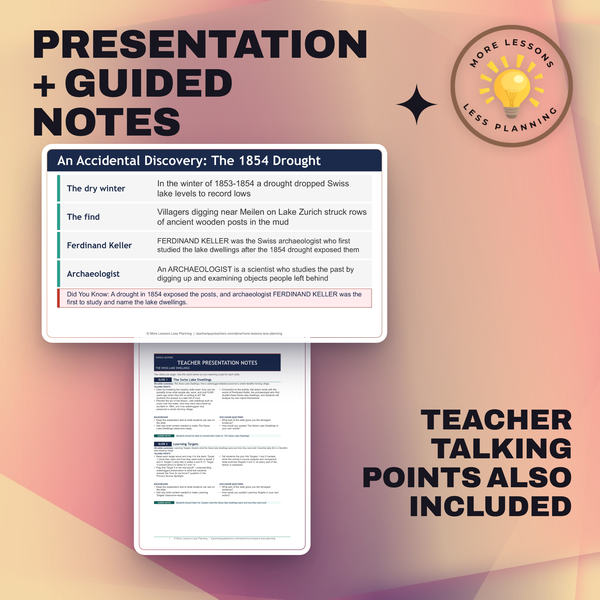

The Swiss Lake Dwellings
Quality reviewed September 2026
- Subject
- World History
- Grades
- Grades 9-12
- Time
- About two 50-minute class periods
- Includes
- 11 ready-to-teach files
- Format
- Word (.docx) · PowerPoint (.pptx)
- Slide deck
- Guided notes
- Guided notes teacher key
- Activity + answer key
- Quiz + answer key
- Exit ticket + answer key
- Teacher guide
- Teacher presentation notes
What students do
- Explain how pile dwellings were built on wooden posts driven into a lakebed and why that setting matters
- Describe how waterlogged, oxygen-poor mud preserved wood, food remains, and artifacts that normally rot away
- Compare hunter-gatherer life to Neolithic lake-dweller life using farming, herding, and domestication
- Read an excerpt of Ferdinand Keller's 1866 report and explain what his excavation revealed about the site
What it covers
- How pile dwellings were constructed over and beside lakes, and why archaeologists call this a Neolithic settlement
- Why waterlogged preservation kept wood, tools, and food remains intact when drier sites would have lost them
- A hunter-gatherer vs. Neolithic lake-dweller comparison table covering farming, herding, and daily life
- Ferdinand Keller's 1866 excavation report, written after an 1854 drought first exposed the lake dwellings
Learning targets
- Explain what the Swiss lake dwellings were and how their pile houses were built
- Describe daily life in a Neolithic lake-dwelling village, including farming, herding, tools, and food
- Analyze how waterlogged preservation lets archaeologists reconstruct daily Neolithic life
Peek inside
The Villages
Ancient farming villages built beside Swiss lakes
Built about 5,000-6,000 years ago (Neolithic)
Homes raised over shallow water or the marshy shore
Found around lakes in Switzerland and the Alps
Villages on the Water
A PILE DWELLING is a house built on wooden posts, called , driven into the bed of a lake or wetland.
The Swiss lake dwellings were ancient farming villages built beside Swiss .
Homes were raised over shallow water or the shore to stay above the damp ground.
1. Who wrote this account, roughly when was it published, and what kind of source is it? Use the citation and the context line to answer.
Why this matters
A pile dwelling built on wooden posts over open water forced Neolithic builders to solve problems hunter-gatherer sites never faced, working around waves, water level, and a soft lakebed instead of solid ground. Setting that settled, farming and herding life directly against an earlier hunter-gatherer existence makes the shift concrete instead of a vocabulary pair to memorize.
Ferdinand Keller's own 1866 report, written after an 1854 drought first exposed the old timbers, is what I hand students instead of a summary of what he found. Reading an archaeologist's original account is worth the extra difficulty, and it is the closest thing to watching the discovery happen in real time.
From one teacher to another
I built this one around a site that's almost too perfect for teaching preservation: a Neolithic village built on posts over a lake, only found because an 1854 drought dropped the water level and exposed the old timbers. Students learn what a pile dwelling actually is and why farming and herding show up here in a way they don't in earlier prehistory lessons, then spend real time on the waterlogged mud itself, because that's the mechanism - no oxygen, no rot, and suddenly you have wood, food scraps, and tools that survived thousands of years intact. The primary source is Ferdinand Keller's own 1866 report on the discovery, which lets students read the archaeologist's original account instead of a paraphrase. It pairs well with a hand-axe or toolmaking lesson earlier in the unit since it shows how much more archaeologists can reconstruct once people settle down and start leaving a fuller record behind.
Every file in this toolkit
Download
Where should I send the next one?
Everything here is free and it stays that way. Leave your email and I'll send you the new lessons as they go up. You can unsubscribe from any one of them.
Related resources

Discovering Neanderthals
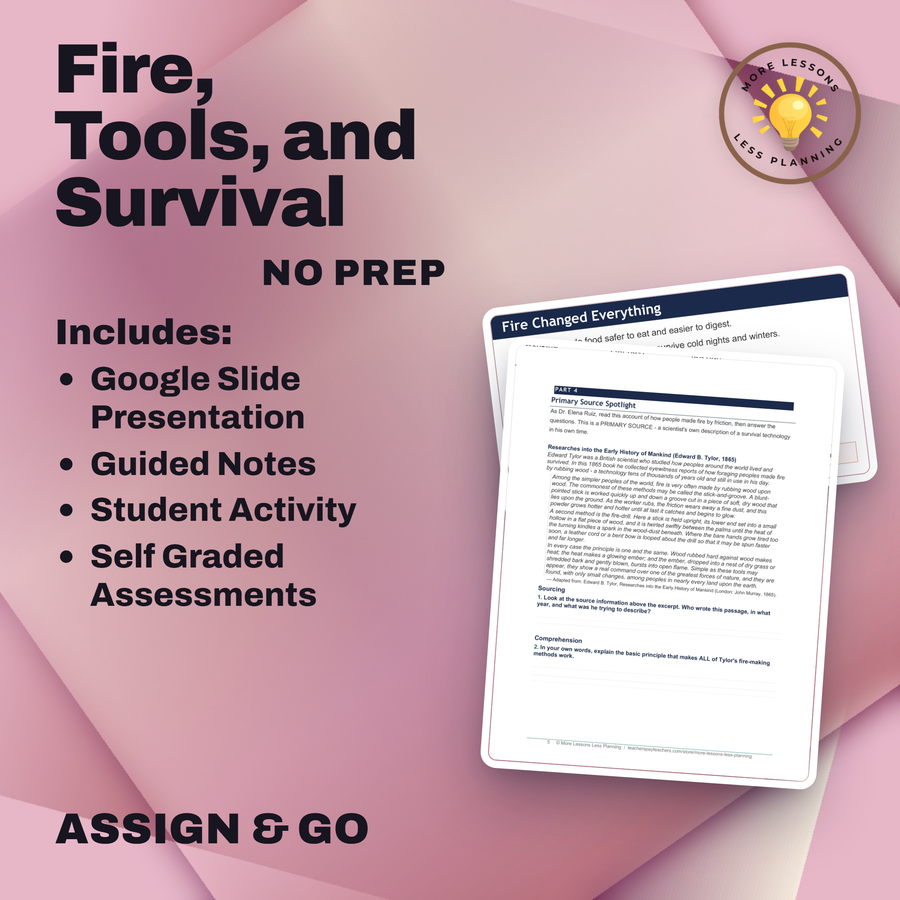
Fire, Tools, and Survival
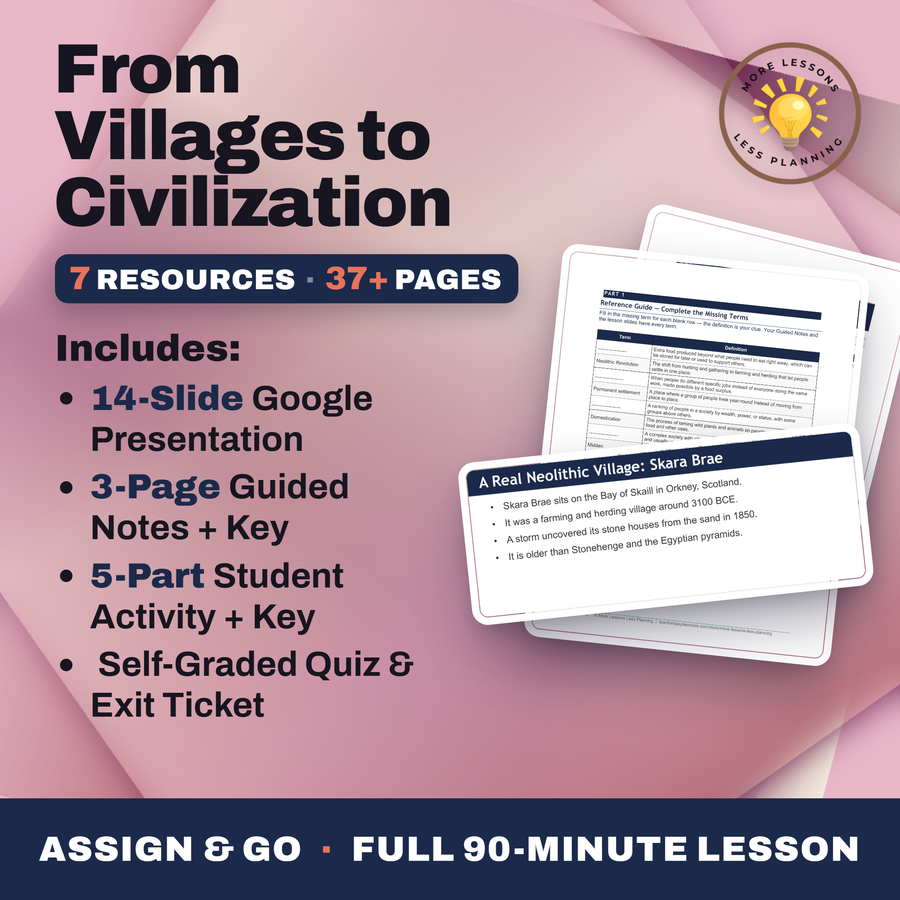
From Villages to Civilization

Ice Age Cave Art
Newgrange Tomb of the Ancients
Stonehenge and the Megaliths
Every lesson on this site is free to download and use. If one of them saved you a prep period, you can chip in a few bucks toward my three kids' daycare fund. That's genuinely where tips go.