Discovering Neanderthals
- Slide deck
- Guided notes
- Guided notes teacher key
- Activity + answer key
- Quiz + answer key
- Exit ticket + answer key
- Teacher guide
- Teacher presentation notes
Where should I send the next one?
Everything here is free and it stays that way. Leave your email and I'll send you the new lessons as they go up. You can unsubscribe from any one of them.
Every file in this toolkit
Related resources
From Villages to Civilization
Ice Age Cave Art
Taming Wild Animals
Aggression and Appeasement
Alliances and the Causes of WWI

Blitzkrieg and the Fall of France
What students do
- Describe the 1856 Feldhofer Grotto discovery and the skull features that set it apart
- Compare the competing nineteenth-century theories for what the Neander Valley bones actually were
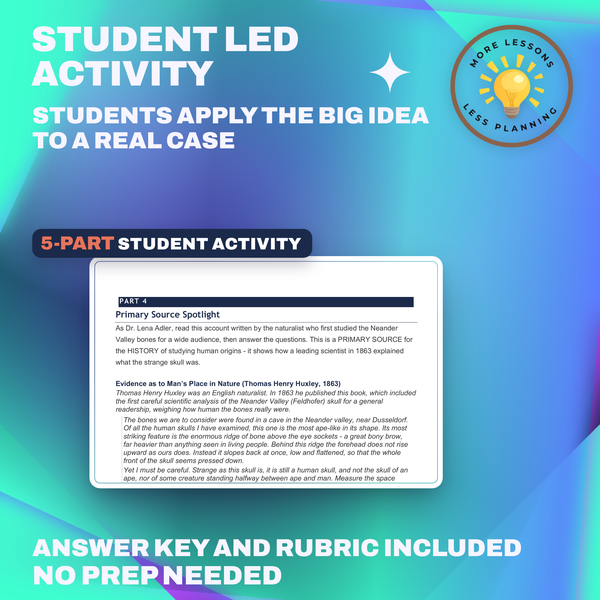
- Analyze Thomas Huxley's 1863 conclusion that the skull was ape-like in shape yet still human
- Explain how one contested skull opened the science of paleoanthropology
What it covers
- What the 1856 Neander Valley discovery actually consisted of, a skullcap and a few limb bones
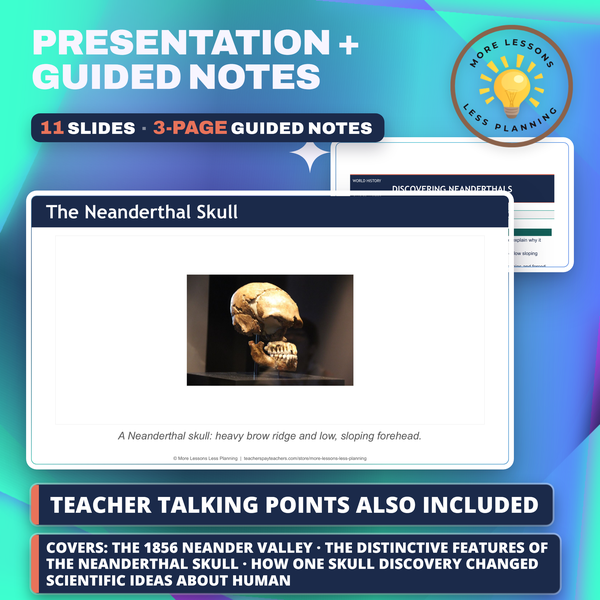
- The heavy brow ridge and sloping forehead that made scientists question what they were looking at
- How Thomas Huxley's careful measurements led to his 1863 conclusion
- Why the Neanderthal debate is a good model for how science corrects itself
Learning targets
- Describe the 1856 Neander Valley (Feldhofer Grotto) fossil discovery and explain why it surprised scientists.
- Identify the distinctive features of the Neanderthal skull (heavy brow ridge, low sloping forehead) and what they suggested about early humans.
- Analyze how one skull discovery changed scientific ideas about human origins and forced scientists to reconsider what 'human' meant.
- Evaluate how naturalists like Thomas Huxley used evidence to revise earlier assumptions, showing how science self-corrects.
From one teacher to another
What do you do with a skull that doesn't look like anyone currently walking around? That's the single question this lesson sits with, and students follow the whole argument that grew out of it, from a diseased-person theory through Huxley's careful anatomical comparison to his conclusion that the bones were ape-like yet still human. It's a compact period, but it earns its place by showing students that a scientist changing his mind in the face of new evidence is part of the process working correctly.
Every lesson on this site is free to download and use. If one of them saved you a prep period, you can chip in a few bucks toward my three kids' daycare fund. That's genuinely where tips go.