
Stonehenge and the Megaliths
Quality reviewed September 2026
- Subject
- World History
- Grades
- Grades 9-12
- Time
- About two 50-minute class periods
- Includes
- 11 ready-to-teach files
- Format
- Word (.docx) · PowerPoint (.pptx)
- Slide deck
- Guided notes
- Guided notes teacher key
- Activity + answer key
- Quiz + answer key
- Exit ticket + answer key
- Teacher guide
- Teacher presentation notes
What students do
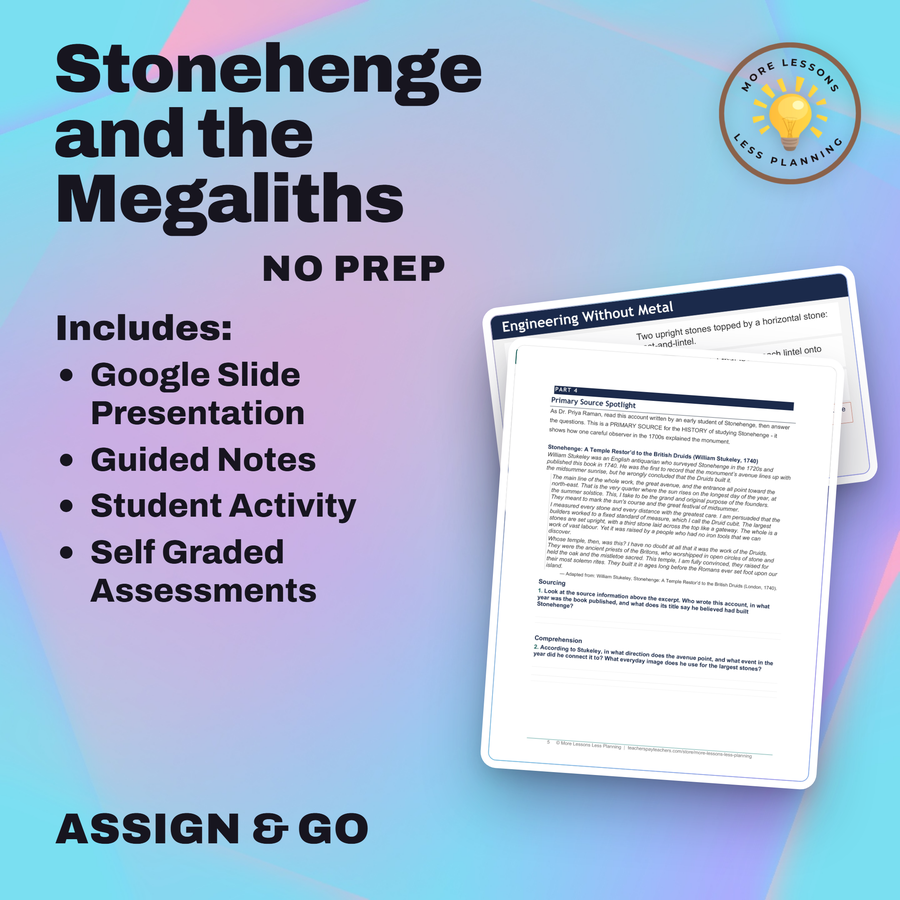
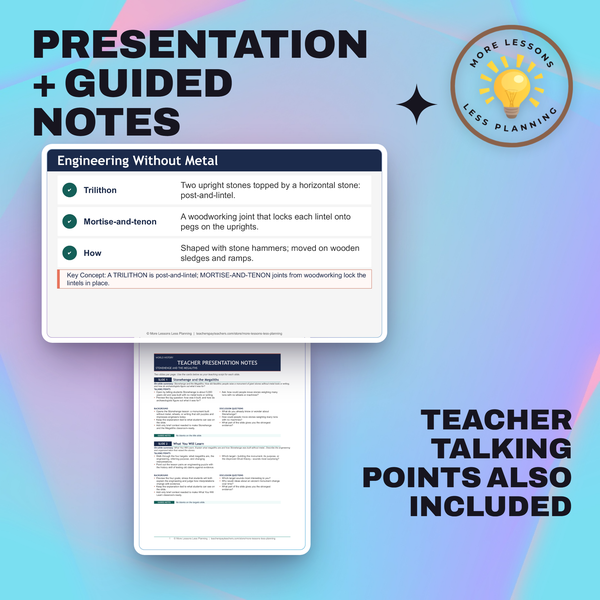
- Explain how Neolithic builders raised and locked sarsen stones with no metal tools
- Trace the 150-mile journey of the bluestones from Wales as evidence of organized labor
- Read William Stukeley's 1740 survey and sort what he got right from what he got wrong
- Weigh the solstice alignment and buried remains as evidence for what Stonehenge was for
What it covers
- Trilithons and mortise-and-tenon joints, a woodworking trick locked into stone
- Why the bluestones' 150-mile trip from Wales matters as much as their size
- Stukeley's accurate solstice observation next to his wrong claim about the Druids
- Why archaeologists trust testable physical evidence over an old confident claim
Learning targets
- Explain what megaliths are and describe how Neolithic people built Stonehenge without metal tools or writing.
- Describe the engineering techniques (post-and-lintel, mortise-and-tenon joints, sledges and ramps) and the organized labor used to move and raise the stones.
- Analyze the likely astronomical and ritual purposes of Stonehenge and explain how archaeologists infer meaning from a monument that left no written records.
- Evaluate how interpretations of Stonehenge, such as the Druid theory, have changed as archaeological evidence improved.
Peek inside
Giant Stones of the Stone Age
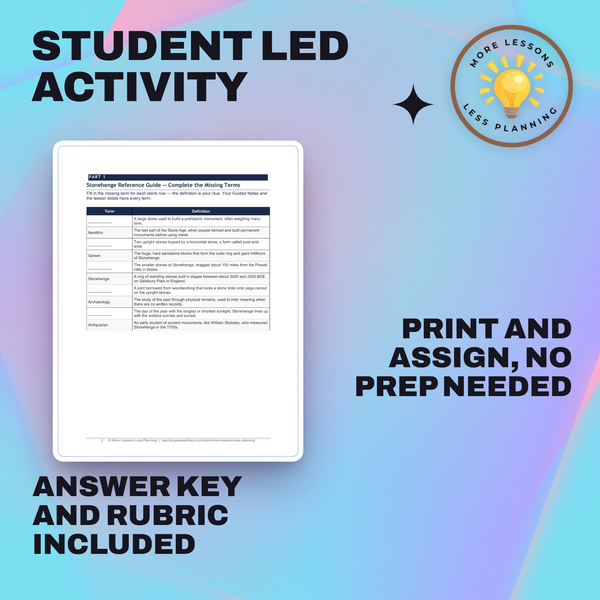
A MEGALITH is a large used to build a prehistoric monument, often weighing many tons.
The NEOLITHIC was the last part of the Stone Age, when people farmed and built permanent monuments before using .
Why this matters
A stone weighing several tons traveled roughly 150 miles from Wales to Salisbury Plain with no wheel and no metal tool to move it. That journey, not just the size of the sarsens left standing, is the detail that makes Stonehenge an organized labor project rather than a lucky pile of rocks.
I put the mortise and tenon joints, a woodworking trick locked into solid stone, next to that 150 mile trip so students see two kinds of proof at once: precise engineering and coordinated effort across real distance. Neither one needed metal or writing to happen, which is usually the part that surprises them most.
From one teacher to another
Stukeley measured Stonehenge carefully in the 1720s and still got the builders wrong by about two thousand years, which makes him the perfect case study for how good data and a wrong conclusion can sit right next to each other. My students read his own 1740 account of the solstice alignment, the same one still accepted today, right before deciding why his Druid theory didn't hold up. It's a chance to talk about engineering with no metal tools and no writing, but the bigger point is showing them how archaeologists correct a claim once better evidence shows up.
Every file in this toolkit
Download
Where should I send the next one?
Everything here is free and it stays that way. Leave your email and I'll send you the new lessons as they go up. You can unsubscribe from any one of them.
Related resources
Discovering Neanderthals
Fire, Tools, and Survival
From Villages to Civilization
Ice Age Cave Art
Newgrange Tomb of the Ancients
Taming Wild Animals
Every lesson on this site is free to download and use. If one of them saved you a prep period, you can chip in a few bucks toward my three kids' daycare fund. That's genuinely where tips go.