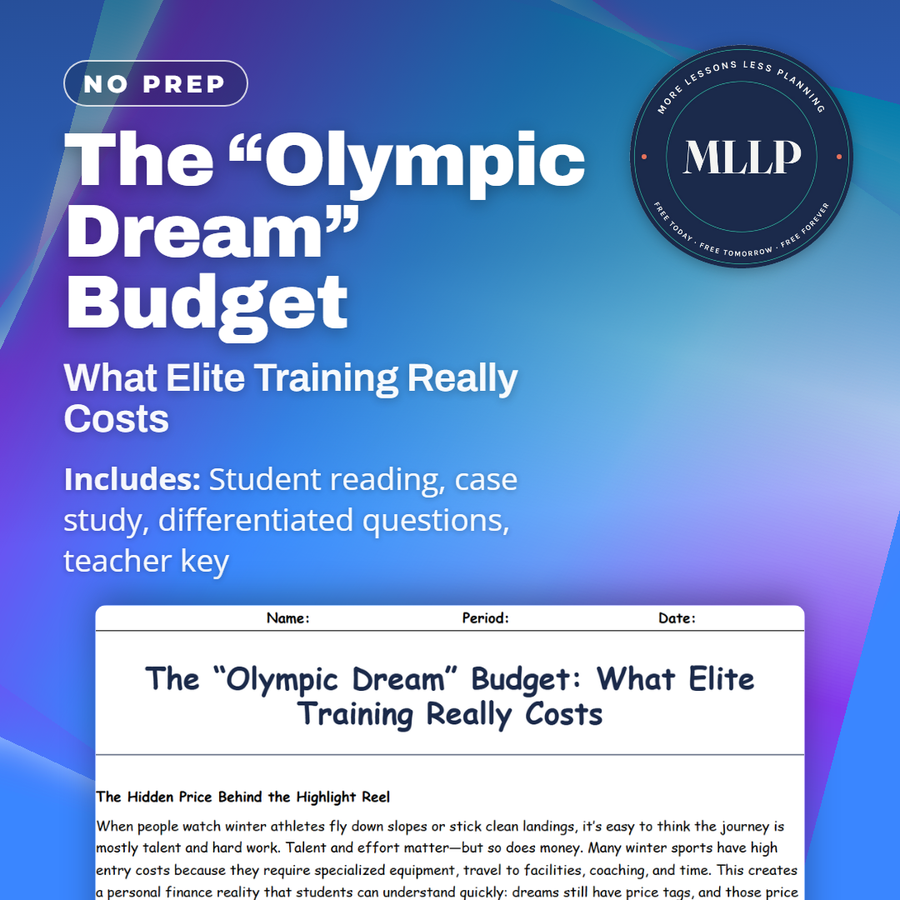
The “Olympic Dream” Budget: What Elite Training Really Costs
Quality reviewed September 2026
Facts verified September 9, 2026
- Subject
- Career & Life Skills
- Grades
- Grades 9-12
- Length
- 8-page student worksheet
- Time
- About one 50-minute class period
- Great for
- Sub plans and independent work
- Includes
- Reading passage, comprehension questions + full answer key
- Format
- Print-and-go PDF
What students do
- Identify which costs are fixed versus variable in a competitive athlete's annual plan
- Evaluate cost-per-benefit when choosing between equipment upgrades and travel expenses
- Analyze how opportunity cost applies when families choose between priorities
- Design a budget with boundaries that protects both athletic goals and financial stability
What it covers
- Elite training costs and access barriers
- Opportunity cost and financial tradeoffs
- Sustainable budgeting for long-term goals
Start reading this worksheet
The Hidden Price Behind the Highlight Reel
When people watch winter athletes fly down slopes or stick clean landings, it’s easy to think the journey is mostly talent and hard work. Talent and effort matter. But so does money. Many winter sports have high entry costs because they require specialized equipment, travel to facilities, coaching, and time. This creates a personal finance reality that students can understand quickly: dreams still have price tags, and those price tags shape who gets access. In personal finance, a budget is more than a list of expenses. A budget is a plan that reflects priorities and tradeoffs. For families supporting an athlete, the budget can include season passes, travel, event fees, coaching sessions, strength training memberships, and equipment replacement. Winter gear isn’t a one-time purchase. Skis, boards, boots, blades, helmets, and protective gear wear out or become unsafe. Growth spurts in teen athletes mean boots and clothing sizes change quickly. Even “small” costs (wax, tuning, sharpening, gloves, base layers) add up. Travel is often the biggest surprise. Some athletes must travel long distances to find snow, a track, or a quality rink. Competition schedules can involve multiple weekends away, hotel stays, meals on the road, and missed work hours for parents. That’s why budgeting for elite training includes both direct costs (what you pay) and indirect costs (income you lose because of time). This is also where personal finance becomes emotional. Families may feel pressure to keep spending because “we’ve already come this far.” That’s a normal feeling, but smart budgeting requires honest check-ins: Is the plan sustainable? Are there scholarships or lower-cost pathways? Can we set goals that protect both the athlete’s growth and the family’s financial health?
Budgeting Basics: Fixed Costs, Variable Costs, and Surprise Expenses
One helpful strategy is to separate fixed and variable costs. Fixed costs are predictable: club dues, rink memberships, training program fees. Variable costs change: travel, repairs, competition fees, new equipment, extra coaching sessions. If you only plan for fixed costs, your budget will “break” the first time a flight price jumps or a binding snaps. A strong athlete budget also includes a buffer: money set aside for unexpected expenses. In personal finance, that’s similar to an emergency fund. For sports, emergencies can mean a last-minute trip, equipment replacement, or medical copays. Buffers reduce stress and help families avoid high-interest debt. Goal-setting matters too. Many athletes and families benefit from short-term goals (this season) and long-term goals (the next four years). Short-term goals might include making a varsity team or qualifying for regionals. Long-term goals might include college recruitment. Each goal has a different cost profile. If a long-term goal depends on heavy spending, families should explore funding sources early: sponsorships, scholarships, fundraising, and community grants. Another key personal finance concept is opportunity cost. If money is going toward sport, it can’t be used for other priorities: college savings, car repairs, medical needs, or basic household stability. Opportunity cost isn’t about guilt; it’s about clarity. It helps families make decisions based on reality, not pressure. Finally, students should understand that budgeting isn’t a “one and done” task. It’s a living plan. A smart budget gets reviewed monthly, adjusted after big competitions, and updated when new costs appear. The goal is not perfection. The goal is control.
Smart Spending Choices: Saving Without Cutting the Dream
Not every cost is unavoidable. Many athlete families reduce costs through smart strategies: buying secondhand gear, sharing travel with teammates, staying with host families, choosing fewer high-cost competitions, and prioritizing coaching quality over quantity. This is where finance becomes strategic rather than restrictive. For example, one athlete might spend heavily on travel but underinvest in strength training, and then get injured and miss half the season. Another athlete might focus on injury prevention, consistent practice, and fewer competitions, improving performance while spending less. The “best” budget is the one that aligns with goals and protects health. A helpful idea here is cost-per-benefit thinking. Ask: Which expenses truly improve performance and safety, and which are mostly status purchases? The newest gear might look impressive, but it won’t always create the biggest improvement. A consistent training plan and a safe technique might matter more than brand-new equipment. Families also need to watch out for debt traps. If costs go on a credit card and aren’t paid off quickly, interest becomes a silent opponent. High-interest debt can turn a sports season into a long financial hangover. A safer approach is to plan ahead, save monthly, and keep a clear cap on spending.
Like what you read? The full reading, the case study, and every question set are in the free download below, along with the answer key.
Why this matters
Maria's family can afford new skis or the travel event that gets her noticed by coaches, not both. That single decision is the whole lesson before any formula shows up: which cost actually moves her future forward, and which one just feels good right now.
The credit card question quiets a classroom fastest. Financing a season you cannot afford does not solve anything, it just moves the cost to a later month with interest attached. Sorting fixed costs from variable ones stops feeling like math and starts feeling like a warning.
From one teacher to another
Maria's boot versus ski decision is something students can feel. Her family isn't rich, and they have to choose between new skis and a travel event. But that choice teaches more personal finance than any textbook. Equipment matters, but so does knowing when you can't afford both things you want. The reading shows smart families asking "which expense improves performance most?" and "what happens if we use credit cards?" instead of just spending and hoping.
What you get
Download
Where should I send the next one?
Everything here is free and it stays that way. Leave your email and I'll send you the new lessons as they go up. You can unsubscribe from any one of them.
Related resources
Altitude, Cold Stress, and Human Adaptation: How the Body Stays in Balance
Blueprint of Power: Muscles and Joints That Make Winter Sports Work
Doping Investigations: How Forensic Science Protects Sport Integrity

Gold Medals Need Geography: Why Some Places Can Host and Others Can’t
Luge and Skeleton: Extreme Speed, Risk Variables, and Safety Engineering
Nations, Boycotts, and Global Messages: When the Olympics Become Diplomacy
Every lesson on this site is free to download and use. If one of them saved you a prep period, you can chip in a few bucks toward my three kids' daycare fund. That's genuinely where tips go.