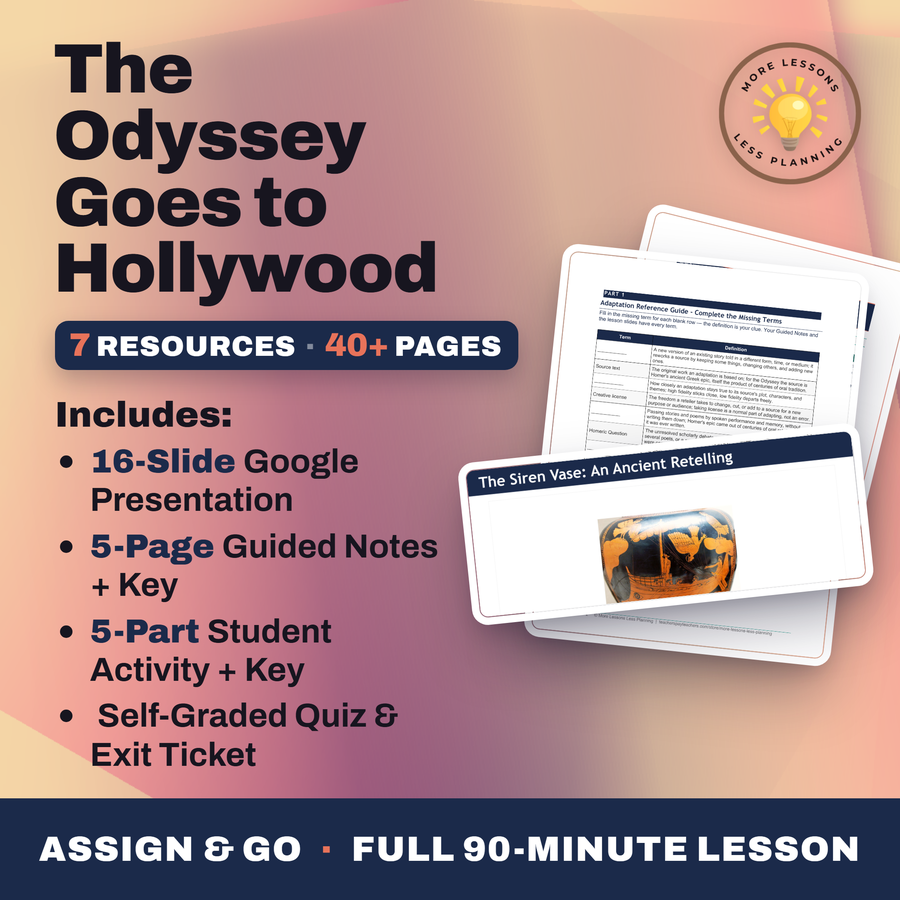
The Odyssey Goes to Hollywood
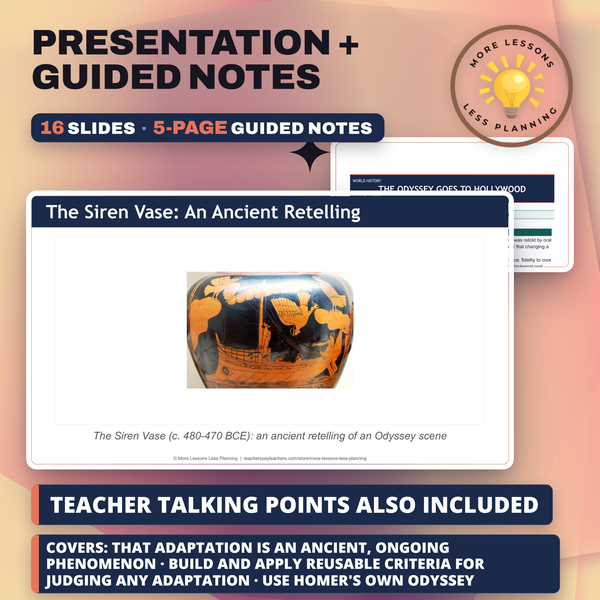
- Slide deck
- Guided notes
- Guided notes teacher key
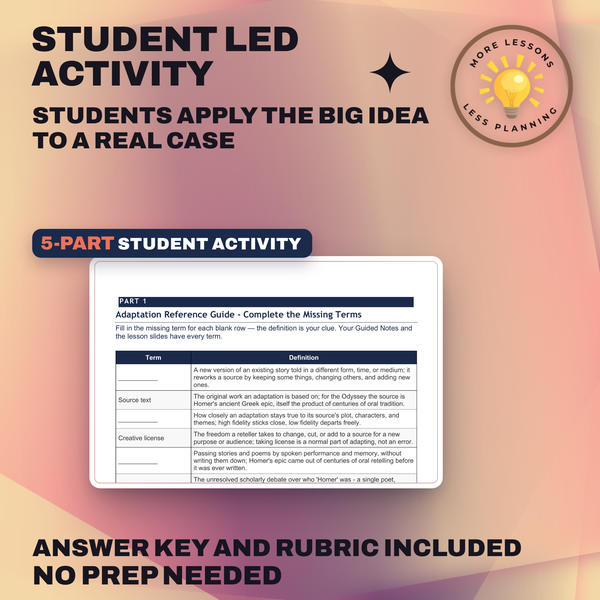
- Activity + answer key
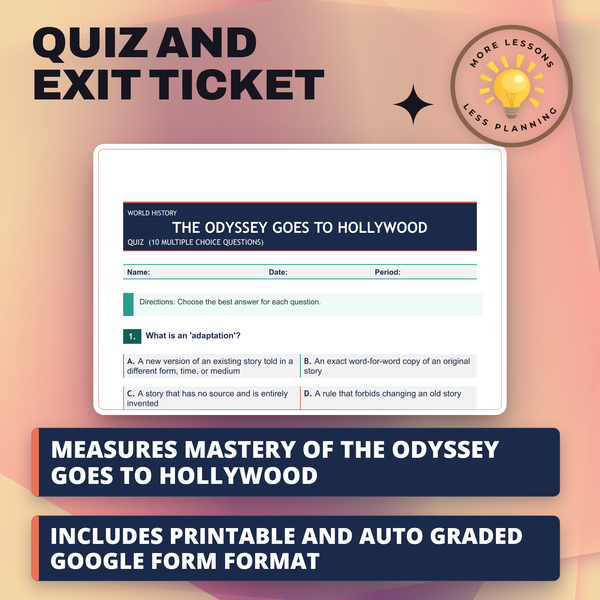
- Quiz + answer key
- Exit ticket + answer key
- Teacher guide
- Teacher presentation notes
Where should I send the next one?
Everything here is free and it stays that way. Leave your email and I'll send you the new lessons as they go up. You can unsubscribe from any one of them.
Every file in this toolkit
Related resources
Homer and the Oral Tradition
Monsters of the Mediterranean
The Bronze Age Collapse
The Odyssey - The Long Journey Home
The Trojan War - Myth vs. History
The World of Homer - Mycenaean Greece
What students do
- Explain that adaptation is an ancient, ongoing practice stretching from oral bards to modern film
- Build reusable criteria for judging any adaptation: fidelity, theme, context, and audience
- Read Homer's own invocation of the Muse and the bard Phemius scene as evidence the epic endorses retelling
- Compare a modern film adaptation against the Odyssey's core values of xenia, nostos, and metis
What it covers
- Why a translation itself counts as an adaptation, not a neutral transfer
- What changes across ancient vase paintings, Roman poetry, and modern film reveal about each era
- Why "the book is always better" isn't an argument on its own
Learning targets
- Explain that adaptation is an ancient, ongoing phenomenon - the Odyssey was retold by oral bards, vase painters, Roman poets, translators, and modern filmmakers - and that changing a source is what adaptation is, not 'getting it wrong'
- Build and apply reusable criteria for judging any adaptation against its source: fidelity to core plot and characters, preservation of theme and values (xenia, nostos, metis), historical and cultural context, and the purpose and audience of the new version
- Use Homer's own Odyssey (Book I, trans. Butler 1900) - the invocation of the Muse and the bard Phemius scene - to explain how the epic itself endorses retelling and novelty, while keeping the Homeric Question honestly open
From one teacher to another
A whole unit of myth-versus-history training finally gets loose on something modern here, instead of ancient. Students build their own judging criteria before I let them near a film adaptation, then defend a verdict using fidelity, theme, and audience rather than just declaring the book better. Reading Homer's own invocation of the Muse beside a bard performing inside the epic makes the case that retelling isn't a modern habit, it's the oldest one this story has.
Every lesson on this site is free to download and use. If one of them saved you a prep period, you can chip in a few bucks toward my three kids' daycare fund. That's genuinely where tips go.