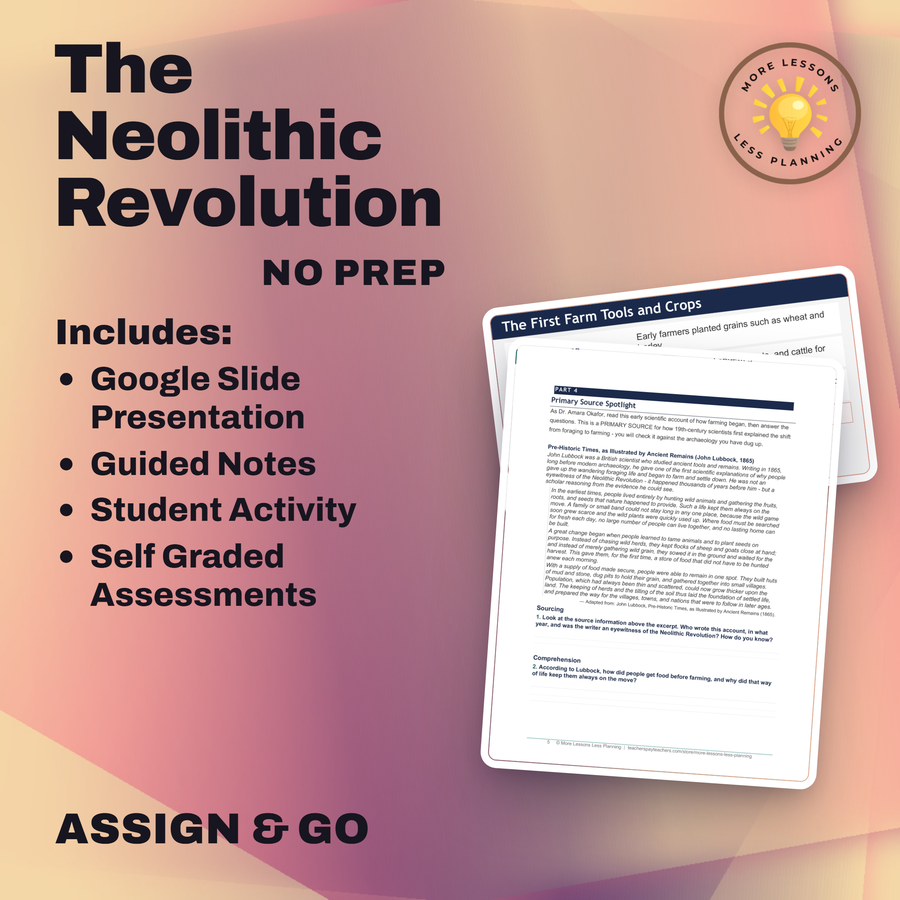


The Neolithic Revolution
Quality reviewed September 2026
- Subject
- World History
- Grades
- Grades 9-12
- Time
- About two 50-minute class periods
- Includes
- 11 ready-to-teach files
- Format
- Word (.docx) · PowerPoint (.pptx)
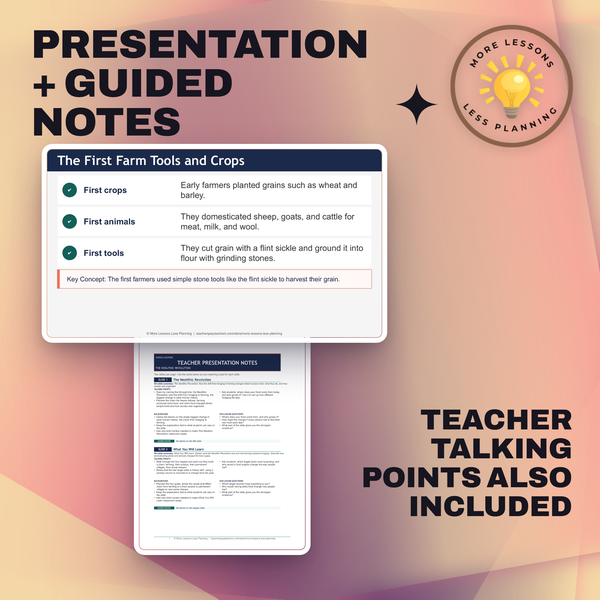
- Slide deck
- Guided notes
- Guided notes teacher key
- Activity + answer key
- Quiz + answer key
- Exit ticket + answer key
- Teacher guide
- Teacher presentation notes
What students do
- Sequence the shift from foraging nomads to domestication and surplus to permanent villages to artisan specialization
- Match imaginary dig finds - storage pits, mud-brick houses, penned animal bones, pottery - to what each proves
- Read John Lubbock's 1865 account of farming's origins and source it as a scholar reasoning from evidence, not an eyewitness
- Write a reconstruction report using three or more Reference Guide terms plus one piece of dig or Lubbock evidence
What it covers
- How foraging nomads gave way to domestication and agriculture beginning around 10,000 BCE
- How a storable food surplus is the specific mechanism that let people stop wandering and settle into permanent villages
- How settlement and surplus together produced specialization, artisans, and the first social classes
- Combining archaeology with John Lubbock's 1865 written account to reconstruct a change nobody recorded at the time
Learning targets
- Explain what the Neolithic Revolution was and how farming replaced foraging around 10,000 BCE.
- Describe how the domestication of plants and animals changed the human food supply.
- Explain how a food surplus led people to settle in permanent villages, changing settlement patterns.
- Analyze how a food surplus reshaped social organization and use a primary source to reconstruct the change.
Why this matters
A stored surplus of grain is a small, specific thing, but it is the single mechanism that explains why people stopped wandering, built permanent walls, and eventually split into farmers, artisans, and rulers. Storage pits, mud brick houses, and penned animal bones are the physical proof, each one tied to a piece of that chain.
What keeps the Neolithic Revolution from staying an abstract term, in my experience, is a closing report that forces real vocabulary onto real evidence instead of letting either one float free. Students have to explain not just that a surplus reorganized Neolithic society but exactly which choice, penning animals or storing grain, made which change possible.
From one teacher to another
I anchor this whole lesson on one chain and make students hold onto it start to finish: domestication produces a surplus, a surplus lets people stop wandering, and settling down is what makes specialization and social class possible. Playing an archaeologist named Dr. Amara Okafor, students get four dig finds, storage pits, mud-brick houses, penned sheep and goat bones, pottery and cloth, and have to say what each one actually proves about food, settlement, or jobs. Then they read John Lubbock's real 1865 account of why people gave up wandering to farm, and the sourcing question I care about most asks them to notice he wasn't there either, a nineteenth-century scientist reasoning from evidence thousands of years after the fact, not an eyewitness. What makes the lesson click is putting his written reasoning next to the physical dig evidence and asking why the two agreeing is more trustworthy than either alone. The closing report forces them to use the vocabulary for real, tracing how a stored surplus reorganized both where people lived and how their society was structured.
Every file in this toolkit
Download
Where should I send the next one?
Everything here is free and it stays that way. Leave your email and I'll send you the new lessons as they go up. You can unsubscribe from any one of them.
Related resources
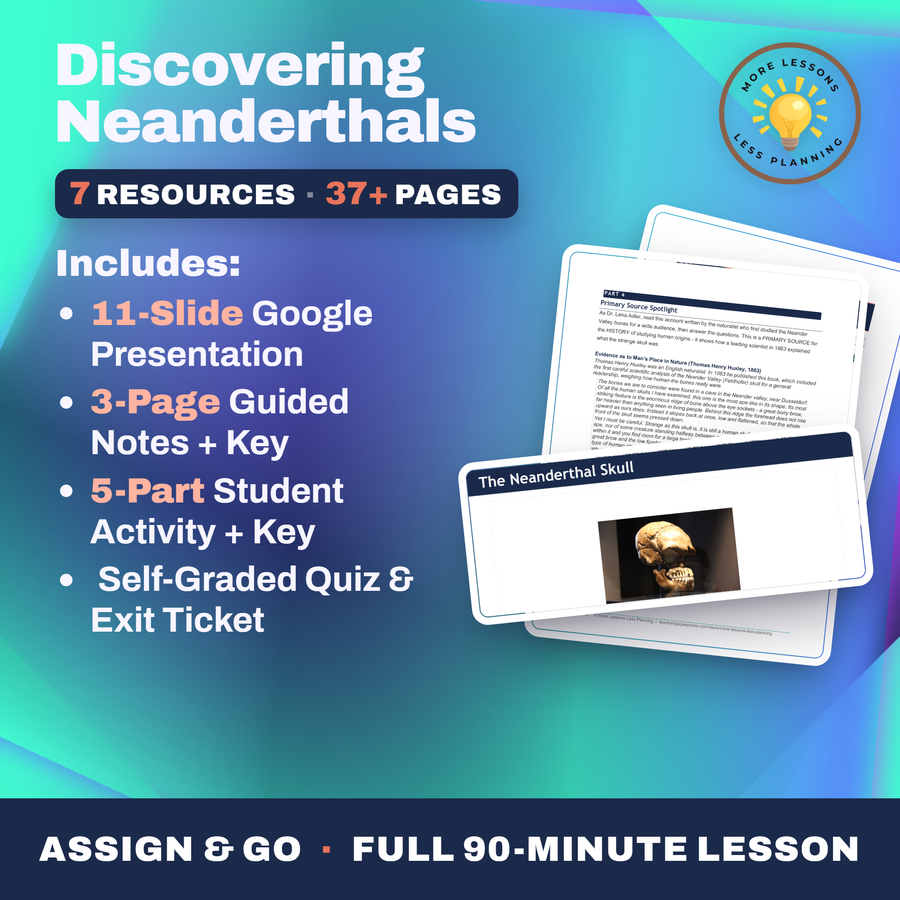
Discovering Neanderthals

Fire, Tools, and Survival
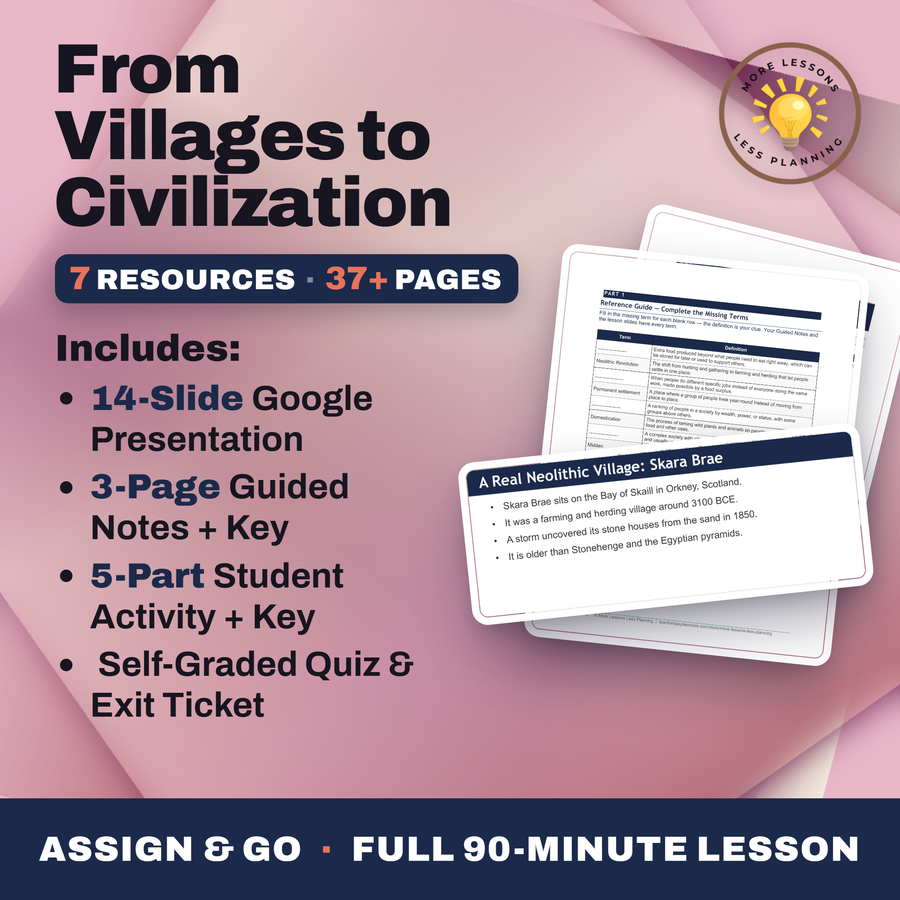
From Villages to Civilization

Ice Age Cave Art
Newgrange Tomb of the Ancients
Stonehenge and the Megaliths
Every lesson on this site is free to download and use. If one of them saved you a prep period, you can chip in a few bucks toward my three kids' daycare fund. That's genuinely where tips go.