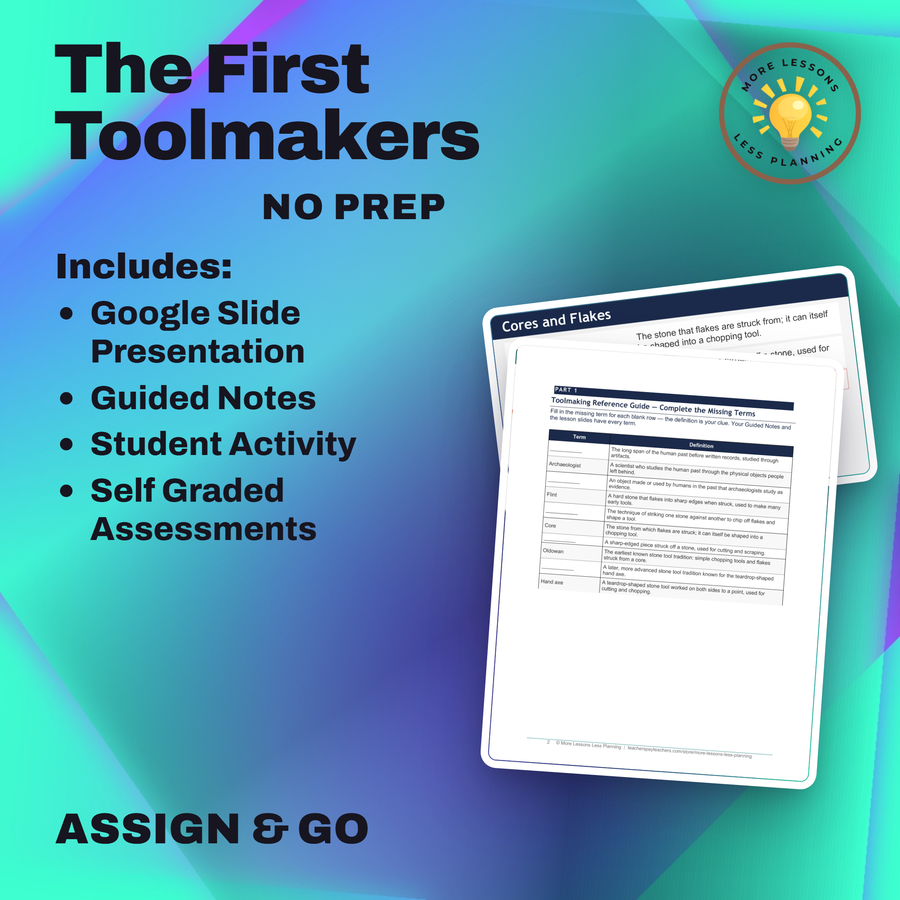

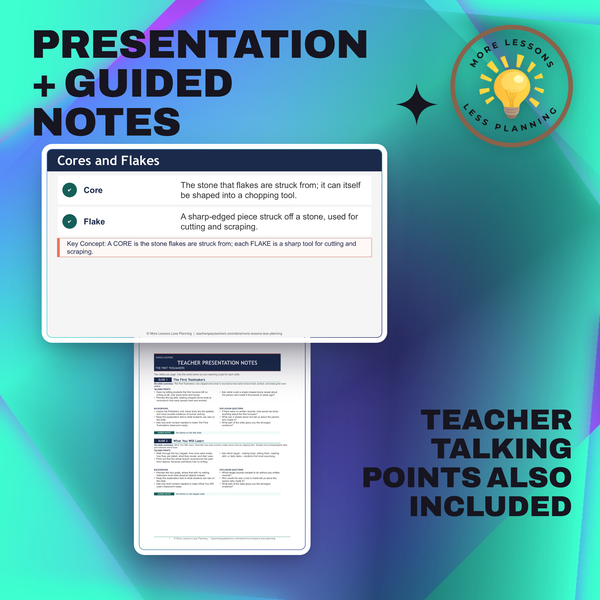

The First Toolmakers
Quality reviewed September 2026
- Subject
- World History
- Grades
- Grades 9-12
- Time
- About two 50-minute class periods
- Includes
- 11 ready-to-teach files
- Format
- Word (.docx) · PowerPoint (.pptx)
- Slide deck
- Guided notes
- Guided notes teacher key
- Activity + answer key
- Quiz + answer key
- Exit ticket + answer key
- Teacher guide
- Teacher presentation notes
What students do
- Trace how stone tools moved from simple Oldowan cores and flakes to symmetrical two-sided Acheulean hand axes
- Explain what wear marks and residue on tool edges reveal about butchering, hide-scraping, and woodworking tasks
- Define knapping and describe how a core is struck to produce a sharp-edged flake
- Read John Lubbock's 1865 argument about flint tools and connect rising tool complexity to changes in early human thinking
What it covers
- The difference between Oldowan cores/flakes and later Acheulean hand axes, and what that jump in skill means
- How archaeologists read wear marks and residue on stone tools to identify butchering, scraping, and woodworking
- Core vocabulary: prehistory, artifact, flint, knapping, core, flake, Oldowan, Acheulean, hand axe
- John Lubbock's 1865 argument about flint implements as a primary source on early toolmaking
Learning targets
- Describe how early humans made stone tools by striking and chipping flint, from the Oldowan to the Acheulean tradition.
- Explain how archaeologists date and interpret stone tools to reconstruct early human life and technological change.
- Analyze how the growing complexity of stone tools reveals developing skill and thinking.
- Describe the daily survival tasks early humans performed with stone tools, such as cutting, scraping, and hunting.
Peek inside
Reading Objects, Not Documents
PREHISTORY is the long span of the human past that comes before records, so we study it through artifacts.
An ARCHAEOLOGIST is a scientist who studies the human past through the physical that people left behind.
1. What word names the long span of the human past that comes before written records? (one word)
Why this matters
A chipped stone flake and a symmetrical Acheulean hand axe look like two separate crafts until you learn to read the wear marks between them. Edge damage tells a specific story, meat cut here, a hide scraped there, wood worked somewhere else, turning a plain rock into a record of an actual task.
John Lubbock argued in 1865 that rising tool complexity tracked a real change in how early humans thought, and that claim moves students past treating stone tools as a joke. Seeing the jump from a plain core to a hand axe as a genuine skill leap makes the vocabulary feel like evidence instead of busywork.
From one teacher to another
I built this one around a persona I liked: a paleolithic archaeologist reading a dig site from the bottom up, oldest layer first. Students start with the plainest Oldowan cores and flakes, then move up into the more skilled, two-sided Acheulean hand axes, and along the way they learn to read wear marks and residue the way an archaeologist would - what edge damage says about cutting meat versus scraping a hide versus working wood. The primary source is real: John Lubbock's 1865 argument about flint implements, which lets students engage with an actual historical debate over how to interpret stone tools instead of just memorizing vocabulary. It's a good entry point lesson for a prehistory unit because it's concrete - there's a physical object in front of students the whole time - and it sets up the "how do we know what we know" habit you want before moving into written-record history.
Every file in this toolkit
Download
Where should I send the next one?
Everything here is free and it stays that way. Leave your email and I'll send you the new lessons as they go up. You can unsubscribe from any one of them.
Related resources
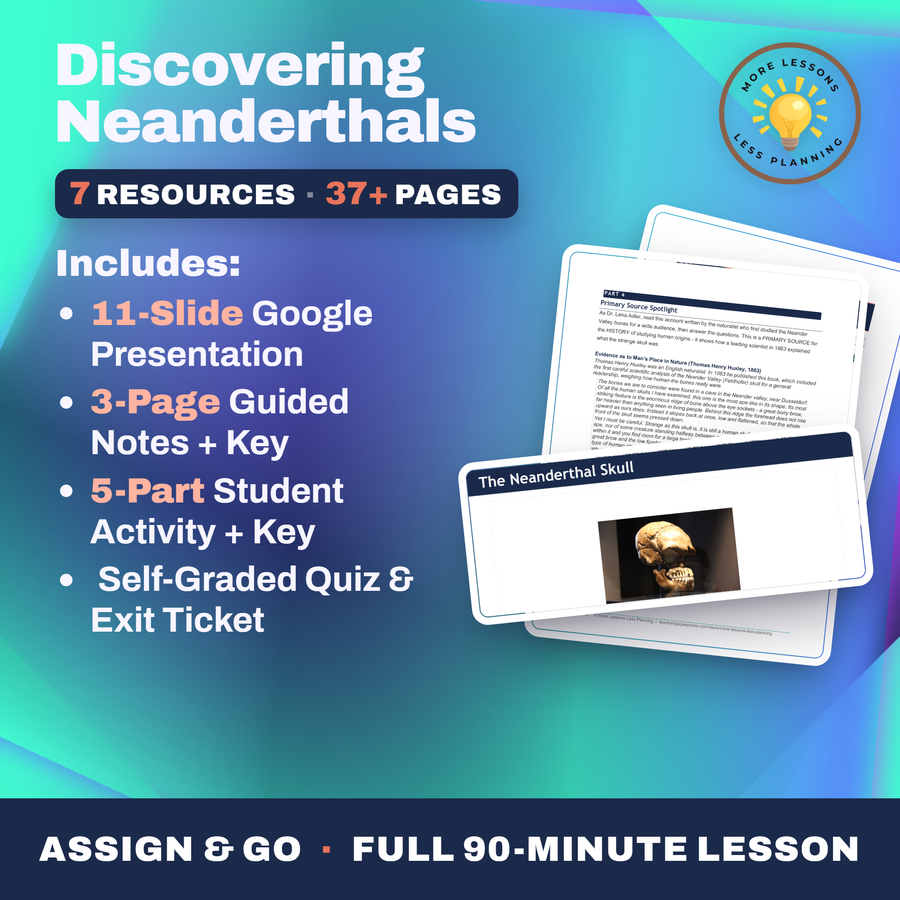
Discovering Neanderthals
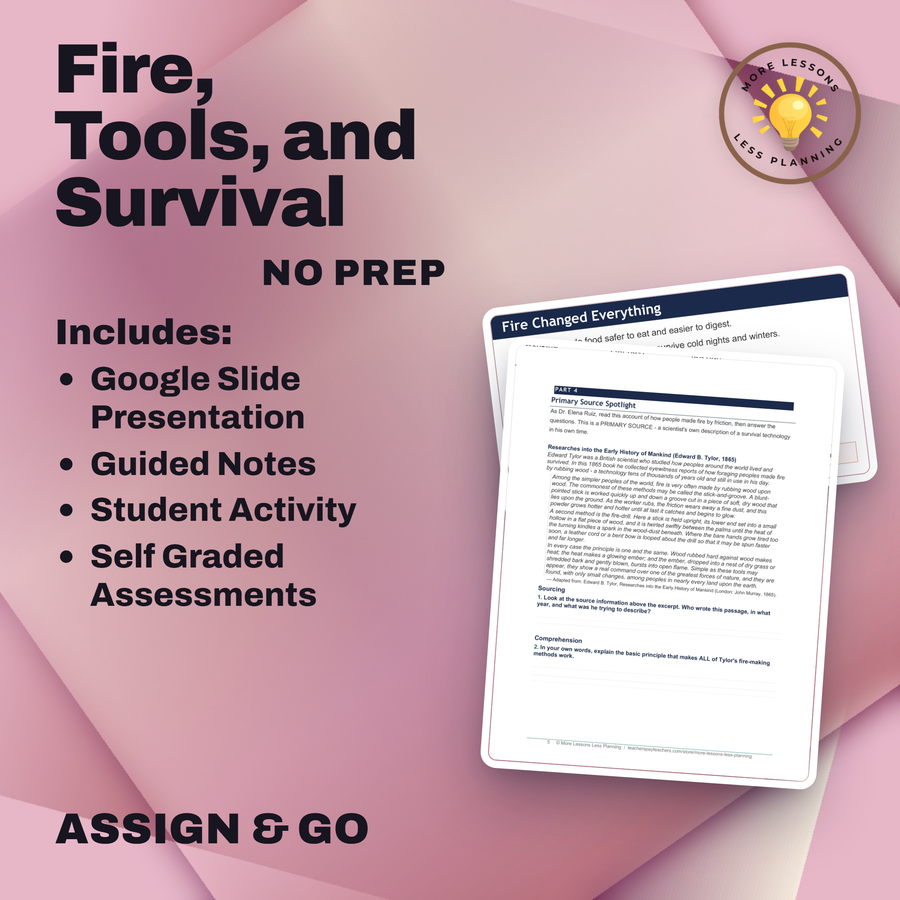
Fire, Tools, and Survival
From Villages to Civilization
Ice Age Cave Art
Newgrange Tomb of the Ancients
Stonehenge and the Megaliths
Every lesson on this site is free to download and use. If one of them saved you a prep period, you can chip in a few bucks toward my three kids' daycare fund. That's genuinely where tips go.