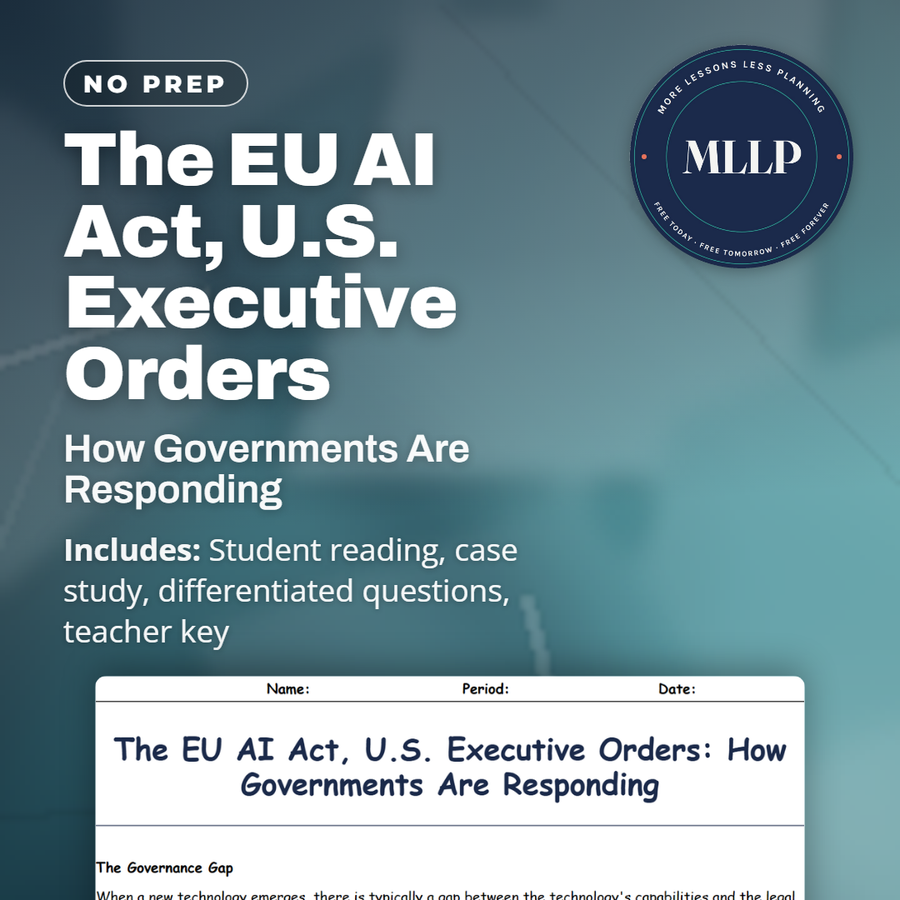
The EU AI Act, U.S. Executive Orders: How Governments Are Responding
Quality reviewed September 2026
Facts verified September 20, 2026
- Subject
- Career & Life Skills
- Grades
- Grades 9-12
- Length
- 9-page student worksheet
- Time
- About one 50-minute class period
- Great for
- Sub plans and independent work
- Includes
- Reading passage, comprehension questions + full answer key
- Format
- Print-and-go PDF
What students do
- The EU's four risk tiers, from prohibited to minimal-risk, get sorted against real AI examples
- Match key terms, from extraterritorial jurisdiction to the governance gap, to their definitions
- Three key-term blanks get filled using facts on fines, dates, and state-level AI laws
- Short answer questions cover why a risk-based tier system beats a total ban or no rules at all
What it covers
- Four reading passages on the EU AI Act, U.S. executive orders, and state-level AI laws
- A case study on a hiring AI audit required under the EU Act's high-risk tier
- The risk-based tier system, extraterritorial jurisdiction, the social scoring ban, and the Hiroshima AI Process
Start reading this worksheet
The Governance Gap
When a new technology emerges, there is typically a gap between the technology's capabilities and the legal frameworks designed to govern it. Automobiles were invented before speed limits, seatbelt requirements, or drunk driving laws. Social media existed for over a decade before meaningful privacy legislation began to catch up. Artificial intelligence is now at the center of a similar governance gap, but the stakes are arguably higher, the technology is moving faster, and the international dimension is more complex than almost any previous regulatory challenge. The fundamental difficulty is that AI is not a single technology but an enormous category of technologies with vastly different capabilities, risks, and applications. Regulating AI requires governments to make decisions about which applications pose enough risk to require oversight, how to balance innovation with safety, who should be responsible when AI systems cause harm, and how to maintain regulatory coherence in a global technology landscape where rules in one country have limited effect on development in another.
The European Union's Approach: The AI Act
The European Union moved earliest and most comprehensively to regulate artificial intelligence. The EU AI Act, passed in 2024 and entering full force in phases through 2025 and 2026, is the world's first comprehensive legal framework for AI governance. Its central organizing principle is a risk-based tier system that classifies AI applications by the level of risk they pose and applies proportionally stricter requirements to higher-risk uses. The act establishes four risk tiers. At the top are prohibited applications: AI uses that pose unacceptable risks to fundamental rights, including real-time biometric surveillance in public spaces, social scoring systems (AI systems that rate citizens and restrict their rights based on behavior), and manipulative AI that exploits psychological vulnerabilities. In the second tier are high-risk applications that are permitted but heavily regulated, including AI used in hiring decisions, credit scoring, medical devices, critical infrastructure, and law enforcement. In the third tier are limited-risk systems requiring disclosure. For example, chatbots must inform users they are interacting with AI. The fourth tier covers minimal-risk applications with no specific requirements. The enforcement mechanism is significant: non-compliance can trigger fines of up to 35 million euros or 7% of a company's global annual revenue, whichever is larger. For major technology companies, this represents a genuinely consequential penalty. The EU has also established an AI Office, a new regulatory body specifically responsible for overseeing compliance with the Act.
The United States Approach: Executive Action and Fragmentation
The United States has taken a markedly different approach. Rather than comprehensive legislation, the U.S. federal response has been primarily through executive orders, directives from the President that don't require congressional approval but are also more easily reversed by a subsequent administration. President Biden's Executive Order on Safe, Secure, and Trustworthy AI, issued in October 2023, was the most significant federal action: it directed federal agencies to develop AI standards, required companies developing the most powerful AI models to share safety test results with the government, and established voluntary commitments from major AI developers on safety practices. The Biden executive order was substantially revised by the Trump administration in early 2025, reflecting different priorities around innovation versus regulation. This instability underscores a fundamental weakness of the executive order approach: AI governance through presidential directive is subject to reversal with each administration change, making it difficult for companies to plan long-term or for the public to rely on consistent protections. In the absence of comprehensive federal legislation, individual U.S. states have moved to fill the gap. California, New York, Illinois, and Texas have all passed AI-related legislation covering areas including facial recognition, employment discrimination, and consumer disclosure requirements. This has created a patchwork of state-level rules that apply differently depending on where a company operates or a consumer lives.
Like what you read? The full reading, the case study, and every question set are in the free download below, along with the answer key.
Why this matters
These students will spend their working lives inside whatever regulatory system ends up governing AI, whether that is the EU's risk-tier model, a version of the state patchwork the reading describes, or something not yet written. Watching how a bias audit required by law caught a hiring algorithm's hidden discrimination, a problem the company had not found on its own, makes an abstract compliance requirement concrete: oversight sometimes catches harm that good intentions alone would have missed. The reading also gives students a framework for evaluating any law aimed at fast-moving technology, weighing the cost of possibly premature rules against the cost of leaving harm unaddressed while lawmakers catch up. That is a judgment they will be asked to make about AI policy, and about whatever comes after AI, for the rest of their lives.
From one teacher to another
Governments move slower than AI does, and this worksheet is about the gap between the two. The EU passed the world's first comprehensive AI law in 2024, sorting AI uses into four risk tiers, from outright bans on things like real-time public facial recognition to lightly regulated, low-risk tools, with fines that can reach 35 million euros or 7 percent of a company's global revenue. The United States has taken a different route: a 2023 executive order on AI safety was significantly revised two years later when the presidential administration changed, which is exactly the instability critics point to when they argue executive orders are a weaker foundation than legislation. In that gap, states including California, New York, Illinois, and Texas have written their own AI rules, creating a patchwork students can trace directly in the reading. The case study follows a company whose EU-mandated bias audit catches a hiring algorithm quietly penalizing graduates of certain universities, a problem nobody had noticed before the audit was required.
What you get
Download
Where should I send the next one?
Everything here is free and it stays that way. Leave your email and I'll send you the new lessons as they go up. You can unsubscribe from any one of them.
Related resources
AI Phishing Emails: Spotting the New Tricks
AI Safety Research: The Effort to Keep AI Aligned With Humans
AI and Election Misinformation
AI-Powered Scams: The New Wave of Fraud
Being a Responsible AI Citizen: A Personal Code of Use
Open Source vs. Closed Source AI: Why It Matters
Every lesson on this site is free to download and use. If one of them saved you a prep period, you can chip in a few bucks toward my three kids' daycare fund. That's genuinely where tips go.