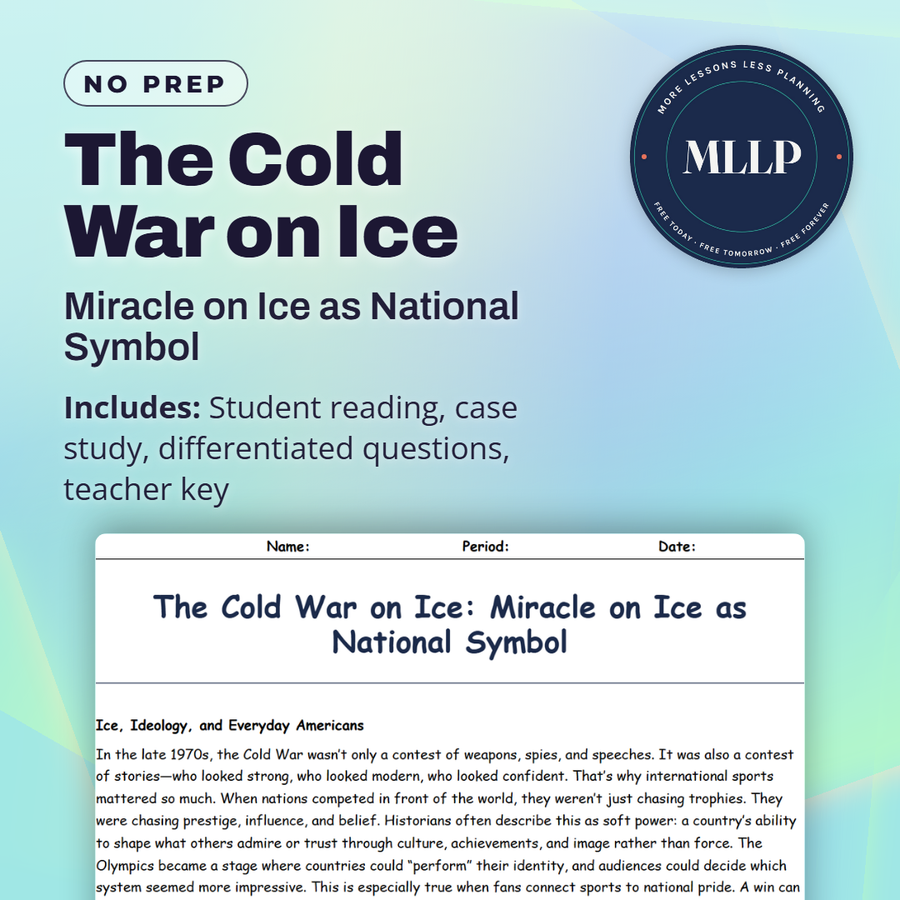
The Cold War on Ice: Miracle on Ice as National Symbol
Quality reviewed September 2026
Facts verified September 9, 2026
- Subject
- Social Studies
- Grades
- Grades 9-12
- Length
- 8-page student worksheet
- Time
- About one 50-minute class period
- Great for
- Sub plans and independent work
- Includes
- Reading passage, comprehension questions + full answer key
- Format
- Print-and-go PDF
What students do
- Compare how the US and Soviet media framed the same hockey game differently
- Explain how national pride shaped what people believed the 1980 game "meant"
- Analyze how framing by broadcast tone and replay shaped public memory
- Evaluate whether a sports moment can change policy without changing feelings
What it covers
- Cold War soft power and image
- Framing and national narrative
- Sports symbolism in geopolitics
Start reading this worksheet
Ice, Ideology, and Everyday Americans
In the late 1970s, the Cold War wasn’t only a contest of weapons, spies, and speeches. It was also a contest of stories: who looked strong, who looked modern, who looked confident. That’s why international sports mattered so much. When nations competed in front of the world, they weren’t just chasing trophies. They were chasing prestige, influence, and belief. Historians often describe this as soft power: a country’s ability to shape what others admire or trust through culture, achievements, and image rather than force. The Olympics became a stage where countries could “perform” their identity, and audiences could decide which system seemed more impressive. This is especially true when fans connect sports to national pride. A win can feel like proof that “our way works,” while a loss can feel like embarrassment. During the Cold War, that emotional reaction was amplified because the rivalry between the United States and the Soviet Union was framed as a global struggle between freedom and control. That framing wasn’t neutral; it was repeated through speeches, school lessons, films, and news coverage. By the time teams met on the ice, many people were already primed to interpret the game as symbolic. In the United States, sports also carried a particular cultural meaning: the underdog story. Americans often admire the idea that ordinary people can rise through effort, teamwork, and grit. So when a young U.S. hockey team faced the powerful Soviet program, it wasn’t just a matchup of athletes. For many viewers, it felt like a matchup of identities.
Two Hockey Systems, Two Political Stories
The Soviet hockey program was famous for discipline, conditioning, and a style built on speed and precision passing. It was also supported by a system where elite sports were treated like a national project. Officially, Olympic rules at the time favored “amateurs,” not professionals. But the Soviet team blurred that line. Many players trained full-time while holding nominal jobs connected to the military or state organizations. That arrangement created arguments about fairness and legitimacy: whether the competition was truly even and whether the public could trust the “amateur” label. The United States, in contrast, leaned into the idea that its athletes were not state-made but self-made. The 1980 roster was mostly young players connected to college hockey. That detail became part of the broader Cold War story Americans liked to tell: free individuals achieving greatness without the heavy hand of a controlling government. This is where propaganda can appear in a subtle form. Propaganda doesn’t always mean inventing facts. Often it means highlighting certain truths while ignoring others, shaping a message that supports your side. American media highlighted youth, heart, and courage. Soviet messaging highlighted collective strength and the results of organized training. Coach Herb Brooks complicates the “luck” version of the story. He didn’t simply gather a random group of kids and hope for the best. He built a team with a plan: players who could handle pressure, skate relentlessly, and commit to a demanding system. That matters historically because it reminds us that famous moments usually come from preparation plus opportunity, not magic.
Lake Placid 1980: The Mood of a Nation
To understand why the “Miracle on Ice” became such a powerful symbol, you have to understand the national mood in 1980. The United States was struggling with rising prices, energy worries, and a sense that the country’s confidence was slipping. The Iran hostage crisis, in particular, left many Americans feeling powerless and frustrated. In that atmosphere, a clear victory, especially against a rival that seemed dominant, offered emotional relief. A hockey game didn’t solve political problems, but it gave people something they could see: a moment where the U.S. stood tall. That’s one reason historians study national symbols. Symbols don’t have to change policy to matter. They can change how people feel about their country, and that can influence civic life. Pride can increase unity. Shared celebration can soften divisions, at least temporarily. Sports are especially good at creating shared moments because they’re dramatic, simple to follow, and emotionally intense. The Soviet Union was also more than a team in many Americans’ minds. It represented a threatening rival: powerful, organized, and seemingly unstoppable. Hockey, with its speed and physical intensity, made that rivalry feel even more dramatic. When the U.S. team held its ground, people interpreted it as proof that the Soviet “machine” wasn’t invincible. In other words, the game became a historical event not just because of the score, but because of what people believed the score meant.
Like what you read? The full reading, the case study, and every question set are in the free download below, along with the answer key.
Why this matters
American college players beat the best hockey team on earth at Lake Placid in 1980, and by the next morning the game had stopped being about hockey at all. American broadcasters replayed the final seconds until the score felt like proof of something larger than a scoreboard, while Soviet coverage told a different story about the same sixty minutes on the same ice.
Students walk in assuming a hockey game is just a hockey game, then trace how two countries broadcast identical minutes and reached opposite conclusions about which system was winning the Cold War. What lands is realizing meaning gets built after the final buzzer, by whoever controls the replay, not during the game itself.
From one teacher to another
This one lands because students don't expect to read about propaganda in a hockey story. The reading separates the actual game from the cultural story people built around it. Lake Placid 1980 becomes a case study in how meaning gets made, media frames the event, people's emotional moment shapes memory, and suddenly a single hockey game feels like proof that one system works better. My students come in thinking sports are separate from politics, and leave understanding they never are.
What you get
Download
Where should I send the next one?
Everything here is free and it stays that way. Leave your email and I'll send you the new lessons as they go up. You can unsubscribe from any one of them.
Related resources
Altitude, Cold Stress, and Human Adaptation: How the Body Stays in Balance
Blueprint of Power: Muscles and Joints That Make Winter Sports Work

Doping Investigations: How Forensic Science Protects Sport Integrity

Gold Medals Need Geography: Why Some Places Can Host and Others Can’t

Luge and Skeleton: Extreme Speed, Risk Variables, and Safety Engineering
Nations, Boycotts, and Global Messages: When the Olympics Become Diplomacy
Every lesson on this site is free to download and use. If one of them saved you a prep period, you can chip in a few bucks toward my three kids' daycare fund. That's genuinely where tips go.