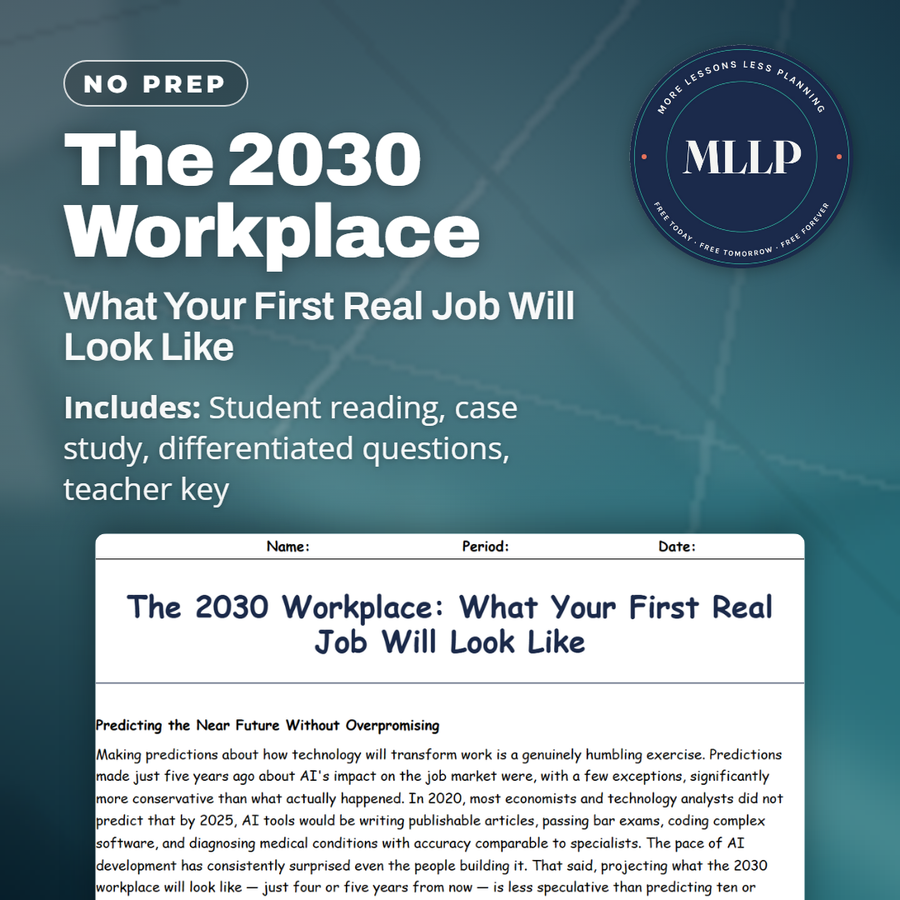
The 2030 Workplace: What Your First Real Job Will Look Like
Quality reviewed September 2026
Facts verified September 20, 2026
- Subject
- Career & Life Skills
- Grades
- Grades 9-12
- Length
- 10-page student worksheet
- Time
- About one 50-minute class period
- Great for
- Sub plans and independent work
- Includes
- Reading passage, comprehension questions + full answer key
- Format
- Print-and-go PDF
What students do
- Five terms, from hybrid work to portfolio, get matched to their definitions
- Fill in three blanks pulling spreadsheets, transparency, and degree straight from the reading
- Three multiple choice questions cover the spreadsheet and email comparison, why offices still exist, and the portfolio mindset
- Explain what changed in the hiring market that left Amara's sister struggling despite doing everything right
What it covers
- Five passages on AI as a universal workplace tool, hybrid work, disclosure norms, and skills based hiring
- A key info table summarizing credential shifts and major employers dropping degree requirements
- Amara's case study on building a portfolio before the work is polished, plus a PDF answer key
Start reading this worksheet
Predicting the Near Future Without Overpromising
Making predictions about how technology will transform work is a genuinely humbling exercise. Predictions made just five years ago about AI's impact on the job market were, with a few exceptions, significantly more conservative than what actually happened. In 2020, most economists and technology analysts did not predict that by 2025, AI tools would be writing publishable articles, passing bar exams, coding complex software, and diagnosing medical conditions with accuracy comparable to specialists. The pace of AI development has consistently surprised even the people building it. That said, projecting what the 2030 workplace will look like (just four or five years from now) is less speculative than predicting ten or twenty years out. The technologies that will reshape work in 2030 are largely visible today: they are being tested, deployed, and iterated on right now. The trends are clear even if the exact pace and distribution of change are not. For students entering the workforce in the next few years, understanding these trends is not abstract future-gazing: it is practical preparation for a workplace they will encounter soon.
AI as a Universal Workplace Tool
By 2030, AI tools will be embedded into virtually every workplace in the way that spreadsheets and email are today. The question of whether to use AI at work will no longer be a meaningful question; it will be assumed. The meaningful questions will be which tools to use, how to use them effectively, and how to maintain quality and accuracy in AI-assisted work. Workers who enter the 2030 workforce without baseline AI literacy will be in the same position as workers who entered the workforce in 2000 without the ability to use a computer, severely disadvantaged in virtually every field. The specific AI tools will vary by industry and will certainly look different in 2030 than they do today, but certain capabilities will likely be universal: AI writing and communication assistance, AI research and information synthesis, AI scheduling and workflow optimization, and AI-powered data analysis. The workers who will be most effective are not those who have memorized how to use today's specific tools, but those who have developed genuine understanding of how AI systems work, what they are good at, what they fail at, and how to direct them productively.
The Hybrid Work and AI Collaboration Environment
The 2030 workplace will involve more flexible work arrangements than current norms, with remote and hybrid work options more widespread across more industries. AI tools are partly responsible for this trend: when much of the coordination, communication, and information work that previously required physical co-presence can be handled by AI-assisted platforms, the case for mandatory office work weakens. For workers, this means that the ability to self-direct, manage your own schedule, and produce results without direct supervision will be increasingly valued. The ability to collaborate effectively with distributed teams will be essential. The physical workplace that does exist will be increasingly designed around the kinds of work that benefit from in-person collaboration: complex problem-solving sessions, relationship-building, creative brainstorming, and high-stakes communications. The routine, heads-down, individual work that once filled most office hours will increasingly happen anywhere, because AI tools make it efficient to do so regardless of location. This shift rewards people who are productive outside traditional supervision structures and challenges those who have relied on office routines as their primary source of workplace structure.
Like what you read? The full reading, the case study, and every question set are in the free download below, along with the answer key.
Why this matters
Most of your students will enter a job market where AI tool fluency and a portfolio of real work matter as much as a diploma, and several of them are already watching an older sibling or parent navigate exactly the gap this reading describes. Amara's instinct, to start documenting imperfect work now rather than waiting until it is impressive, is a habit worth naming out loud in class, because most teenagers assume they need to be good at something before they can show it to anyone.
From one teacher to another
Predicting exactly what work looks like in 2030 is guesswork, but this reading sticks to trends that are already visible: AI embedded everywhere the way email and spreadsheets are today, hybrid schedules expanding, and employers like Google, Apple, and IBM dropping degree requirements in favor of skills. Amara, the case study student, is 16 and starts a portfolio of real class projects after watching her older sister struggle to find work despite a finished business degree. Students read her reasoning for saving unfinished, unimpressive work anyway. The reading treats AI literacy as practical preparation for a job market that is already shifting, grounded in specifics rather than speculation.
What you get
Download
Where should I send the next one?
Everything here is free and it stays that way. Leave your email and I'll send you the new lessons as they go up. You can unsubscribe from any one of them.
Related resources
AI in Construction and the Skilled Trades
AI in Office Work: What Junior Roles Look Like Now
AI in Retail, Food Service, and Hospitality
How to Make Yourself AI-Proof: Skills That Still Matter
Jobs AI Will Change in the Next 10 Years
_COVER.png)
New Jobs That Didn't Exist 5 Years Ago (Prompt Engineer, AI Trainer)
Every lesson on this site is free to download and use. If one of them saved you a prep period, you can chip in a few bucks toward my three kids' daycare fund. That's genuinely where tips go.