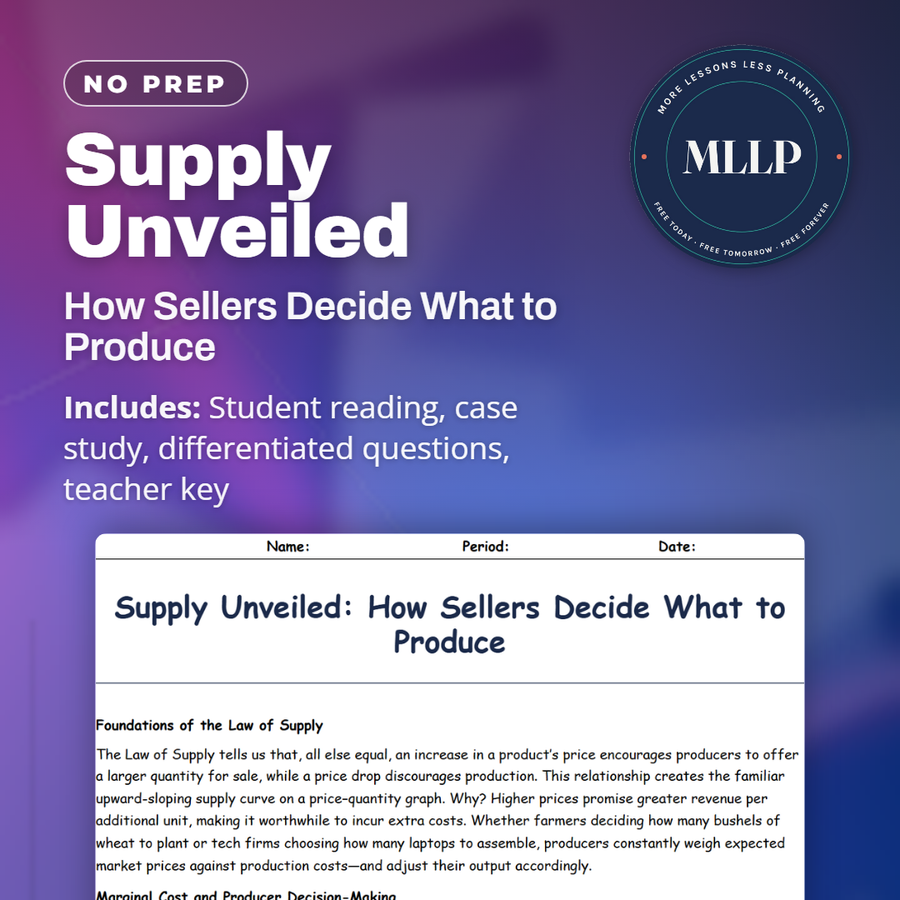
Supply Unveiled: How Sellers Decide What to Produce
Quality reviewed September 2026
Facts verified September 8, 2026
- Grades
- Grades 9-12
- Length
- 7-page student worksheet
- Time
- About one 50-minute class period
- Great for
- Sub plans and independent work
- Includes
- Reading passage, comprehension questions + full answer key
- Format
- Print-and-go PDF
What students do
- Analyze the 5G smartphone case study, where premium prices and chip shortages kept early production limited until factories invested in new equipment
- Describe how a sudden rise in energy costs would change a factory's production plans
- Match terms like supply relationship, marginal cost, input cost, technological gain, and supply adjustment to their definitions
- Explain why producers might hold back supply when they expect prices to rise
What it covers
- The foundations of the law of supply and why higher prices call forth more output
- Marginal cost and how producers decide the next unit is or is not worth making
- Technology, input prices, and other influences that shift supply, ending with a smartphone manufacturing example
Start reading this worksheet
Foundations of the Law of Supply
The Law of Supply tells us that, all else equal, an increase in a product’s price encourages producers to offer a larger quantity for sale, while a price drop discourages production. This relationship creates the familiar upward‐sloping supply curve on a price–quantity graph. Why? Higher prices promise greater revenue per additional unit, making it worthwhile to incur extra costs. Whether farmers deciding how many bushels of wheat to plant or tech firms choosing how many laptops to assemble, producers constantly weigh expected market prices against production costs, and adjust their output accordingly.
Marginal Cost and Producer Decision-Making
At the heart of every supply decision is marginal cost, the cost of producing one more unit. Firms expand output until marginal cost equals market price; beyond that, producing extra units would reduce profit. For example, extending a factory’s operating hours may involve overtime wages and additional maintenance. When those costs exceed the sale price, production slows. By comparing marginal cost curves to expected revenue, businesses optimize output and maximize profit, ensuring each unit contributes positively to the bottom line.
Influences That Alter Supply
Supply does not hinge on price alone. Non-price factors, from input costs to government policy, can cause the entire supply relationship to move. The table below summarizes key influences and their effects on what producers are willing to supply at each price: Each of these influences moves the entire supply relationship, meaning producers supply more or less at every price level. Recognizing these drivers helps predict market responses to policy changes, resource shortages, or technological breakthroughs.
Like what you read? The full reading, the case study, and every question set are in the free download below, along with the answer key.
Why this matters
A new phone launches at a premium price while the factory behind it is still limited by a chip shortage, and that gap between what buyers would pay and what the company can actually produce is the whole story of supply. The 5G case study shows a producer deciding, unit by unit, whether making one more phone is worth what it costs, long before new equipment let output catch up with demand.
Demand gets most of the airtime in the economics units I teach, so this reading is my deliberate correction, forcing equal attention onto the seller's side of the table. Once students can explain why a factory holds back production when it expects prices to rise, or ramps up after an energy cost spike, supply stops being background scenery behind the demand curve.
From one teacher to another
Demand gets all the attention, so I use this reading to give the seller's side equal time. Students follow a producer's actual decision: is the next unit worth making at this price, given what it costs to make it? The 5G phone case study shows supply stretching over time, with early output limited by chip costs until new fabrication capacity came online and volumes climbed. The question set makes them apply the logic to fresh scenarios like an energy price spike. Answer key included for quick grading.
What you get
- Answer Key
-
Student Worksheet
5G phones launched in 2022 priced $200 above earlier flagship models, and by mid-2023 new lithography tools had lifted chip yield 30 percent while cutting per-unit costs 40 percent. A temporary cut in import tariffs trimmed assembly expenses further, and factories ramped 5G output by 50 percent while retail prices held steady. Adoption then surged in regions like Southeast Asia that had been priced out before the cost drops.
Download
Where should I send the next one?
Everything here is free and it stays that way. Leave your email and I'll send you the new lessons as they go up. You can unsubscribe from any one of them.
Related resources

Ceilings & Floors: When Prices Can’t Find Their True Level

Elastic or Inelastic? Mastering Price Elasticity of Demand

Finding Balance: Market Equilibrium and Price Discovery
Markets & the State: Government’s Role in Supply and Demand
Measuring Welfare: Consumer Surplus & Producer Surplus

Supply’s Sensitivity: Understanding Price Elasticity of Supply
Every lesson on this site is free to download and use. If one of them saved you a prep period, you can chip in a few bucks toward my three kids' daycare fund. That's genuinely where tips go.