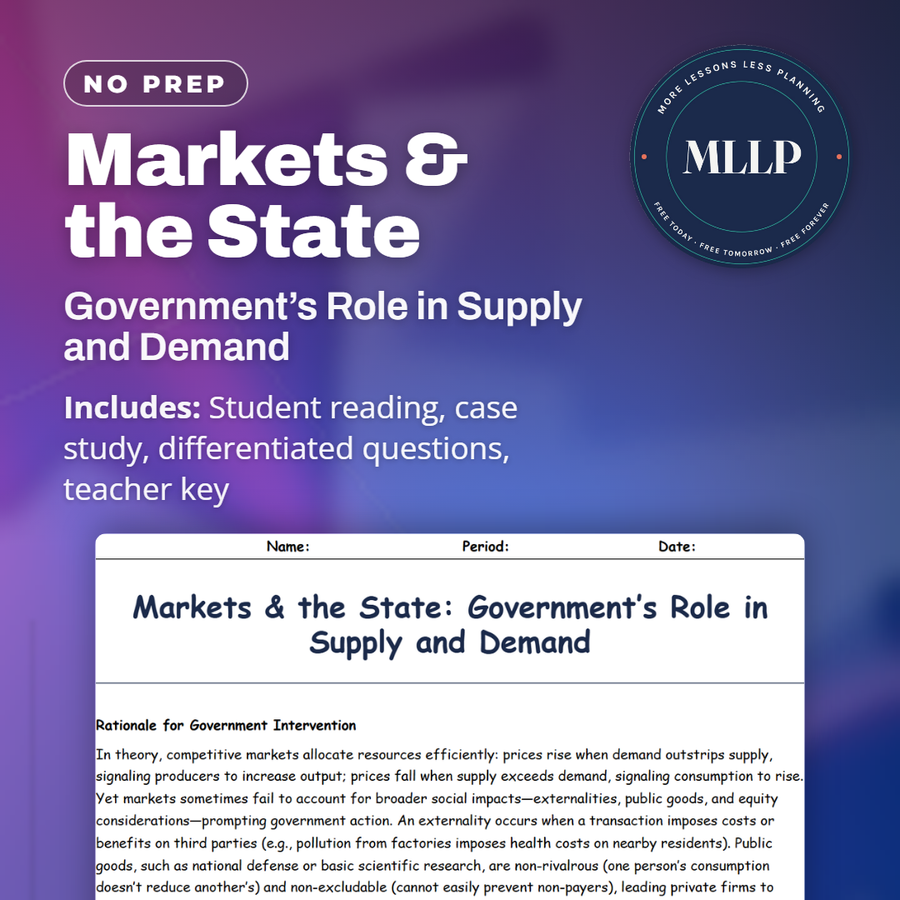
Markets & the State: Government’s Role in Supply and Demand
Quality reviewed September 2026
Facts verified September 8, 2026
- Grades
- Grades 9-12
- Length
- 8-page student worksheet
- Time
- About one 50-minute class period
- Great for
- Sub plans and independent work
- Includes
- Reading passage, comprehension questions + full answer key
- Format
- Print-and-go PDF
What students do
- Analyze the Greenvale case study, where a $30 per-ton carbon tax raised gas prices 20 cents a gallon and pushed investment toward renewables
- Explain how taxes and subsidies shift supply curves and change what gets produced
- Match policy tools like carbon tax, subsidy, emissions regulation, transit voucher program, and research grants to their definitions
- Discuss why pairing the carbon tax with transit and home-weatherization grants made the policy easier to accept
What it covers
- The rationale for government intervention in otherwise free markets
- How taxes and subsidies shift supply curves and reshape incentives
- Regulations and public goods, anchored by a carbon tax and renewable subsidy case study
Start reading this worksheet
Rationale for Government Intervention
In theory, competitive markets allocate resources efficiently: prices rise when demand outstrips supply, signaling producers to increase output; prices fall when supply exceeds demand, signaling consumption to rise. Yet markets sometimes fail to account for broader social impacts (externalities, public goods, and equity considerations), prompting government action. An externality occurs when a transaction imposes costs or benefits on third parties (e.g., pollution from factories imposes health costs on nearby residents). Public goods, such as national defense or basic scientific research, are non-rivalrous (one person’s consumption doesn’t reduce another’s) and non-excludable (cannot easily prevent non-payers), leading private firms to underprovide them. Finally, markets can produce unequal income distributions, warranting redistributive policies. By imposing corrective taxes, offering subsidies, setting regulations, and providing public goods, governments aim to align private incentives with social welfare and ensure that vulnerable populations are protected.
Taxes and Subsidies: Shifting Supply Curves
A per-unit tax on producers effectively raises their marginal cost by the tax amount. Graphically, the entire supply curve shifts upward (or leftward) by that amount. Consumers face higher market prices, while producers receive a lower net price (market price minus tax). The result is a higher consumer price, lower producer revenue, and reduced equilibrium quantity. Governments collect tax revenue (the rectangle between price paid and price received), though some trades that would have benefited both parties no longer occur, creating deadweight loss. Conversely, a per-unit subsidy lowers producers’ marginal cost by the subsidy amount, shifting supply downward (or rightward). Consumers enjoy lower prices, producers receive higher net revenue, and equilibrium quantity rises. While total welfare increases through expanded trade, taxpayers bear the subsidy cost, which can lead to debates about budgetary priorities.
Like what you read? The full reading, the case study, and every question set are in the free download below, along with the answer key.
Why this matters
Ask why a government gets to raise the price of gas and most students assume it is just a cash grab. Greenvale's carbon tax added thirty dollars per ton, which showed up as twenty cents more at the pump, but the point was never the twenty cents. It was pushing investment toward renewables and pairing the cost with transit vouchers and weatherization grants.
The transit and weatherization piece is what changes my students' minds. They arrive certain a tax just punishes drivers, then notice Greenvale built relief into the policy itself. This is the argument I want them to leave with: a tax is a lever, not a punishment, and whether it works depends on what a government does with the money it raises.
From one teacher to another
I use this reading when students ask why the government meddles in markets at all. The Greenvale carbon tax case gives them a full policy story: refineries passed costs to consumers, gas got more expensive, and money flowed toward renewables and transit vouchers. Students see that a tax is never just a price change, it rewires incentives across an economy. The matching section keeps the policy vocabulary straight, and the short answer questions push them to argue whether the trade-offs were worth it. Answer key included.
What you get
- Answer Key
-
Student Worksheet
By 2024, renewable capacity in Greenvale had doubled and power-sector emissions had fallen 25 percent, even though fossil fuel use dropped only 5 percent at first. Electricity rates rose 5 percent, the tax brought in $500 million a year, and surveys found 70 percent of residents backed the package. A policy table then lines up emissions rules, price ceilings, and price floors by which curve each one shifts.
Download
Where should I send the next one?
Everything here is free and it stays that way. Leave your email and I'll send you the new lessons as they go up. You can unsubscribe from any one of them.
Related resources

Ceilings & Floors: When Prices Can’t Find Their True Level

Elastic or Inelastic? Mastering Price Elasticity of Demand

Finding Balance: Market Equilibrium and Price Discovery
Measuring Welfare: Consumer Surplus & Producer Surplus
Supply Unveiled: How Sellers Decide What to Produce

Supply’s Sensitivity: Understanding Price Elasticity of Supply
Every lesson on this site is free to download and use. If one of them saved you a prep period, you can chip in a few bucks toward my three kids' daycare fund. That's genuinely where tips go.