Supply’s Sensitivity: Understanding Price Elasticity of Supply
Quality reviewed September 2026
Facts verified September 8, 2026
- Grades
- Grades 9-12
- Length
- 6-page student worksheet
- Time
- About one 50-minute class period
- Great for
- Sub plans and independent work
- Includes
- Reading passage, comprehension questions + full answer key
- Format
- Print-and-go PDF
What students do
- Analyze the vaccine production case study, where supply stayed inelastic at first because factories were already running at full capacity
- Describe how modular fill-finish plants made vaccine supply far more responsive over time
- Match determinants like spare capacity, input specificity, production lead time, inventory flexibility, and regulatory barriers to their definitions
- Explain why digital products can show highly elastic supply almost immediately after a price rise
What it covers
- What price elasticity of supply measures and what makes supply responsive
- Short-run versus long-run elasticities and why time changes everything for producers
- Real-world variation across industries, from vaccines to digital goods
Start reading this worksheet
Defining Supply Elasticity
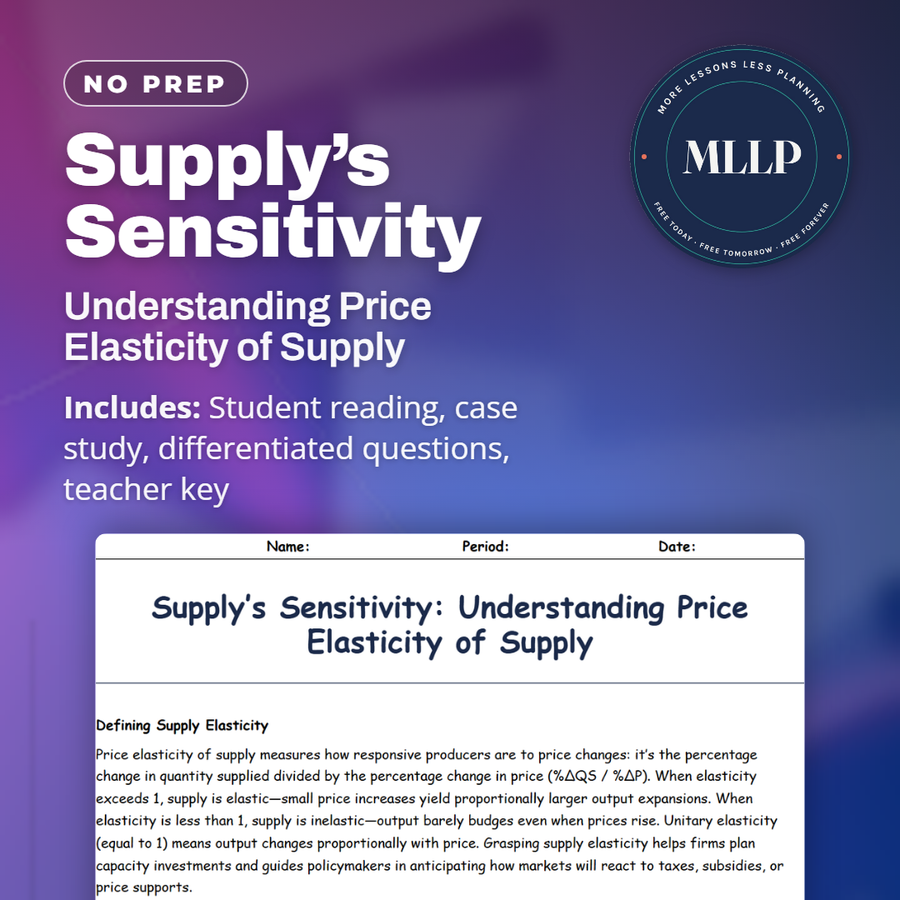
Price elasticity of supply measures how responsive producers are to price changes: it’s the percentage change in quantity supplied divided by the percentage change in price (%ΔQS / %ΔP). When elasticity exceeds 1, supply is elastic. Small price increases yield proportionally larger output expansions. When elasticity is less than 1, supply is inelastic. Output barely budges even when prices rise. Unitary elasticity (equal to 1) means output changes proportionally with price. Grasping supply elasticity helps firms plan capacity investments and guides policymakers in anticipating how markets will react to taxes, subsidies, or price supports.
Short Run vs. Long Run Elasticities
In the short run, many production inputs are fixed. Factories operate at existing capacity, and land or equipment cannot be quickly added, so supply is relatively inelastic. Over the long run, firms can adjust all inputs: build new plants, hire more workers, or adopt new technologies, rendering supply more elastic. For example, a factory may struggle to boost output immediately if machinery is running at full tilt (short-run), but over months it can install additional production lines (long-run). Recognizing these temporal differences allows analysts to predict how quickly supply can respond to price changes. This table illustrates why some industries (from clothing manufacturing to digital services) can scale up swiftly, while others, like heavy machinery, require extended lead times.
Like what you read? The full reading, the case study, and every question set are in the free download below, along with the answer key.
Why this matters
Vaccine factories running at full capacity early in the pandemic could not make more doses just because prices or urgency went up. Supply stayed inelastic until manufacturers built modular fill-finish plants and cleared regulatory hurdles, which took months, not days. Compare that to a digital product, where another copy costs almost nothing and supply can stretch the moment demand does.
"Why can't they just make more?" is the question I hear most when this topic comes up, and this reading finally gives students an answer beyond a shrug. Spare capacity, how specialized the inputs are, how long production actually takes: all of it decides whether a price increase turns into more output next week or next year instead of never.
From one teacher to another
This is the reading I use to answer a question students always raise: if prices go up, why can't companies just make more? The vaccine case study explains it well. Early in the pandemic, plants were maxed out, so even tripling prices barely moved output. Supply only loosened once manufacturers added modular capacity and cleared regulatory hurdles. Students then flip the logic to digital goods, where another copy costs almost nothing and supply stretches instantly. The determinants list gives them a framework they can reuse all semester.
What you get
- Answer Key
-
Student Worksheet
Global health agencies forecast a surge in vaccine demand in early 2021, but with contract manufacturers already running full tilt, a price move from $5 to $15 a dose lifted output just 10% that quarter, an elasticity near 0.05. By mid-2022, after new production lines and added manufacturers, output had quadrupled and elasticity reached 1.2, the same product flipping from rigid to responsive once firms had time to build capacity.
Download
Where should I send the next one?
Everything here is free and it stays that way. Leave your email and I'll send you the new lessons as they go up. You can unsubscribe from any one of them.
Related resources

Ceilings & Floors: When Prices Can’t Find Their True Level

Elastic or Inelastic? Mastering Price Elasticity of Demand
Finding Balance: Market Equilibrium and Price Discovery
Markets & the State: Government’s Role in Supply and Demand
Measuring Welfare: Consumer Surplus & Producer Surplus
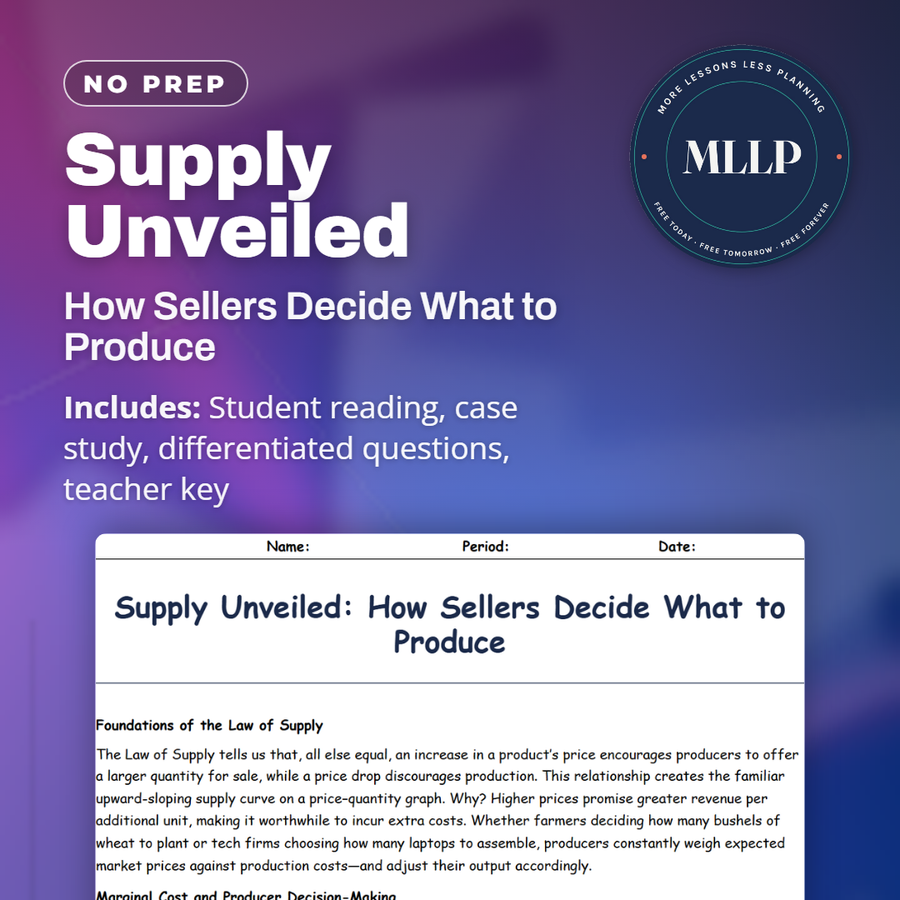
Supply Unveiled: How Sellers Decide What to Produce
Every lesson on this site is free to download and use. If one of them saved you a prep period, you can chip in a few bucks toward my three kids' daycare fund. That's genuinely where tips go.