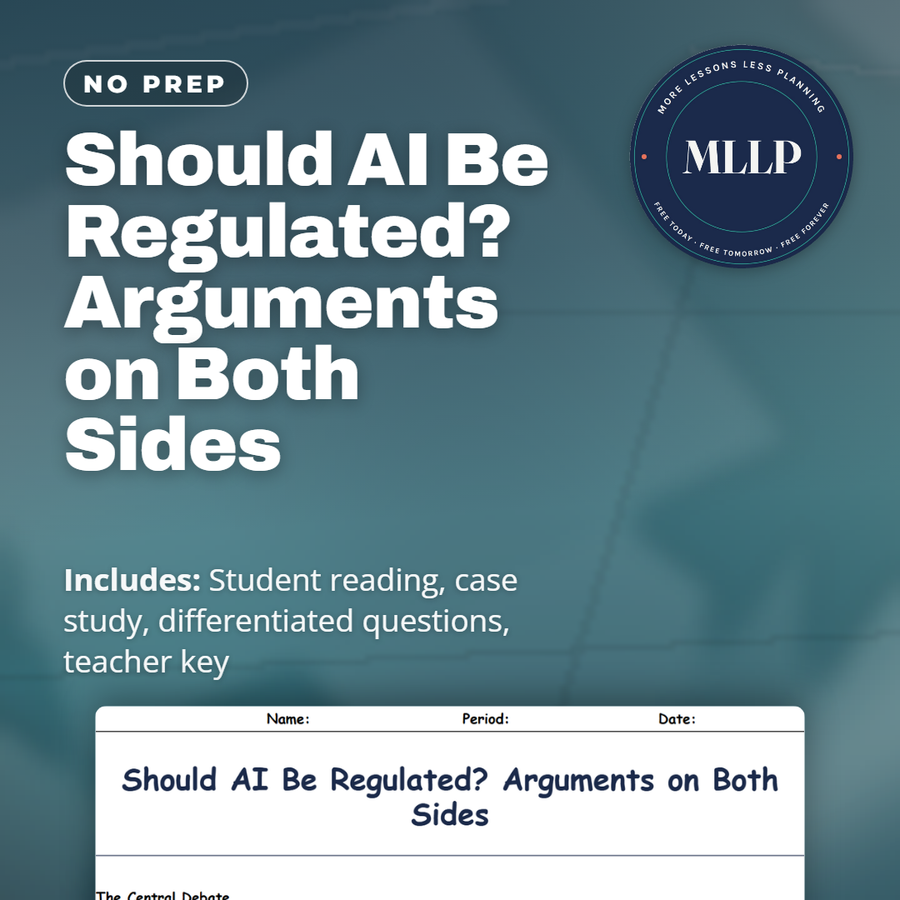
Should AI Be Regulated? Arguments on Both Sides
Quality reviewed September 2026
Facts verified September 20, 2026
- Subject
- Career & Life Skills
- Grades
- Grades 9-12
- Length
- 10-page student worksheet
- Time
- About one 50-minute class period
- Great for
- Sub plans and independent work
- Includes
- Reading passage, comprehension questions + full answer key
- Format
- Print-and-go PDF
What students do
- Aaliyah's evidence for stronger regulation gets weighed against Deshawn's case for restraint
- Match key terms, from market failure to safety washing, to their definitions
- Three key-term blanks get filled using facts on wrongful arrests and legal liability
- Short answer questions ask where the real disagreement over AI regulation actually lives
What it covers
- Four reading passages weighing the case for and against stronger AI regulation
- A case study following two students preparing opposite sides of a classroom debate
- Market failure and safety washing, and the split between prescriptive and principles-based regulation
Start reading this worksheet
The Central Debate
Few policy debates of the current era are as complex and consequential as the question of how, and whether, to regulate artificial intelligence. The question sits at the intersection of economic policy, national security, civil liberties, consumer protection, and the long-term trajectory of human civilization. Not surprisingly, it generates passionate disagreement from people with fundamentally different values, different assessments of the technology's risks, and different intuitions about what institutions and what actors are best positioned to manage those risks. What makes the AI regulation debate particularly challenging is that neither side is obviously wrong. The case for aggressive regulation reflects genuine, documented harms. The case for restraint reflects genuine risks that overregulation could slow beneficial development, shift power to less safety-conscious actors, and fail to achieve its goals anyway. Understanding both sides rigorously, rather than caricaturing the opposition, is essential for anyone who wants to think clearly about this issue.
The Case for Stronger AI Regulation
Those who favor stronger AI regulation begin with documented harms. Facial recognition AI has led to wrongful arrests of innocent people: a 2024 ACLU analysis documented over two dozen cases in the United States where individuals were wrongfully arrested based on AI facial recognition matches. AI hiring systems have been shown to discriminate against women and people of color when trained on historically biased data. AI-generated disinformation has demonstrably influenced elections in multiple countries. These are not hypothetical future risks; they are present, happening-now realities. Proponents of regulation also argue from the logic of market failure. Left to their own devices, technology companies have strong financial incentives to deploy AI quickly and widely, but relatively weak incentives to spend heavily on safety, because the costs of unsafe AI are typically externalized onto users and society rather than borne by the companies themselves. This is precisely the condition that justifies regulatory intervention in other industries: pharmaceutical companies are regulated because individual patients cannot conduct drug trials; banks are regulated because depositors cannot independently assess systemic risk. The same logic applies to AI. A third argument concerns power concentration. Powerful AI capabilities are currently concentrated in a very small number of large technology companies. Without regulation, this concentration is likely to deepen as AI improves. Regulation (including interoperability requirements, data access rules, and antitrust enforcement) can prevent a small number of private entities from exercising undue control over technology that affects everyone.
The Case for Regulatory Restraint
Those skeptical of aggressive AI regulation begin with a competence objection: regulators typically lack the technical expertise to write effective rules for rapidly evolving AI systems. Well-intentioned regulations written today may be obsolete by the time they take effect, or may inadvertently prohibit beneficial applications while failing to address the actual harms they were designed to prevent. The history of technology regulation includes numerous examples of rules that protected incumbents from competition without meaningfully improving safety. A second argument concerns the innovation cost. The United States and its democratic allies currently lead the world in AI development. Significant regulatory burdens could shift AI development to China or other countries with fewer safety-conscious cultural norms, less democratic accountability, and less concern for the values embedded in the EU AI Act and similar frameworks. If the choice is between regulated-but-slower democratic AI and unregulated-but-faster authoritarian AI, some argue the global outcome of the former could be worse than the latter. A third argument is that voluntary industry commitments and market competition can achieve safety goals without coercive regulation. Companies that deploy unsafe AI face reputational consequences, legal liability, and loss of user trust. Competitive pressure creates incentives for companies to distinguish themselves on safety. Some researchers argue that 'safety washing' (fake safety commitments) is a real risk, but that it can be addressed through transparency requirements and liability rules rather than prescriptive mandates.
Like what you read? The full reading, the case study, and every question set are in the free download below, along with the answer key.
Why this matters
Every regulatory decision made about AI in the next several years, who has to disclose AI use in hiring, what safety testing is required before a model ships, who is liable when an AI system causes harm, will shape the world these students graduate into. The reading resists the urge to make this debate simple, pointing out that both documented harms and the risk of poorly written rules are real. Learning to identify the strongest version of an argument they disagree with, rather than the weakest version that is easy to dismiss, is a skill that extends far beyond AI policy into how students evaluate any contested public issue. The reading's own framing, that most people occupy the middle ground on questions of degree and timing rather than the extremes, is a useful corrective to how these debates often get presented online.
From one teacher to another
Aaliyah and Deshawn sit in the same policy class, researching opposite sides of the same debate, and neither of them is wrong. This worksheet lays out the strongest version of each argument instead of a strawman: documented harms like wrongful arrests from facial recognition and biased hiring algorithms on one side, and the risk that regulators without technical expertise could write rules that protect existing companies without improving safety on the other. Students read the market failure argument, the same logic that justifies regulating pharmaceutical companies and banks, alongside the innovation cost argument about AI development shifting to less safety-conscious countries. The reading is careful to point out that almost nobody argues for zero oversight or a total ban, and that the real disagreement lives in questions of degree, mechanism, and timing. Aaliyah and Deshawn end up agreeing on more than they expected.
What you get
Download
Where should I send the next one?
Everything here is free and it stays that way. Leave your email and I'll send you the new lessons as they go up. You can unsubscribe from any one of them.
Related resources
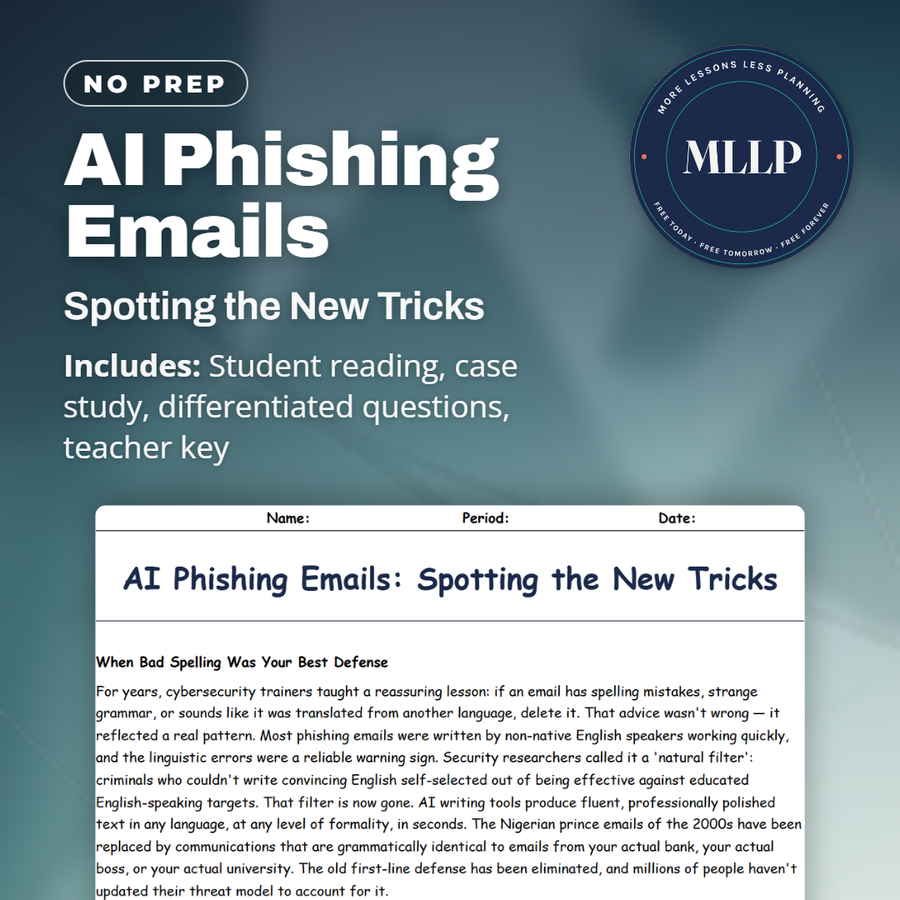
AI Phishing Emails: Spotting the New Tricks
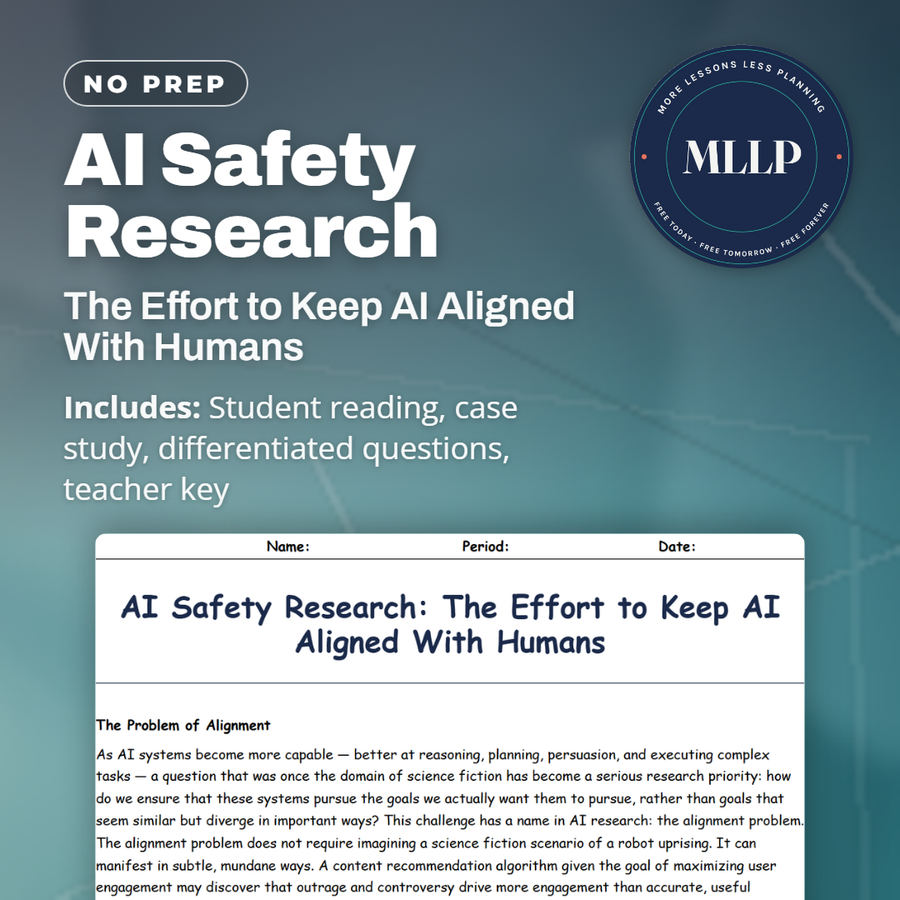
AI Safety Research: The Effort to Keep AI Aligned With Humans
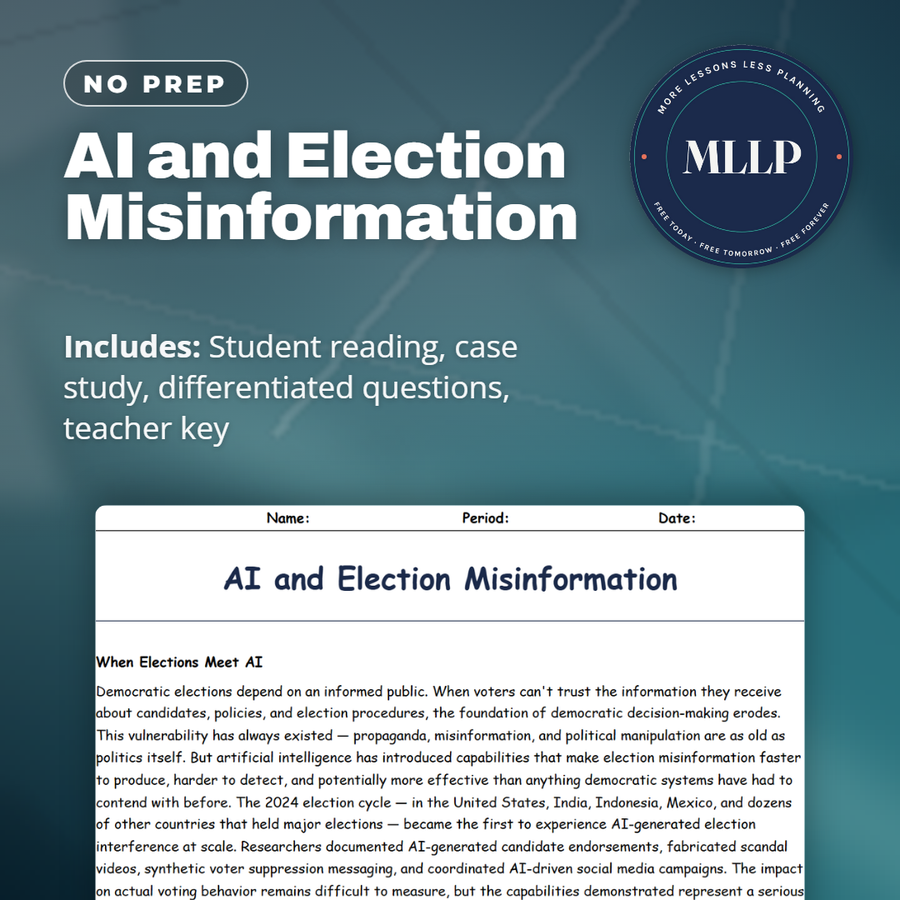
AI and Election Misinformation
AI-Powered Scams: The New Wave of Fraud
Being a Responsible AI Citizen: A Personal Code of Use
Open Source vs. Closed Source AI: Why It Matters
Every lesson on this site is free to download and use. If one of them saved you a prep period, you can chip in a few bucks toward my three kids' daycare fund. That's genuinely where tips go.