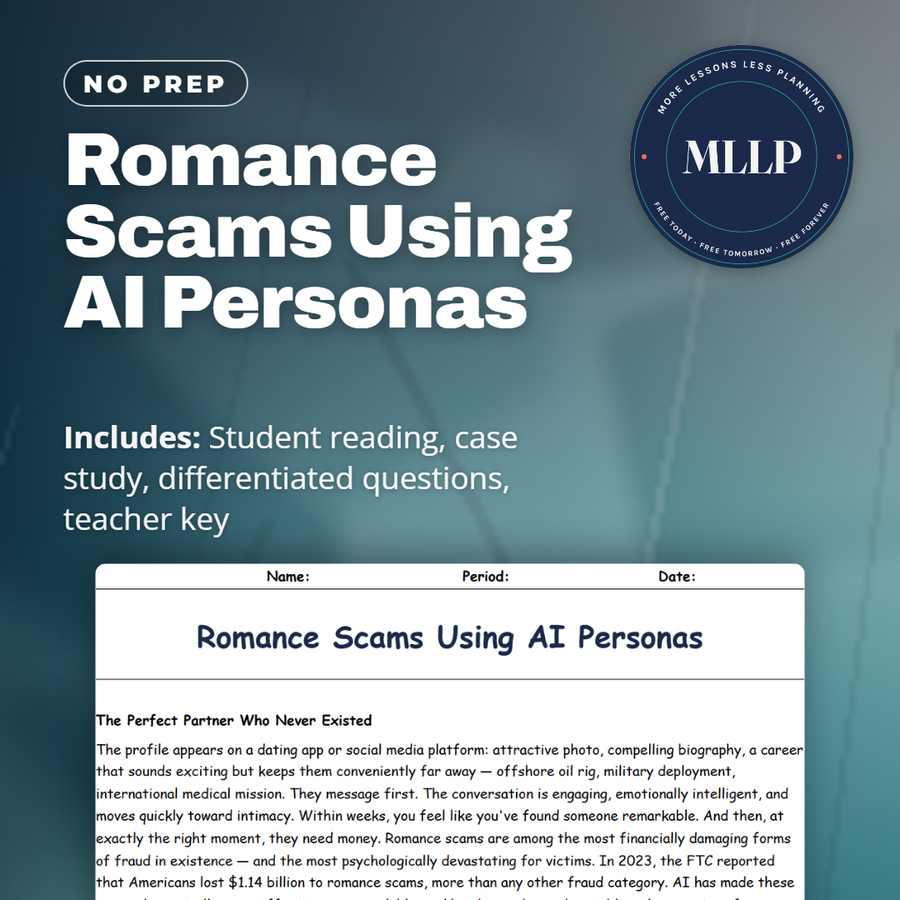
Romance Scams Using AI Personas
Quality reviewed September 2026
Facts verified September 20, 2026
- Subject
- Career & Life Skills
- Grades
- Grades 9-12
- Length
- 9-page student worksheet
- Time
- About one 50-minute class period
- Great for
- Sub plans and independent work
- Includes
- Reading passage, comprehension questions + full answer key
- Format
- Print-and-go PDF
What students do
- David's six-month relationship with 'Sarah' gets checked against the reading's five warning signs
- Match key terms, from pig-butchering to the sunk cost fallacy, to their definitions
- Three key-term blanks get filled using facts from the reading, including the 2023 loss total
- Short answer questions explain why smart, educated people fall for these scams as often as anyone else
What it covers
- Five reading passages on romance scams, AI-generated personas, and the psychology of the pig-butchering scam
- A case study following David's escalating online relationship with an AI-generated persona
- Pig-butchering, the grooming phase, the sunk cost fallacy, and the video call test
Start reading this worksheet
The Perfect Partner Who Never Existed
The profile appears on a dating app or social media platform: attractive photo, compelling biography, a career that sounds exciting but keeps them conveniently far away (offshore oil rig, military deployment, international medical mission). They message first. The conversation is engaging, emotionally intelligent, and moves quickly toward intimacy. Within weeks, you feel like you've found someone remarkable. And then, at exactly the right moment, they need money. Romance scams are among the most financially damaging forms of fraud in existence, and the most psychologically devastating for victims. In 2023, the FTC reported that Americans lost $1.14 billion to romance scams, more than any other fraud category. AI has made these scams dramatically more effective, more scalable, and harder to detect by enabling the creation of synthetic personas that can maintain convincing relationships with thousands of victims simultaneously.
What AI Adds to Romance Fraud
Traditional romance scams required human operators to maintain relationships manually. Each fake persona needed a real person to write messages, track what they'd said to each victim, respond to questions, and manage the emotional arc of the relationship. This was labor-intensive, and the human operators often made mistakes: inconsistencies in the story, emotional tone that didn't quite match, or simple inability to maintain multiple relationships at scale without slipping up. AI changes this in fundamental ways. A single AI system can manage thousands of 'relationships' simultaneously, maintaining complete memory of every conversation with every victim. It can generate emotionally calibrated responses: being supportive when someone shares something difficult, being playful when things are light, being passionate when that's what the emotional arc requires. It can generate original love letters, poems, and deeply personal-feeling messages that are actually produced algorithmically. AI-generated profile photos have also improved dramatically. Early fake profiles used stock photos or images stolen from real people's social media accounts. Reverse image searches could often expose them. Today, AI image generators create entirely synthetic faces that belong to no real person. These images pass reverse image searches because they don't exist anywhere else online, and they can be generated to match whatever appearance the scammer thinks will appeal to the target.
The Anatomy of a Romance Scam
Romance scams follow a predictable arc called 'pig-butchering', a term from Mandarin Chinese that refers to the practice of fattening a pig before slaughter. The first phase is grooming: intensive emotional investment, daily contact, declarations of connection, and the gradual construction of what feels like a genuine relationship. Victims describe this phase as among the most meaningful relationships they've ever had. The second phase introduces financial elements gradually. This might begin with sharing an 'incredible investment opportunity' (often involving cryptocurrency) or a personal crisis requiring temporary assistance. The amounts start small and escalate. Each successful request increases the victim's investment in the relationship and their reluctance to accept that the person they care about is not real. By the time the scam reaches its full scale, victims may have sent tens or even hundreds of thousands of dollars. The third phase is the exit. Once a victim runs out of money or starts asking too many difficult questions, the persona disappears, blocking contact and leaving the victim with financial loss, emotional trauma, and often profound shame that makes them reluctant to report what happened.
Like what you read? The full reading, the case study, and every question set are in the free download below, along with the answer key.
Why this matters
Students are the exact age group the reading identifies as reporting the most romance scam victimization, and most of them are already on the dating apps and social platforms where these scams start. The video call test the reading recommends, asking someone to get on an unscripted live call before any money changes hands, is a specific, teachable habit rather than a vague warning to be careful online. The reading also names the psychological trap that keeps people from getting out once they suspect something is wrong: the sunk cost fallacy, the same mechanism that makes it hard to walk away from any investment of time, money, or emotion. Understanding that mechanism in the classroom, before it applies to their own life, gives students a chance to recognize it in themselves or a friend before real money is lost.
From one teacher to another
Sarah's profile photo returned zero matches on a reverse image search, because she doesn't exist. This worksheet uses David's story, three months into an online relationship with a synthetic AI persona who is now asking for $10,000 in crypto returns, to walk students through how AI has changed romance scams. The reading breaks the scam into three phases, grooming, financial escalation, and exit, a pattern researchers call pig-butchering. Students learn why AI-generated faces beat the reverse image searches that used to catch stolen photos, and why the FTC's $1.14 billion 2023 loss figure keeps climbing. The reading is also direct about who gets targeted, naming adults aged 18 to 29 as the group that reports being victimized most often.
What you get
Download
Where should I send the next one?
Everything here is free and it stays that way. Leave your email and I'll send you the new lessons as they go up. You can unsubscribe from any one of them.
Related resources
AI Phishing Emails: Spotting the New Tricks
AI Safety Research: The Effort to Keep AI Aligned With Humans
AI and Election Misinformation
AI-Powered Scams: The New Wave of Fraud
Being a Responsible AI Citizen: A Personal Code of Use
Open Source vs. Closed Source AI: Why It Matters
Every lesson on this site is free to download and use. If one of them saved you a prep period, you can chip in a few bucks toward my three kids' daycare fund. That's genuinely where tips go.