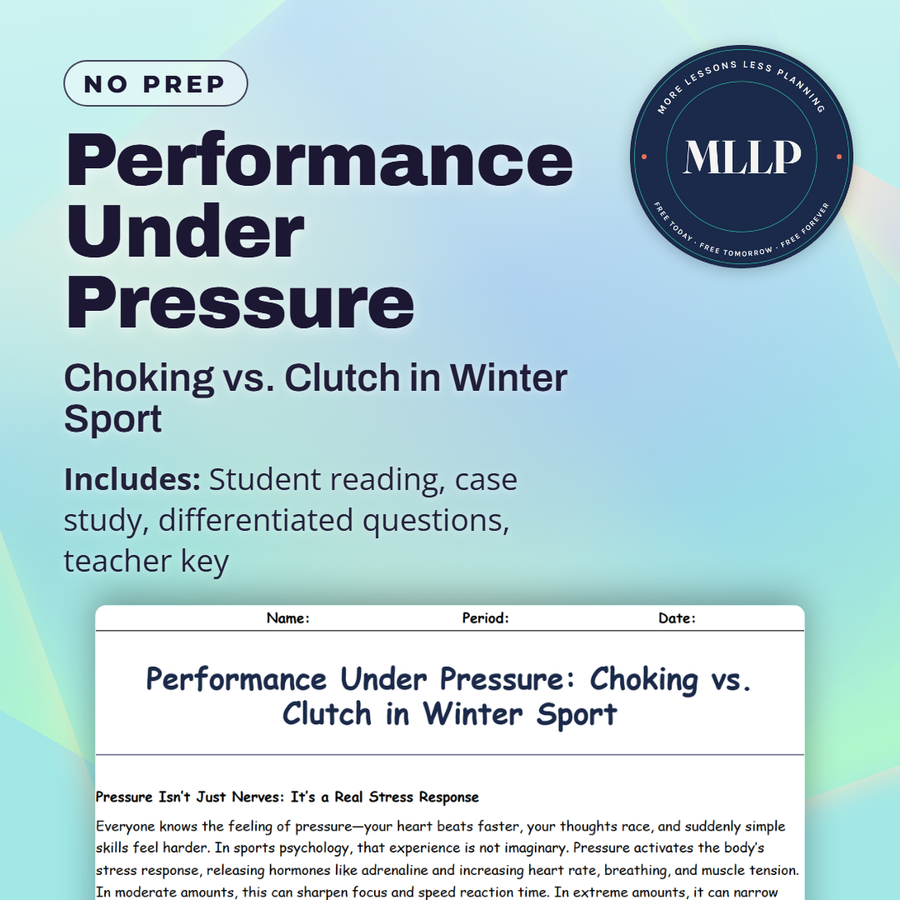
Performance Under Pressure: Choking vs. Clutch in Winter Sport
Quality reviewed September 2026
Facts verified September 9, 2026
- Subject
- Health & PE
- Grades
- Grades 9-12
- Length
- 8-page student worksheet
- Time
- About one 50-minute class period
- Great for
- Sub plans and independent work
- Includes
- Reading passage, comprehension questions + full answer key
- Format
- Print-and-go PDF
What students do
- Analyze how attention shifts affect performance under pressure
- Identify stress responses and how to regulate arousal
- Evaluate pre-performance routines and reset strategies
- Apply mental skills to real high-pressure scenarios
What it covers
- Stress response and attention
- Mental techniques and cue words
- Pressure management and recovery
Start reading this worksheet
Pressure Isn’t Just Nerves: It’s a Real Stress Response
Everyone knows the feeling of pressure: your heart beats faster, your thoughts race, and suddenly simple skills feel harder. In sports psychology, that experience is not imaginary. Pressure activates the body’s stress response, releasing hormones like adrenaline and increasing heart rate, breathing, and muscle tension. In moderate amounts, this can sharpen focus and speed reaction time. In extreme amounts, it can narrow attention too much, disrupt timing, and increase mistakes. That’s why the same athlete can look unstoppable in practice and shaky in a final run. The environment changed, and the brain-body system changed with it. Winter sports can magnify pressure because outcomes often turn on tiny moments: a single landing, one missed gate, one shot in biathlon, one wobble in a spin. The margin is small, so the mind begins to treat each move as high-stakes. This can pull athletes into a mental trap: trying too hard to control movements that normally happen automatically. Psychologists sometimes describe this as “overthinking the automatic.” When that happens, timing becomes choppy and confidence drops. But pressure doesn’t always cause failure. Some athletes perform better under pressure, in what fans call “clutch.” The difference often comes down to attention and interpretation. Athletes who choke often interpret pressure as threat: “If I mess up, I ruin everything.” Athletes who thrive often interpret pressure as challenge: “This is hard, but I’m ready.” That shift doesn’t eliminate nerves, but it changes how the brain uses them.
Attention: Where Your Mind Goes, Your Performance Follows
One of the simplest ways to understand choking is to look at attention. In high-pressure moments, attention can become too narrow (tunnel vision) or too scattered (distracted). Either way, performance suffers. Winter sports require both focus and flexibility. A skier must focus on the next gate while staying responsive to changing snow texture. A skater must focus on rotation while adjusting balance mid-air. If attention locks on the wrong thing (fear, the crowd, the scoreboard), the athlete loses the present moment. Athletes often use pre-performance routines to protect attention. A routine might include breathing, cue words, visualization, or a consistent sequence before starting. Routines work because they create familiarity inside an unfamiliar moment. They also give the athlete something controllable to do. You can’t control judges or weather, but you can control your breathing and your cue word. Confidence also plays a role. Confidence isn’t pretending you’re perfect; it’s trusting your preparation. Athletes with stable confidence recover faster from small errors. Athletes with shaky confidence treat small errors as proof they’re failing, and that spirals. Coaches often train “reset skills”: a quick mental action that returns the athlete to the next task rather than the last mistake. This is why mental training belongs next to physical training. The brain is part of performance. Ignoring it doesn’t make pressure disappear.
Clutch Performance: Skills That Keep Athletes Stable
Clutch performance is not luck. It is often the result of habits: routine, breathing control, self-talk, and experience in pressure settings. One important tool is arousal regulation: the ability to raise or lower intensity to match the task. Some athletes get too amped and need calming strategies. Others get too flat and need energizing strategies. The right level depends on the sport. A shooter in biathlon needs calm steadiness. A downhill skier may need controlled aggression. Another clutch skill is external focus. Instead of thinking, “Don’t fall,” an athlete focuses on a cue like “strong edges” or “quick hands.” This directs attention to an action rather than a fear. Visual imagery can also help. Athletes mentally rehearse the exact movement pattern they want, which can prime the nervous system. Clutch athletes also accept nerves as normal. They don’t panic about feeling nervous. They interpret nerves as readiness. That reduces the “second fear” (fear of fear), which often causes choking.
Like what you read? The full reading, the case study, and every question set are in the free download below, along with the answer key.
Why this matters
Most athletes assume choking is a sign of weakness. Lena's story argues otherwise. The instant the stakes spiked, her focus jumped from her practiced routine to her fear of failing, and her timing fell apart in the gap between those two things.
Students tend to think clutch performers simply have stronger nerves. This reading argues the opposite: the difference between choking and clutch is a set of trainable habits, cue words, reset routines, and deliberate control over where attention goes. I walk through Lena's recovery step by step with the class, and that is what makes it click: afterward students start noticing the same pressure traps in their own test-taking instead of treating nerves as something fixed.
From one teacher to another
Most athletes think choking is a sign of weakness, but it's actually a misdirection of attention under pressure. Lena's story shows exactly how: when stakes spike, her thoughts jumped to fear and away from her routine, and suddenly her timing collapsed. The worksheet walks through what mental skills brought her back, and students identify their own pressure traps in sport and academics. Training your mental response to stress is trainable and testable, that reframes pressure from something you endure to something you can build skills around.
What you get
Download
Where should I send the next one?
Everything here is free and it stays that way. Leave your email and I'll send you the new lessons as they go up. You can unsubscribe from any one of them.
Related resources
Altitude, Cold Stress, and Human Adaptation: How the Body Stays in Balance
Blueprint of Power: Muscles and Joints That Make Winter Sports Work
Doping Investigations: How Forensic Science Protects Sport Integrity

Gold Medals Need Geography: Why Some Places Can Host and Others Can’t
Luge and Skeleton: Extreme Speed, Risk Variables, and Safety Engineering
Nations, Boycotts, and Global Messages: When the Olympics Become Diplomacy
Every lesson on this site is free to download and use. If one of them saved you a prep period, you can chip in a few bucks toward my three kids' daycare fund. That's genuinely where tips go.