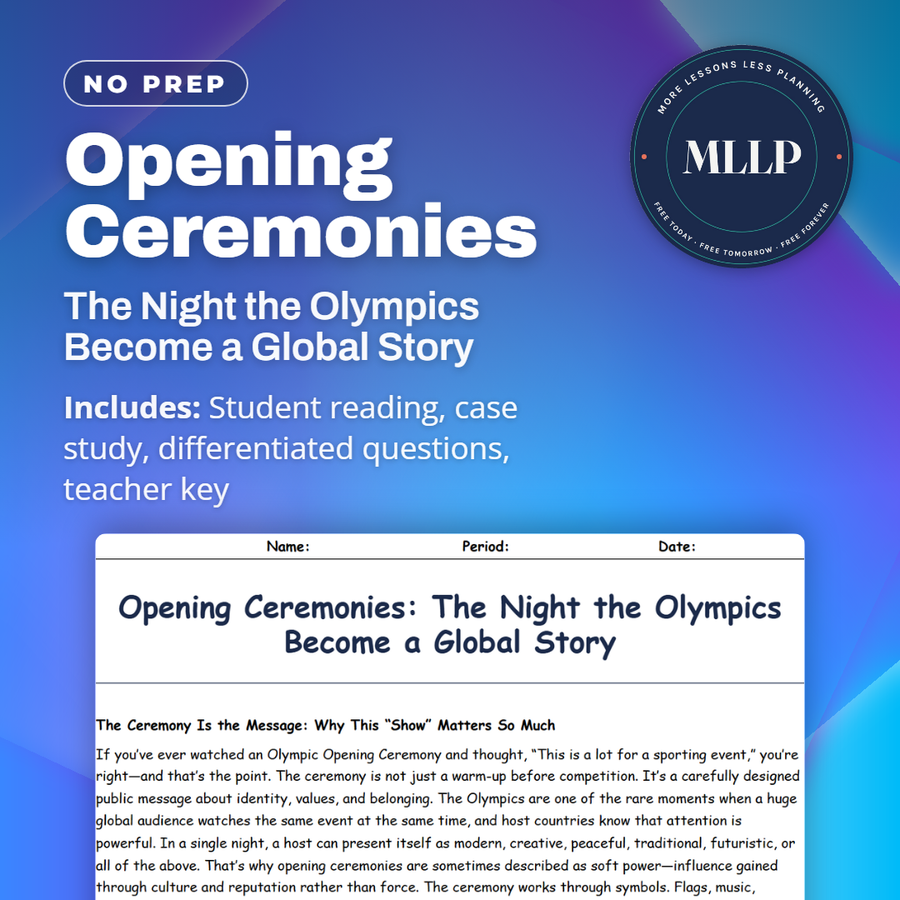
Opening Ceremonies: The Night the Olympics Become a Global Story
Quality reviewed September 2026
Facts verified September 9, 2026
- Subject
- Social Studies
- Grades
- Grades 9-12
- Length
- 9-page student worksheet
- Time
- About one 50-minute class period
- Great for
- Sub plans and independent work
- Includes
- Reading passage, comprehension questions + full answer key
- Format
- Print-and-go PDF
What students do
- Analyze how opening ceremonies communicate national identity
- Evaluate whose stories are highlighted, excluded, or simplified
- Explain why rituals like torch-lighting build legitimacy
- Compare intended message vs. audience impact in ceremonies
What it covers
- Symbolism and representation
- Ritual and legitimacy
- Spectacle and media literacy
Start reading this worksheet
The Ceremony Is the Message: Why This “Show” Matters So Much
If you’ve ever watched an Olympic Opening Ceremony and thought, “This is a lot for a sporting event,” you’re right, and that’s the point. The ceremony is not just a warm-up before competition. It’s a carefully designed public message about identity, values, and belonging. The Olympics are one of the rare moments when a huge global audience watches the same event at the same time, and host countries know that attention is powerful. In a single night, a host can present itself as modern, creative, peaceful, traditional, futuristic, or all of the above. That’s why opening ceremonies are sometimes described as soft power: influence gained through culture and reputation rather than force. The ceremony works through symbols. Flags, music, costumes, choreography, lighting, and language all communicate meaning without needing a speech. The parade of nations is a perfect example: athletes enter as individuals, but also as representatives of larger communities. When viewers see uniforms and flags, they’re not just seeing clothes. They’re seeing identity. This can feel inspiring, but it also carries tension. The Olympics celebrate unity, yet they organize the world into nations. That combination is part of why the ceremony feels emotional: it’s both “we’re all here together” and “we’re competing.” Opening ceremonies also make the Olympics feel bigger than sports because they create a shared narrative. Many people can’t name every event or athlete, but they remember the imagery of the ceremony. It becomes the emotional “gateway” into the Games. And for students, it’s a clear reminder that major public events are constructed. Someone chooses what to include, what to leave out, and what message to send. That doesn’t automatically make it dishonest. It just makes it intentional.
Rituals That Repeat: Torch, Oaths, Anthems, and the Feeling of Legitimacy
One reason opening ceremonies feel powerful is that they follow recognizable rituals. Humans respond to ritual because it creates order and meaning. In the Olympics, rituals like the Olympic torch, the athletes’ oath, and the official welcome help the event feel legitimate and serious. The torch relay, in particular, is designed to build anticipation. It connects the host country to the Olympic tradition and turns a flame into a symbol of continuity. Even if you don’t know the history behind it, the visuals communicate, “This is important.” The parade of nations is another ritual that carries a quiet lesson about world geography and politics. Who marches under which name? Which flag is used? Who walks together? Those details can reflect recognition, conflict, or compromise. That’s why opening ceremonies are often described as “apolitical” in official language but very political in reality. Politics is more than arguments and elections. It also includes representation, inclusion, and status. Ritual also creates emotional buy-in for athletes. Many competitors describe the opening ceremony as one of the most memorable moments of their lives, even if they don’t medal. Standing in a stadium with thousands of other athletes can feel like joining a global community. That emotional connection matters because it strengthens the Olympic brand and reinforces the idea that the Games are “special.” For students, this is a useful lens: rituals don’t just reflect values. They teach values. The ceremony teaches viewers what the Olympics claim to stand for: fairness, peace, respect, and excellence. Then the world watches to see whether the Games actually live up to that message.
Spectacle Meets Storytelling: Whose History Gets Spotlighted?
Opening ceremonies usually tell a story about the host country, but “a story” is never the same as “the full story.” Hosts often highlight beautiful landscapes, famous inventions, traditional art, or national turning points. They may emphasize unity and progress because those themes play well on a world stage. At the same time, audiences often notice what’s missing: uncomfortable history, marginalized groups, or ongoing conflicts. That’s one reason ceremonies create debate: people aren’t only reacting to what they saw, but to what they didn’t see. This is where media literacy becomes a real skill. Students should ask: What image is the host trying to project? Who is positioned as the hero of the story? Who appears only briefly, or not at all? Sometimes ceremonies include symbolic gestures toward inclusion: language recognition, cultural tributes, or moments of remembrance. Those can be meaningful, but they can also feel performative if they aren’t backed by real policy or respect beyond the ceremony. Another big factor is audience. The ceremony has multiple audiences at once: citizens inside the host country, athletes in the stadium, international viewers, and future tourists and investors. A host might create a ceremony that inspires national pride at home while also signaling “welcome” to the world. That balancing act shapes the choices: the visuals must be easy to understand quickly, which often leads to simplified storytelling. It’s also worth noting that ceremonies don’t only represent the host. They represent the Olympics as an institution. That means the ceremony has to deliver two messages at once: “Here is who we are” and “Here is what the Olympics are.” When those messages fit together, the ceremony feels uplifting. When they clash, the ceremony becomes a spotlight for criticism.
Like what you read? The full reading, the case study, and every question set are in the free download below, along with the answer key.
Why this matters
Why does the host country get to decide what the world remembers about it? That question sits underneath every Olympic opening ceremony, long before anyone lights a torch. Every segment and camera angle is a choice about which version of a nation gets broadcast for the next two weeks.
The ceremony reads as a warm-up act right up until students analyze a real ceremony debate. Organizers and critics can watch the identical broadcast and describe two different countries, because "unity" means something different depending on who is telling the story. Torch-lighting borrows the weight of ritual rather than explaining anything, and once students notice that, they cannot watch a ceremony passively again.
From one teacher to another
Students often watch opening ceremonies for the spectacle and miss that everything in the frame is a choice. The worksheet teaches them to ask: whose story gets center stage, and whose gets left out? Through analyzing a real ceremony debate, they discover that 'unity' means different things to organizers versus critics, and that the same moment can feel inspirational to athletes while sparking controversy online. By the end, they're thinking like media critics and historians, seeing how public events communicate power and meaning beyond the words spoken.
What you get
Download
Where should I send the next one?
Everything here is free and it stays that way. Leave your email and I'll send you the new lessons as they go up. You can unsubscribe from any one of them.
Related resources
Altitude, Cold Stress, and Human Adaptation: How the Body Stays in Balance
Blueprint of Power: Muscles and Joints That Make Winter Sports Work
Doping Investigations: How Forensic Science Protects Sport Integrity
Gold Medals Need Geography: Why Some Places Can Host and Others Can’t
Luge and Skeleton: Extreme Speed, Risk Variables, and Safety Engineering
Nations, Boycotts, and Global Messages: When the Olympics Become Diplomacy
Every lesson on this site is free to download and use. If one of them saved you a prep period, you can chip in a few bucks toward my three kids' daycare fund. That's genuinely where tips go.