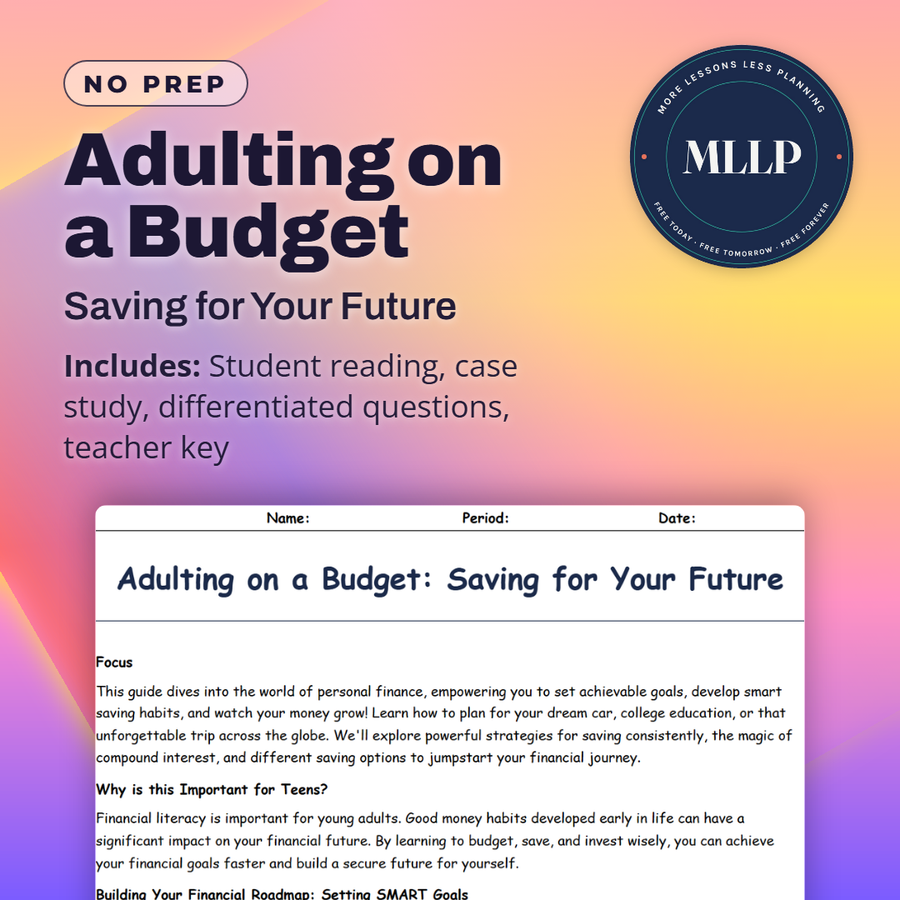
Adulting on a Budget: Saving for Your Future
Quality reviewed September 2026
Facts verified September 16, 2026
- Subject
- Career & Life Skills
- Grades
- Grades 9-12
- Length
- 8-page student worksheet
- Time
- About one 50-minute class period
- Great for
- Sub plans and independent work
- Includes
- Reading passage, comprehension questions + full answer key
- Format
- Print-and-go PDF
What students do
- Match four types of savings accounts, plus principal balance, to their descriptions
- Fill in the missing parts of a SMART goal and the two kinds of spending a budget sets aside money for
- Answer multiple choice questions on SMART goals, the purpose of a budget, and how compound interest grows savings
- Write short answers on why financial literacy matters, how Sarah can close her savings gap, and how to choose a savings account
What it covers
- Setting a SMART goal and tracking income and expenses to find money to save
- Compound interest worked out on a one-time $100 deposit at 5%, from $105 to $110.25
- A case study on Sarah saving $7,500 for a car down payment in two years
Start reading this worksheet
Focus
This guide dives into the world of personal finance, helping you set achievable goals, develop smart saving habits, and watch your money grow! Learn how to plan for your dream car, college education, or that unforgettable trip across the globe. We'll explore powerful strategies for saving consistently, the magic of compound interest, and different saving options to jumpstart your financial journey.
Why is this Important for Teens?
Financial literacy is important for young adults. Good money habits developed early in life can have a significant impact on your financial future. By learning to budget, save, and invest wisely, you can achieve your financial goals faster and build a secure future for yourself.
Building Your Financial Roadmap: Setting SMART Goals
The first step to achieving your financial goals is setting SMART goals. SMART is an acronym that stands for: Specific: Clearly define your goal. Is it a new car, a college fund, or a trip to Europe? The more specific your goal, the easier it will be to track your progress. Measurable: How much money do you need to save? Set a realistic target amount and break it down into smaller, achievable milestones. Attainable: Be honest with yourself about your saving abilities. Set a goal that is challenging but achievable to avoid discouragement. Relevant: Make sure your goal aligns with your overall financial priorities. Time-bound: Set a deadline for achieving your goal. This creates a sense of urgency and keeps you on track.
Like what you read? The full reading, the case study, and every question set are in the free download below, along with the answer key.
Why this matters
Sarah starts where a lot of savers start, with a big goal and a small balance: a $15,000 car and $1,000 from birthday gifts and odd jobs. Turning $7,500 into $312.50 a month shows right away whether a goal is realistic on a part-time income, and the gap is where the real decisions sit, like more hours, better-paying work, or cutting spending. The reading's point about compound interest adds a reason to start now, since the earlier money is saved, the more time it has to grow.
From one teacher to another
Sarah wants a $7,500 down payment on a car in two years, and the case study puts her math in the open: she can save $250 a month, she needs $312.50, and that leaves a $62.50 gap she has to close. Before students get there, the reading sets up the tools she uses. There's the SMART goal, a simple budget, and a one-time $100 deposit at 5% that grows to $110.25, so compound interest is something they can check by hand. It finishes by comparing savings accounts, money market accounts, CDs, and IRAs. For a full zero-based budget built from a paycheck, Building Your First Budget takes the next step.
What you get
Download
Where should I send the next one?
Everything here is free and it stays that way. Leave your email and I'll send you the new lessons as they go up. You can unsubscribe from any one of them.
Related resources
Adulting 101: Essential Life Skills for Teens
Apartment Ready! Life Skills for College
Conquer Cooking! Easy Meals for Busy Teens
DIY SOS: Quick Fixes for Everyday Problems
Grocery Shopping Like a Boss: Teen Edition
Laundry SOS: Decode Your Clothes Labels
Every lesson on this site is free to download and use. If one of them saved you a prep period, you can chip in a few bucks toward my three kids' daycare fund. That's genuinely where tips go.