
Why Your Internet Only Has One Provider
- Slide deck
- Guided notes
- Guided notes teacher key
- Activity + answer key
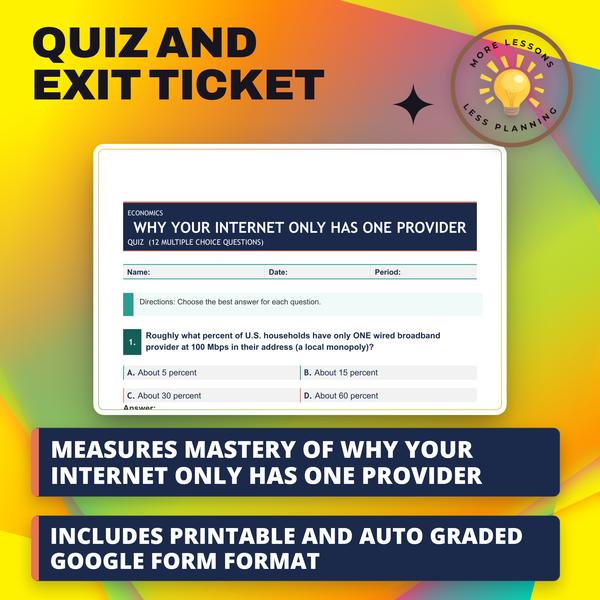
- Quiz + answer key
- Exit ticket + answer key
- Teacher guide
- Teacher presentation notes
Where should I send the next one?
Everything here is free and it stays that way. Leave your email and I'll send you the new lessons as they go up. You can unsubscribe from any one of them.
Every file in this toolkit
Related resources

What students do
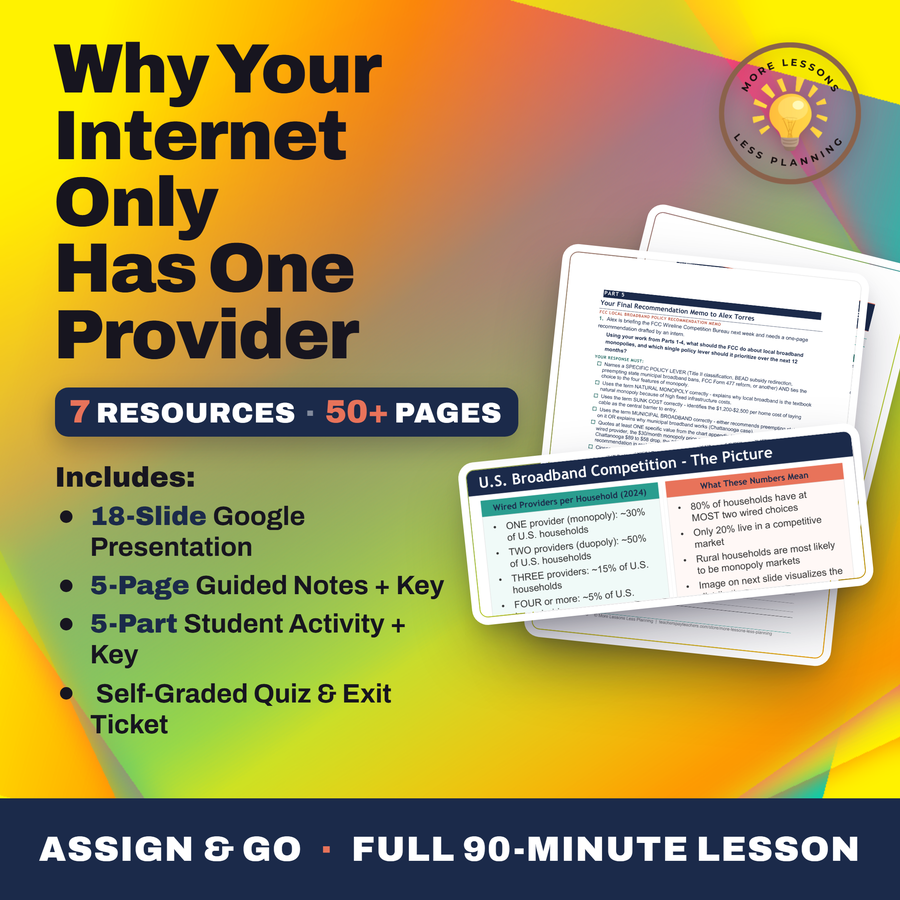
- Apply the four features of monopoly to local broadband ISPs and identify why roughly 30 percent of U.S. households have only one wired provider
- Explain why the sunk cost of laying fiber or cable, $1,200 to $2,500 per home, locks in local broadband monopolies
- Compare broadband prices in Chattanooga before and after the city's EPB Fiber network entered the market in 2010
- Write a Final Recommendation Memo to the FCC on whether municipal broadband should be allowed in every state
What it covers
- Why laying fiber or cable to every home is a sunk cost that discourages a second wired provider from ever entering
- The Chattanooga case, where the city-owned EPB Fiber network dropped average broadband prices from $89 to $58
- Why 19 states currently restrict or ban cities from building their own broadband networks
Learning targets
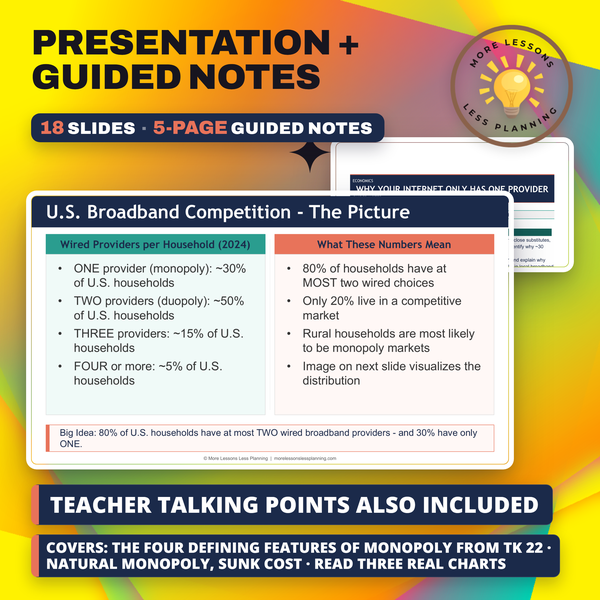
- Apply the four defining features of MONOPOLY from TK 22 (one seller, no close substitutes, high barriers to entry, price-maker firm) to LOCAL BROADBAND ISPs and identify why ~30 percent of U.S. households have only one wired provider
- Define NATURAL MONOPOLY, SUNK COST, and BARRIER TO ENTRY and explain why laying fiber or cable to every home is the central infrastructure cost that locks in local broadband monopolies
- Read three real charts (U.S. broadband competition distribution, price by competition level, and the Chattanooga municipal broadband case) and write a Final Recommendation Memo identifying what the FCC should do about local broadband monopolies and whether municipal broadband should be allowed in all states
From one teacher to another
Students pay into this monopoly every month without realizing it, so I built the lesson around the household internet bill instead of an abstract industry. The Chattanooga case does the real work here because it gives students an actual before-and-after price when a city built its own network, not just a theory about what competition would do. By the end they're writing a real recommendation to the FCC, which forces them to pick a side on municipal broadband instead of just describing the problem.
Every lesson on this site is free to download and use. If one of them saved you a prep period, you can chip in a few bucks toward my three kids' daycare fund. That's genuinely where tips go.