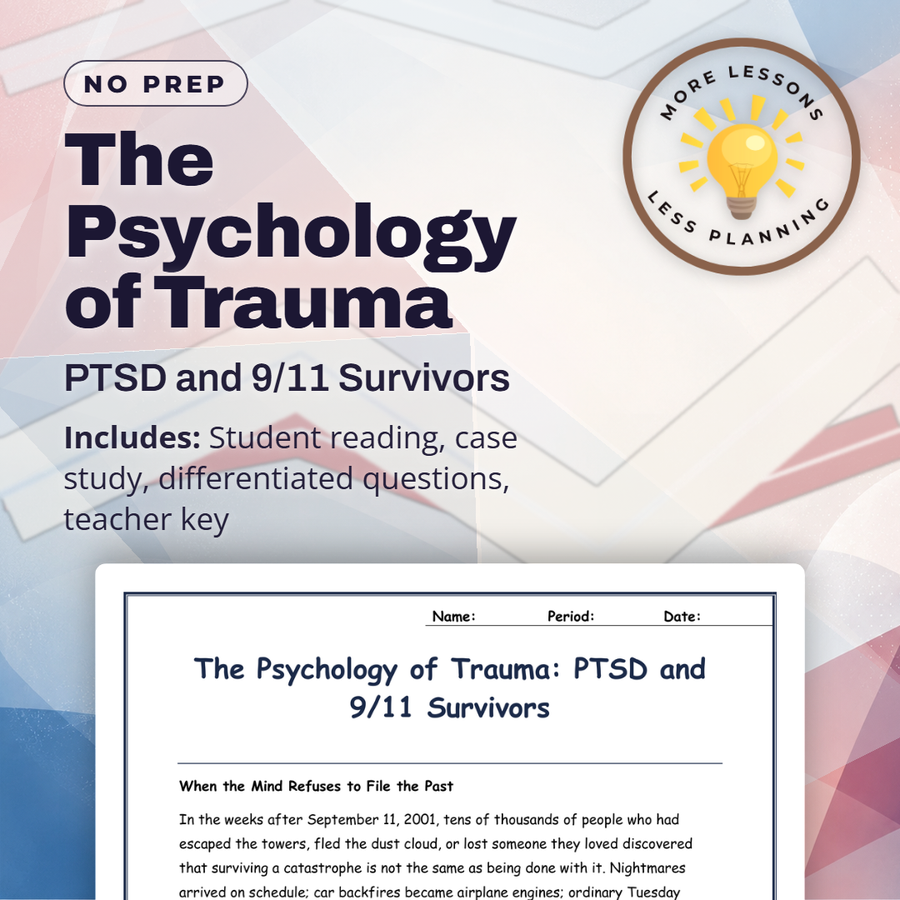
The Psychology of Trauma: PTSD and 9/11 Survivors
Quality reviewed September 2026
Facts verified September 7, 2026
- Subject
- Social Studies
- Grades
- Grades 9-12
- Length
- 9-page student worksheet
- Time
- About one 50-minute class period
- Great for
- Sub plans and independent work
- Includes
- Reading passage, comprehension questions + full answer key
- Format
- Print-and-go PDF
What students do
- Define PTSD and distinguish it from normal grief or stress response to traumatic events
- Identify the four clinical presentations of PTSD and how they manifested differently in survivors
- Analyze why first responders, people on the planes, and survivors in the buildings had different risk profiles
- Evaluate what therapies actually worked to help people heal and why cognitive processing mattered
What it covers
- PTSD is a distinct neurological and psychological condition, not moral weakness
- Who is most vulnerable to PTSD depends on exposure, role, and prior trauma history
- Evidence-based treatments teach people to process traumatic memories differently
Why this matters
A firefighter who spent weeks working the pile and an office worker who watched the towers fall from blocks away can end up with the identical diagnosis. PTSD does not scale neatly with how close someone stood. It depends on exposure, role, and what happened in a person's life before that day.
Students learn the four clinical presentations here: intrusion, avoidance, negative mood, hyperarousal, not as vocabulary to memorize but as a way to recognize a real condition instead of writing it off as someone failing to move on. The treatment part matters too. Healing is not about forgetting. It's about the memory losing its grip.
From one teacher to another
PTSD goes beyond prolonged grief with distinct clinical presentations: intrusion, avoidance, negative mood, hyperarousal. Students learn why a survivor and a first responder might develop PTSD differently, and why some people with direct trauma exposure never developed it while others did. The healing part matters too—it's not about forgetting; it's about integrating the memory so it stops hijacking the nervous system.
What you get
Download
Where should I send the next one?
Everything here is free and it stays that way. Leave your email and I'll send you the new lessons as they go up. You can unsubscribe from any one of them.
Related resources



Every lesson on this site is free to download and use. If one of them saved you a prep period, you can chip in a few bucks toward my three kids' daycare fund. That's genuinely where tips go.