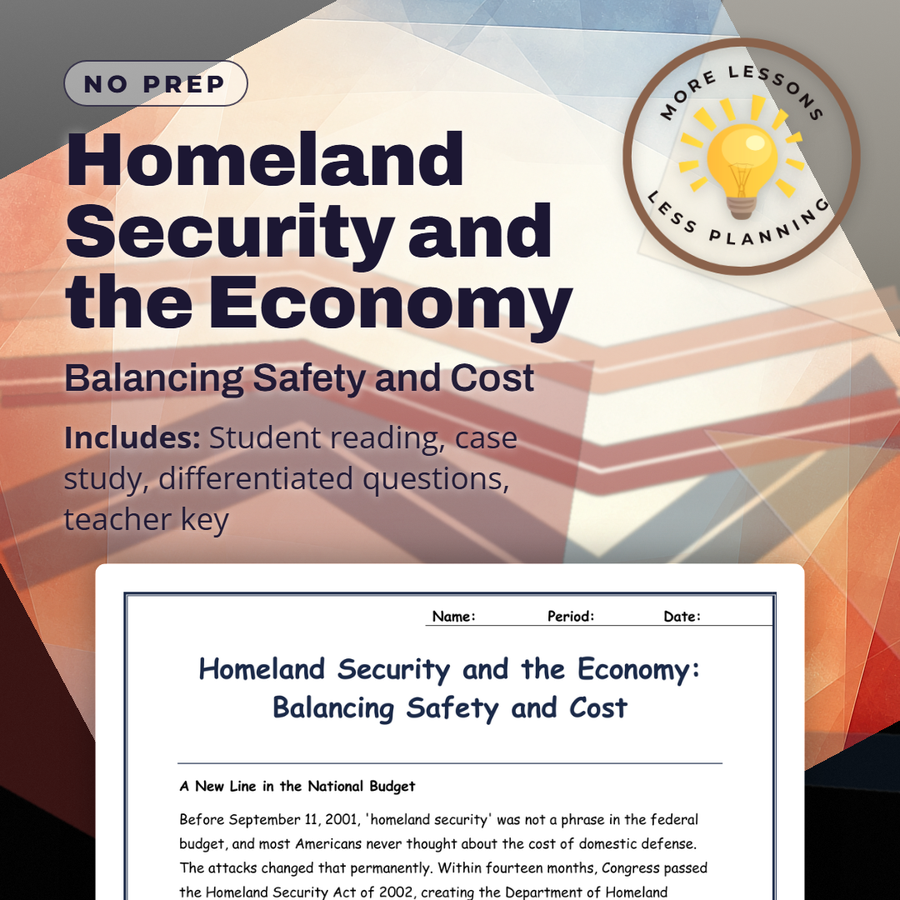
Homeland Security and the Economy: Balancing Safety and Cost
Quality reviewed September 2026
Facts verified September 7, 2026
- Subject
- Social Studies
- Grades
- Grades 9-12
- Length
- 9-page student worksheet
- Time
- About one 50-minute class period
- Great for
- Sub plans and independent work
- Includes
- Reading passage, comprehension questions + full answer key
- Format
- Print-and-go PDF
What students do
- Identify the scale: the Department of Homeland Security became the largest domestic federal agency, Border Patrol staffing doubled, and ICE built the world's largest detention system
- Explain the cost: DHS budget grew to over $50 billion annually, exceeding FBI, DEA, and Secret Service budgets combined, money diverted from other priorities
- Describe security infrastructure: biometric screening at borders, TSA screening at airports, digital surveillance programs, and secure identity documents (REAL ID)
- Analyze the economic tradeoff: security spending as permanent, how longer airport lines and border waits affect commerce and travel, and the opportunity cost
What it covers
- Security as permanent infrastructure: post-9/11 spending on defense and security was normalized and proved politically difficult to reduce even decades later
- The economy of surveillance: how security and private data collection intersected, with corporations profiting from both government contracts and data sales
- Equity and burden: security costs were distributed unevenly—wealthy travelers could use trusted traveler programs while ordinary citizens faced longer waits
Why this matters
Before 2001, there was no Department of Homeland Security. Within a few years it had become the largest domestic federal agency, with a budget bigger than the FBI, DEA, and Secret Service combined. That kind of growth doesn't happen without tradeoffs, and this reading asks students to name them: what got funded, what got cut, and who actually pays for the security lines they stand in.
I teach this in civics and economics together because students tend to see security spending as separate from money. It isn't. Every biometric scanner, every border agent, every screening system was a budget decision, made once during a crisis and never seriously revisited since.
From one teacher to another
This reading is essential for political economy and civics because it shows how one event can permanently reshape budget priorities. Homeland Security spending was not temporary; it was embedded as a permanent line item. Students need to understand that security choices are economic choices, with winners and losers, and that infrastructure built in crisis is hard to question or dismantle later.
What you get
Download
Where should I send the next one?
Everything here is free and it stays that way. Leave your email and I'll send you the new lessons as they go up. You can unsubscribe from any one of them.
Related resources

Every lesson on this site is free to download and use. If one of them saved you a prep period, you can chip in a few bucks toward my three kids' daycare fund. That's genuinely where tips go.