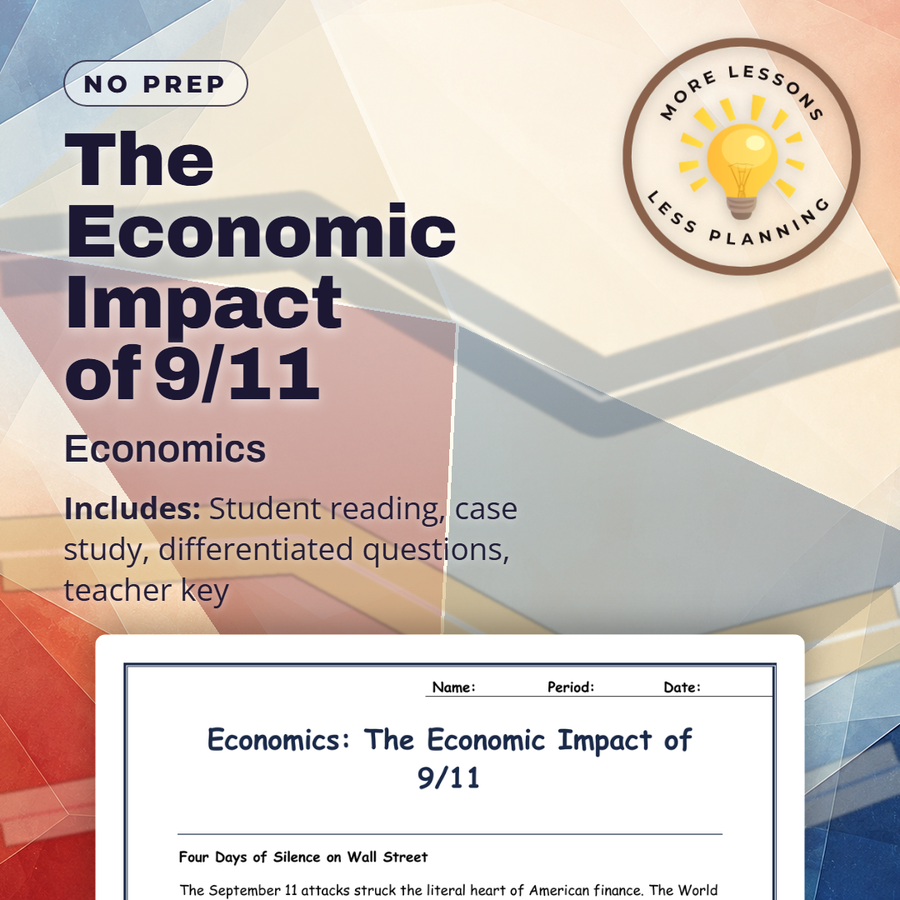
Economics: The Economic Impact of 9/11
Quality reviewed September 2026
Facts verified September 7, 2026
- Subject
- Social Studies
- Grades
- Grades 9-12
- Length
- 9-page student worksheet
- Time
- About one 50-minute class period
- Great for
- Sub plans and independent work
- Includes
- Reading passage, comprehension questions + full answer key
- Format
- Print-and-go PDF
What students do
- Identify the immediate costs: $40+ billion in insurance claims (the largest in industry history), airline industry losses, and six-day stock market closure
- Explain opportunity cost: the $2 trillion spent on wars in Afghanistan and Iraq that could have been directed to infrastructure, health care, or education
- Describe structural changes: Homeland Security spending rising to become a permanent federal line item, security costs embedded in every port and airport
- Analyze how the economy adjusted: defense contractors' profits soared, international trade patterns changed due to heightened border security, and growth rebounded
What it covers
- Insurance as economic barometer: how private insurance companies discovered they could not cover tail risks alone and needed government backing
- War economics: how long-duration military engagement shapes budget priorities, debt levels, and the opportunity cost of resources diverted to defense
- Structural embedding: security spending became normalized in the federal budget, making post-9/11 spending levels politically difficult to reverse
Why this matters
Every plane ticket sold in this country still carries a security fee that traces back to that week. Airlines grounded, a stock exchange closed for six days, insurance claims larger than the industry had ever paid before: the shock didn't stay contained to New York, it moved through systems never built to absorb something that size alone.
I teach this in economics because students think of 9/11 as a political story, not a financial one. But the spending decisions made in the months after, on wars, on security, on rebuilding confidence in markets, were made once and never reversed. Understanding that helps explain why certain costs don't go away.
From one teacher to another
I use this in economics classes because students rarely think about money when they think about 9/11. But the economic choices, spending $2 trillion on wars, $100+ billion on Homeland Security, building massive intelligence agencies, were decisions made once and never reversed. Understanding the economic weight helps students see how one event can cascade through decades of policy.
What you get
Download
Where should I send the next one?
Everything here is free and it stays that way. Leave your email and I'll send you the new lessons as they go up. You can unsubscribe from any one of them.
Related resources

Every lesson on this site is free to download and use. If one of them saved you a prep period, you can chip in a few bucks toward my three kids' daycare fund. That's genuinely where tips go.