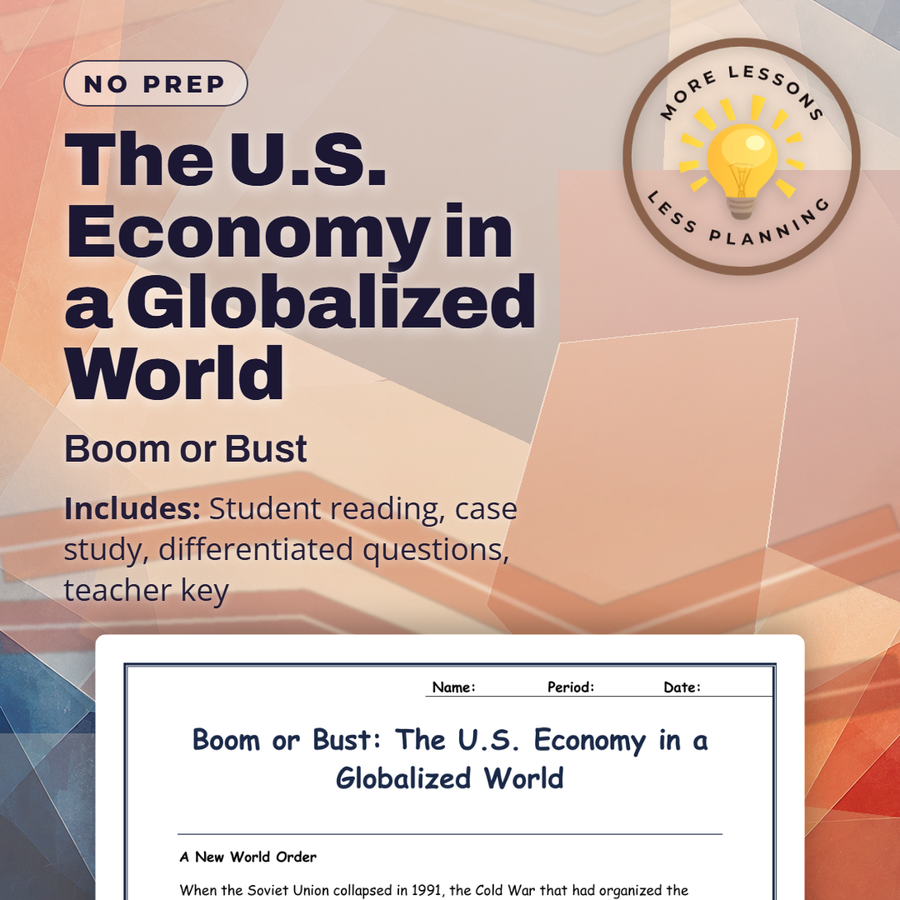
Boom or Bust: The U.S. Economy in a Globalized World
Quality reviewed September 2026
Facts verified September 7, 2026
- Subject
- Social Studies
- Grades
- Grades 9-12
- Length
- 9-page student worksheet
- Time
- About one 50-minute class period
- Great for
- Sub plans and independent work
- Includes
- Reading passage, comprehension questions + full answer key
- Format
- Print-and-go PDF
What students do
- Describe the immediate shutdown: every civilian airplane grounded within hours (4,500+ planes), the New York Stock Exchange closed for six days, and ports disrupted
- Identify the economic costs: lost productivity, airline industry collapse requiring federal bailouts, insurance claims exceeding $40 billion, and unemployment spikes
- Explain how the attacks exposed supply-chain vulnerability: just-in-time global manufacturing meant disruption anywhere cascaded everywhere
- Analyze the recovery strategy: federal spending on security, emergency funding, low interest rates, and a sustained defense buildup that shaped the economy for two decades
What it covers
- Systemic shock: how a single day's disruption at one location exposed how tightly coupled the global economy had become
- Insurance and risk: how insurance companies learned that catastrophic tail risks required government backing because no private company could hold that much risk
- Structural changes: the rise of Homeland Security spending, border infrastructure, and security costs as a permanent line item in government and business budgets
Why this matters
Every commercial plane in the country sat grounded on runways for days, an image that's hard to picture now given how normal flying has become again. That single stoppage showed how one disruption in one place could freeze ports, factories, and stock trading all at once, because the systems were built to run just-in-time, with almost no slack.
Students who've watched shelves go empty during a shortage, or waited out a shipping delay on something they ordered online, are already living with the same fragility this reading describes. The recovery took federal intervention because private markets weren't built to absorb a shock that size on their own.
From one teacher to another
I use this for economics classes because it shows that 9/11 was an economic rupture, not merely a political event. The stock market shutdown happened because the securities infrastructure was damaged, not because of law or fear. Students learn how interdependent systems fail together and why recovery required massive federal intervention that none of the typical stabilizers could provide.
What you get
Download
Where should I send the next one?
Everything here is free and it stays that way. Leave your email and I'll send you the new lessons as they go up. You can unsubscribe from any one of them.
Related resources

Every lesson on this site is free to download and use. If one of them saved you a prep period, you can chip in a few bucks toward my three kids' daycare fund. That's genuinely where tips go.