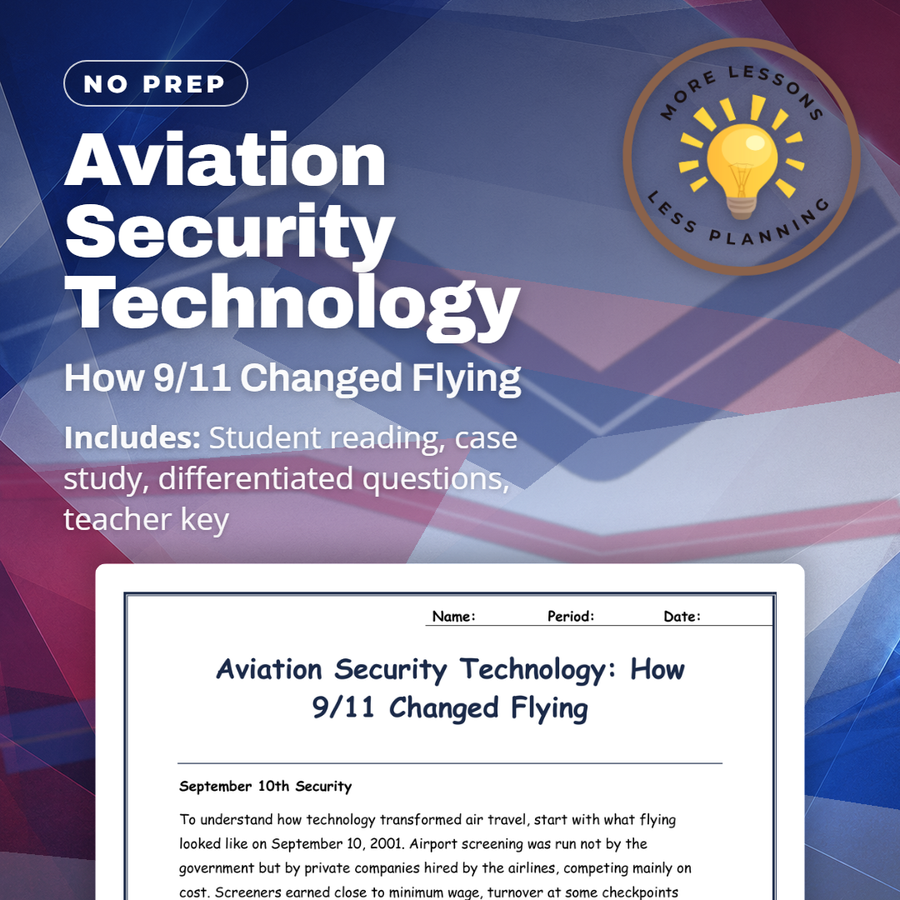
Aviation Security Technology: How 9/11 Changed Flying
Quality reviewed September 2026
Facts verified September 7, 2026
- Subject
- Science
- Grades
- Grades 9-12
- Length
- 9-page student worksheet
- Time
- About one 50-minute class period
- Great for
- Sub plans and independent work
- Includes
- Reading passage, comprehension questions + full answer key
- Format
- Print-and-go PDF
What students do
- Explain how the hijackers trained at civilian flight schools and paid cash for lessons in steering large aircraft without learning to land
- Describe the immediate response: reinforced cockpit doors, armed air marshals, and the closure of the Federal Airspace from all general aviation for six months
- Identify what the Aviation and Transportation Security Act of 2001 created—the TSA, the Federal Air Marshal Service, and the mandate for security screening
- Analyze the tradeoff: security measures eliminated some risks (cockpit access, unscreened carry-on items) while creating new ones (longer wait times, liquid restrictions)
What it covers
- Cockpit vulnerability: how four commercial flights could be seized because pilots did not expect violence and were trained never to resist
- The security response: cameras, locks, procedures, and a federal workforce of screeners replacing private contract security at every airport
- Lasting impact: TSA screening protocols, no-fly lists, biometric boarding, and enhanced surveillance of passengers are now taken for granted
Why this matters
Every student in this class has taken off their shoes at airport security without asking why, because TSA screening is simply how flying has always worked for them. It did not exist before 2001. This reading traces the specific vulnerability, pilots trained never to resist, that turned into a federal screening workforce and reinforced cockpit doors almost overnight.
It also holds both sides of the tradeoff at once: a real danger got solved, while an apparatus built for that one danger kept expanding well past it. Noticing that gap matters more than knowing TSA trivia.
From one teacher to another
This reading shows how a specific technical vulnerability led to a decades-long security apparatus. Students who fly think TSA screening is inevitable, not something that did not exist before 2001. I use it to show both how security measures address real problems (the cockpit door locks work) and how the apparatus outlasts its original justification. It shows how a country decided air travel should work after the attacks forced a reckoning with vulnerability.
What you get
Download
Where should I send the next one?
Everything here is free and it stays that way. Leave your email and I'll send you the new lessons as they go up. You can unsubscribe from any one of them.
Related resources

Every lesson on this site is free to download and use. If one of them saved you a prep period, you can chip in a few bucks toward my three kids' daycare fund. That's genuinely where tips go.